Showing posts with label Tourism. Show all posts

Saturday, February 18, 2017

Villefranche-sur-Mer 4.6.2005


This is a tourism promotion stamp. Villefranche-sur-Mer is a commune in the Alpes-Maritimes department in the Provence-Alpes-Côte d'Azur region on the French Riviera.
The main activity remains tourism, with hotels and restaurants employing a sizeable portion of the population. Traditional activities, like fishing, have now given way to sea-related activities, such as sailing and deep sea diving. Some dockyard activity remains at the harbour of “la Darse” but most of it has now been moved to Antibes. Residential construction and maintenance, which provided a lot of employment in the mid 20th century, has now subsided considerably.

Saturday, November 5, 2016

Saturday, February 13, 2016

Tourism in Spain 7.4.1988

The two stamps on this FDC were issued in 1988 by Spain to promote Tourism.
The first stamp (18) highlights Spanish Gastronomy and depicts the Paella. Paellais a Valencian rice dish with ancient roots that originated in its modern form in the mid-19th century near Albufera lagoon on the east coast of Spain adjacent to the city of Valencia. The dish is widely regarded as Spain's national dish, as well as a regional Valencian dish; Valencians regard paella as one of their identifying symbols.
The second stamp (45) features the Covadonga National Park. Covadonga. Southeast of the village, in the Europa Peaks, is the Covadonga Mountains National Park, which was established in 1918. The park’s heavily wooded area of 65 square miles (169 square km) shelters chamois, roe deer, wildcat, bear, and numerous birds. Pop. (2007 est.) 62.The Covadonga National Park was the first to be established (1918) in Spain and is one of the oldest in Europe. Its fauna and flora include many species of interest and the park area is representative of the prevailing ecosystem throughout the wet zone of Spain neighbouring the Cantabrican mountain range. Its history is complex, having been influenced by different political ideologies dominant within the Government. The last few years have been particularly critical as the massive promotion of the country's tourism has led to the occupation of even the most wild and remote areas.

Thank you Merja.

Monday, November 9, 2015

Dole, France 3.7.1971


Dole is a small, elegant town in the Jura in east France where streets of 18th-century, neo-classical stone buildings surround the collegiate church of Notre-Dame which dominates the skyline.
Designated a Ville d’Art et d’Histoire (Town of Art and History), Dole is known as the birthplace of Louis Pasteur and for the buildings that use the local pink, white and black stone.
In the town square there is a cute little fountain of a child pouring water from a pitcher (shown on the stamp and the FDC).


Thank you Merja.

Thursday, November 5, 2015

Riquewihr, France 3.7.1971

Riquewihr is a commune in the Haut-Rhin department in Alsace in north-eastern France.
A popular tourist attraction for its historical architecture, Riquewihr is also known for the Riesling and other great wines produced in the village. Riquewihr looks today more or less as it did in the 16th century. It is officially one of the most beautiful villages in France, or Les plus beaux villages de France.

Riquewihr was one of the few towns in the area not to be badly damaged during World War II. This village really does seem to have everything that you hope to find in a traditional Alsace village: fortified walls, stone entrance gates, cobbled streets lined with brightly painted half-timber houses, carved wooden beams and stone doorways, wrought iron signs for the shops, lots of flowers....Riquewihr almost looks as if it has just dropped out of a fairytale.

Among the other historical monuments in Riquewihr you can see the Dolder Tower, prominently depicted on the stamp and the cover- this tower is also the upper gate of the town and the belfry and part of the original fortifications of the town. The view from the top of the Dolder Tower looking along Rue du General de Gaulle is a  favourite viewing spot for tourists in the town. The fountain in front of the Dolder tower was originally used to check the capacity of wine barrels hence its name, the fountain of gauging.

Monday, August 10, 2015

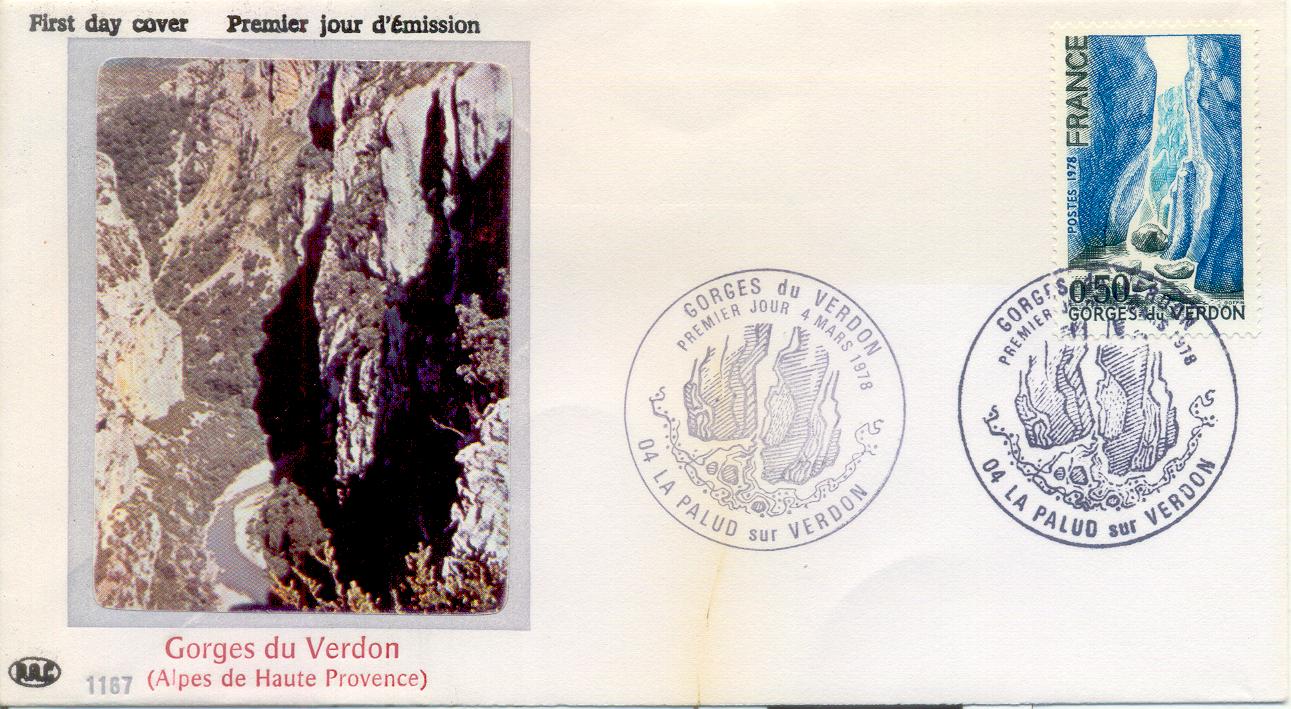
The Gorges Du Verdon 4.3.1978


The Gorges Du Verdon (in French: Les Gorges du Verdon or Grand canyon du Verdon), in south-eastern France (Alpes-de-Haute-Provence), is a river canyon that is often considered to be one of Europe's most beautiful. It is about 25 kilometres long and up to 700 metres deep. It was formed by the Verdon River, which is named for its startling turquoise-green colour, one of the location's distinguishing characteristics. The most impressive part lies between the towns of Castellane and Moustiers-Sainte-Marie, where the river has cut a ravine to a depth of 700 metres through the limestone mass. At the end of the canyon, the Verdon River flows into the artificial lake of Sainte-Croix-du-Verdon (in French: Lac de Sainte-Croix).

Saturday, September 20, 2014

Centenary of the ANWM 1994

These two stamps on the Dutch FDC of 1994 were issued to commemorate the Centenary of the ANWM.  The Royal Dutch Touring Club (Dutch, Algemene Nederlandse Wielrijdersbond or ANWB) is a travelers' association in the Netherlands, supporting all modes of travel. It's responsible for traffic signs and signage on roads and trails. It also offers test reports, travel services and roadside assistance, comparable to the German ADFC / ADAC.
ANWB was formed July 1, 1883 as Nederlandsche Vélocipèdisten-Bond (Dutch bicyclists' club) and renamed two years later. In 1905 the nameKoninklijke Nederlandse Toeristenbond (Royal Dutch Tourist Club) was adopted. ANWB has over four million members, and is the largest nonprofit association in the Netherlands.
In the 20th century, the association expanded to include motorists, hikers, equestrians, motorcyclists, as well as participants in water sports, winter sports and camping.
The second stamp or the one on the right was also issued as The 1994 FEI World Equestrian Games were held in The Hague, Netherlands from July 27 to August 7, 1994. They were the second edition of the games which are held every four years and run by the FEI.

Monday, July 21, 2014

Spain 11.12.1990 - European Tourism Year

Mr Cardoso e Cunha, a member of the Commission, with the 18 Ministers
for Tourism of the Member States for the Community and the EFTA
countries in attendance, launched the European Tourism Year on 11 December in Strasbourg.

Proposed by the European Parliament and approved by the Council of
Ministers, 1990 was declared as the European Tourism Year.

Major national and Europe-wide events as well as projects and
competitions were planned to take place throughout the year in the 18
participating countries. The aim being to emphasize the economic and social
importance of a tourist industry. The colourful stamp issued by Spain on 11.12.1990 cleary underlines this aim.

Thank you Maria.

Wednesday, October 23, 2013

Norway Tourism 1998

The stamps on this FDC were issued by Norway on 20.4.1998 to promote tourism. They chose these three sites for the stamp issue, namely, The Holmenkollen ski jump in Oslo, Ålesund is a town and municipality in Møre og Romsdal county and the mountain Hamarøyskaftet. A short brief about the three will not be out of place. The places I am telling you about are shown on the map on the cover.
The Holmenkollen ski jump is a landmark in Oslo. This is the hill that was demolished in 2008 to make way for a new one in 2010. Holmenkollen is a neighborhood in the Vestre Aker borough of Oslo, Norway. In addition to being a residential area, the area has been a ski recreation area since the late 19th century, with its famous, eponymous, ski jumping hill, the Holmenkollbakken, hosting competitions since 1892. To the north, the area borders to the woodlands area Marka.

The town of Ålesund is the administrative centre of Ålesund Municipality, as well as the principal shipping town of the Sunnmøre district. Ålesund Municipality has a population of 45,033 as of 2013, while the greater Ålesund urban area has a population of 48,460 (this also includes most of neighbouring Sula Municipality as well).
Ålesund has the most important fishing harbour in Norway. The town's fishing fleet is one of the most modern in Europe. Ålesund and surroundings also has a large furniture industry. Some well-known household items are manufactured here. In the 1950s and 1960s, Ålesund was one of the chief stations of the herring fishery business.
Hamarøy is a municipality in Nordland county, Norway. It is part of the traditional district of Salten. The administrative centre of the municipality is the village of Oppeid. Other villages include Innhavet, Karlsøy, Presteid, Skutvika, Tømmerneset, Tranøy, and Ulvsvåg.
The mountain Hamarøyskaftet has long been regarded as nature's own phallic symbol. Hamarøyskaftet (locally known as the "handle") is one of the mountains that make up Hamarøytindan in Hamarøy municipality in Nordland .
The mountain is 512 m.  and is located approximately in the middle of mountain range, approx. 5.3 km southwest of Hamsund and 7.5 miles northeast of Skutvik , and is a distinctive landmark with its almost vertical sides and "swaying" in the back. To the northeast lies Shaft heath against Eldridtinden, and in the southwest Sandheia against Vassengfjellet.
The walk up is described as a simple climb that most can do, but it is recommended that one should have a guide while on the trail. Mountaineer Martin Ekroll from Skrova was the first to climb Hamarøyskaftet in 1885 .
The stamp with a value of NOK 5.50 of Hamarøyskafet photographed by Johan Brun was named as the year's most beautiful postage stamp.
Thank you Pia for this pretty FDC.

Saturday, June 23, 2012

YourSingapore 14.9.2011


YourSingapore is the destination brand of Singapore, launched on 5 March 2010 at the Singapore Tourism Board Tourism Industry Conference 2010. YourSingapore is an evolution of Uniquely Singapore, which remained Singapore's destination brand from 2004 to 2009.
YourSingapore tries to tap upon Singapore’s concentration of dining, shopping, natural and cultural attractions, within the small physical space of the country, making it easy for a user to mix-and-match multiple experiences. YourSingapore aims to differentiate Singapore’s brand proposition from that of its competitors so that Singapore continues to remain relevant and attractive in today's travel industry.
I have been there quite a few times, and it remains and will always remain one of my favourite holiday destinations. You may well ask, “what is there in Singapore?, and my retort to such an irrelevant question would be, “What isn’t in Singapore?”. It is one of the most pleasurable travel destinations, even if I say so ;-)) and if one has good company there like I had, then mere words cannot express ones happiness. And this FDC dated 14th September 2011 only re-emphasises that well known fact with the 10 impressive stamps on it.

Tuesday, June 19, 2012

Europa theme focusing on tourism 9.5.2012


This year's Europa theme is Visit, followed by the country or city in focus on the respective European issue. The stamp Visit Åland  issued on 9th  May gives a summery  picture of Åland. My dear friend Ella sent me this lovely FDC and card.
Visit Åland is also the name of the official tourist organisation of Åland with approximately 340 members. The main function of Visit Åland is to market Åland as a destination and to develop tourism in Åland together with the local hospitality industry. The logotype of Visit Åland is the Åland flag, which reappears on the first day postmark, the back of the cover and the stamp sheet. The stamp photo was shot at the old ‘Kobba klintar' pilot station just outside Mariehamn. ‘Kobba klintar' was also featured on the 2010 Nordic miniature sheet.               

Wednesday, May 30, 2012

EUROPA - Come Visit Finland - You'll Love It


So, are you a fan of Finland? Well, I am. And I am sure Finland loves you too! And who wouldn't love a country this strange? If ice hockey, Moomins, mobile gadgets, design, rally drivers, heavy metal, sauna or Santa gets you all excited, Finland is the country for you. They have it all (except polar bears): endless summer days, even longer winter nights, about 200 000 lakes and a picturesque archipelago, great wilderness and forests where the next person is more than 100 kilometres away, bustling cities with thriving culture and art scenes, best Scandinavian design, and the list goes on and on. But what do you know? The Finns live there. So this one is for all the fans. Go for it! Believe me I am trying my best too. So my Finnish friends don’t be surprised if one day your doorbell rings, you open the door and there’s Yours Truly smiling at you.
For starters this FDC and the two maxi cards will surely entice you. Thank you my friend Ella for this lovely touristy intro with these two card posters and the FDC. These two stamps will surely make the other EUROPA Best Stamp entrants think again!

Sunday, May 13, 2012

Europa - Visit Cyprus 2.5.2012


These two stamps on the special cover were issued by Cyprus. They belong the series of EUROPA stamps printed every year by member countries on a common theme. This year’s Tourism Promotion theme is “VISIT…”. And so we have the Visit Cyprus stamps on the cover given to me by my friend Merja.

Sunday, December 4, 2011

European Tourism Year 1990


1990 was designated European Year of Tourism (EYT) by the European Community. The six member countries of EFTA have also accepted the Community's invitation to take an active part.
Tourism occupies a dominant position in the economy of Cyprus. According to the World Economic Forum's 2011 Travel and Tourism Competitiveness Index, Cyprus' tourism industry ranks 24th in the world in terms of overall competitiveness. In terms of Tourism Infrastructure, in relation to the tourism industry) Cyprus ranks 1st in the world.
In December 1988 the EC Council of Ministers adopted the European Parliament’s recommendation for the designation of 1990 as European Tourism Year. The recognition of the increasing importance of tourism, not only as a source of revenue and employment for all European states but also as an important means through which a United Europe could be created, in view of the abolition of borders in 1992, was the main reason which led to the aforementioned decision. Thus the main aim of the European Tourism Year was defined by the European Community, as the promotion of the idea of a United Europe and the underlining of the huge economic and social importance of Tourism in this New Europe. With this aim in mind, both the member-states of the Community as well as the other countries of Europe, would honour the European Tourism Year with the staging of various events and programmes.
Cyprus would also honour the European Tourism Year being itself a predominantly tourist country, which indeed depends to a large extend on Europe, since more than 60% of the tourist arrivals hail from the EC area. Tourism for Cyprus constitutes today one of the most important factors of economic, social and cultural developments.
The Department of Postal services of Cyprus issued a commemorative series consisting of 4 stamps in order to honour European Tourism Year. The 5-cent stamp is dedicated to the 25th anniversary of the Hotel and Catering Institute (HCI). This Institute was and is the basic factor for success in the development of this sector in Cyprus. For the development of this sector, HCI trains expertly qualified personnel, extending its work to students from overseas, a fact that has earned international recognition for the quality and importance of its contribution. The 7-cent stamps is dedicated to the completion of 11 centuries since the founding of the Saint Lazarus Church. Saint Lazarus took refuge to Kition after the beginning of persecutions against Christians, and was according to legend the first Bishop of the city, in which he was buried after he died for the second time. In 8980 A.D. Emperor Leon VI, the Wise, transferred his body to Constantinople and as a compensation he build the elegant Byzantine Church that stands over his tomb. It possesses a wood-engraved iconostatis of exceptional craftsmanship and a priceless old icon of the Bishop of Kition. The church has played an important role in the history of the city and constituted for centuries the necessary compliment to the pilgrimage to the holy Land. The 15 & 18 cent stamps are dedicated to the natural environment.

Tuesday, November 1, 2011

International Tourism Year 1967 16.10.1987


The resolution of the United Nations Conference on International Travel and Tourism entitled "importance of tourism", which stated, inter alia, that tourism is a basic and most desirable human activity deserving the praise and encouragement of all peoples and all Governments. Bearing in mind the need for international co-operation in promoting tourism in view of its useful role in the educational, cultural, economic and social fields. Recognizing the importance of international tourism, and particularly of the designation of an International Tourist Year, in fostering better understanding among peoples everywhere, in leading to a greater awareness of the rich heritage of various civilizations and in bringing about a better appreciation of the inherent values of difierent cultures, thereby contributing to the strengthening of peace in the world.
Considering that the designation of an International Tourist Year will encourage the intensification of national and international co-operative efforts, by both Governments and interested organizations, for the promotion of tourism, in particular to developing countries, the United Nations decided the following :-
  1. Designates 1967 as International Tourist Year;
  2. Invites the States Members of the United Nations or members of the specialized agencies or of the International Atomic Energy Agency, and the international, inter-govemmental and non-governmental organizations concerned, to exert all possible efforts for the success of the International Tourist Year, with special em- phasis on promoting tourism to developing countries;
  3. Further invites those States and organizations to take into account, as appropriate, in their plans and programmes for the International Tourist Year, the proposals contained in the above-mentioned report of the International Union of Official Travel Organizations;
  4. Requests the Secretary-General to provide, within the limits of existing resources and available funds, the necessary assistance for the successful organization of the International Tourist Year, including the wide-spread dissemination of information on its objectives;
  5. Further requests the Secretary-General to prepare, in co-operation with the International Union of Official Travel Organizations, and to submit to the Economic and Social Council, if possible in 1968, a report embodying:
    1. A description of the programmes and activities undertaken by Governments and interested organizations during the International Tourist Year, with specific mention of exceptional temporary measures taken by individual Governments;
    2. An assessment of the results achieved in realizing the aims and objectives set for the International Tourist Year, particularly in encouraging tourism to developing countries.
In view of the above Cyprus issued a first Day Cover and four stamps, commemorating this important event on 16.10.1967. The stamps featured, Ancient Monuments, the Famagusta Beach, Nicosia Airport, and finally the Youth Hostel at Troodos. This nice card was given to me by Merja.

Tuesday, October 18, 2011

Scenery stamp series completed with Kökar and Jomala stamps 28.8.2011


The time has come to complete the Åland scenery series. The final two municipalities to be featured are the archipelago municipality of Kökar and Åland’s largest municipality, Jomala. All 16 Åland municipalities will then have been presented and a beautiful pack holding the 16 scenery stamps will also be available.
Kökar is an island situated in the outskirts of the Åland archipelago and the southern-most Åland municipality. Kökar is a popular place for tourists to visit. Many come here to visit the Otterböte Bronze Age site, an ancient settlement for seal hunters. Best known among the sights in Kökar is the island of Källskär. Despite its broken landscape and exposed position, the island has been creatively developed with a harbour, several buildings and a lovely garden. Tove Jansson’s painting, featured on a 2007 stamp, was previously on display on Källskär. This is also where the Pitcher of Källskär can be admired, a nature phenomenon formed by the rotation of large boulders in the whirls of glacier waters running under the ice.
Jomala is located in the middle of main Åland and offers a variety of nature experiences. Kjell Söderlund shot the stamp photo at Hammarudda on the border of the Åland Sea. In Jomala, however, we also find open fields, deciduous woodland meadows and Ice Age formations. It is not known from where the name Jomala originates but theories suggest that “jom” comes from the name of the Viking god Jom and that “ala” means “place”. Therefore, Jomala would mean “the place where Jom is worshipped”. Prehistoric sites have been found in Jomala, just like in Kökar. Jettböle, a Stone-Age settlement dated to approx. 2500–2000 B.C., is one of the most renowned ancient sites in Finland, where most findings have been discovered. My dear friend Ella sent me these two FDCs and the two stamp sheets.
The Jomala stamp is also this year’s Åland SEPAC stamp. Every other year, the members of the Small European Postal Administrations’ Cooperation, SEPAC, issue a joint folder, Beautiful Corners of Europe. The folder was first issued in 2007. This year’s folder holds the stamps from 12 small, European postal administrations.

Monday, July 4, 2011

Tourism 1.5.1993


Further to my post on 01.07.2011 on Finnish Tourism, this FDC too is titled ‘Matkailu Suomessa’, issued in 1993. It was also a joint Nordic stamp. The theme was the same in 1993 and in 1995. I’ll tell you something about this FDC too. The stamp on the left depicts Naantali. The town was founded in 1443, so it celebrated 550 years in 1993. It is the fourth oldest town of Finland. It is one of the most important tourist centres of Finland. The most interesting tourist attraction for families with children is of course the Moomin World theme park. Naantali Spa Hotel is the largest spa in Scandinavia. Naantali’s medieval stone church is interesting too. The official summer residence of the President of Finland, the Kultaranta (Golden beach) estate, is also located in Naantali. Naantali hosts the traditional Sleepyhead Day carnival, in July every year. What is the National Sleepy Head Day? Well, National Sleepy Head Day (Finnish: unikeonpäivä) is celebrated in Finland on July 27 every year. Traditionally on this day, the last person in the house (also dubbed as the 'laziest') to wake up is woken up using water, either by being thrown into a lake or the sea, or by having water thrown on them. It is based on the story of the Saints of Ephesus who slept in a cave for some 200 years during the Middle Ages whilst hiding from persecution by Decius, the Roman Emperor at the time. In the city of Naantali, a Finnish celebrity is chosen every year to be thrown in the sea from the city's port at 7 a.m. The identity of the sleeper is kept secret until the event. People who are chosen have usually done something to the benefit of the city. Every city mayor has thus far been thrown to the sea at least once, but other sleepers have included the president Tarja Halonen's husband, Dr Pentti Arajärvi, the CEO of Neste Oil Risto Rinne, along with many writers, artists and politicians.
The stamp on the right depicts town Imatra. It is situated very near the eastern border. On the stamp you can see the Dam of Imatra and an Art Nouveau or Jugend style castle, currently known as Imatran Valtionhotelli, was built near the rapids in 1903 as a hotel for tourists from the Russian Imperial capital Saint Petersburg. The Borough of Imatra was founded in 1948 around three industrial settlements. In the course of the last 50 years, this amorphous group of settlements has grown into a modern industrial town dominated by Lake Saimaa, the River Vuoksi and the Finnish-Russian border. Imatra is situated in the southeast of Finland where it rubs shoulders with the Russian border. On the other side of the border - only 7 kilometres away from the centre of Imatra - lies the town of Svetogorsk. St Petersburg is situated 210 km to the southeast, Finland's capital Helsinki is 230 km away and Lappeenranta, the nearest town to Imatra in Finland, is 40 km away.
The River Vuoksi runs through Imatra and has resumed its rightful place as the recreational oasis for the inhabitants of the town. The river offers excellent opportunities for fishing throughout the year: in winter it is possible to go ice fishing as well as practise open water fishing since the Vuoksi never freezes completely, even in winter. Some of Finland's most beautiful jogging and cycle tracks hug the contours of the Vuoksi, and from the banks of the river bird watchers can observe dozens of bird species. The river is also suitable for swimmers. Additionally, visitors can explore the delightful nature around the Vuoksi following an electronic nature trail. The Imatrankoski Rapids are Imatra's most famous attraction, and travellers have been drawn to the rapids for hundreds of years. Imatra is also a border town which shares a frontier with Russia. The former industrial settlement of Enso (now the Russian town of Svetogorsk) lies just on the other side of the border, which means that Imatra and Svetogorsk are in the unique position as the only twin towns which gaze over the border between the European Union and Russia. Today, the concept of 'twin towns' is used to market the joint advantages offered by the two towns, especially to businesses which can operate on both sides of the border. Thank you My dear friend Ella for this pretty FDC.

Friday, July 1, 2011

Finland - Tourism 12.5.1995


The FDC displayed today is titled ‘Matkailu Suomessa’ which translated in English means ‘Tourism in Finland’. Tourism was the theme in 1995 for joint Nordic stamps.
Both stamps on the Cover depict popular tourist attractions. The stamp on the left depicts Linnanmäki. Linnanmäki is an amusement park in Helsinki, Finland. It was opened on May 27, 1950 and is owned by non-profit organisation called Lasten Päivän Säätiö (Children's Day Foundation). Linnanmäki has 44 different rides of different sizes. It also has other attractions, such as arcades, games, kiosks, restaurants and an outdoor stage on which different performers appear in the summer. In 2007 Linnanmäki had 1.2 million visitors. Probably the most notable ride in the park is the Wooden Roller Coaster or Vuoristorata in Finnish. On the stamp you can see at least the Roller Coaster, Ferris wheel, Panoraama tower, a clown and a carousel.
The stamp on the right depicts Mäntyharju, 400 years in 1995. Mäntyharju, ("Pine Ridge") is a municipality of Finland. It is located in the province of Eastern Finland and is part of the Southern Savonia region. There are many lakes (around 300) in Mäntyharju. Because of the many summer houses, population of Mäntyharju more than doubles during the most popular summer holiday times. Mäntyharju wooden church (on the stamp) was completed in 1822. It is the second largest wood church in Finland and the largest log building with horizontally laid, comer-notched log construction. My Dear Friend Ella sent this lovely cover to me.