Showing posts with label Cyprus1991-2000. Show all posts

Friday, April 7, 2017

UEFA European Championship for Boys Under Sixteen 20.4.1992

It takes place every year and is organised by the UEFA. The Football Associations of the countries of Europe and the Israeli one have the right to participate with their national teams. 
The organisation of the 1992 games has been assigned to Cyprus. This year there will be 16 teams taking part and which will be split up in four teams in four Centres i.e. Nicosia, Paralimni-Agia Napa-Dherynia, Larnaca and Limassol-Paphos. In May 24 preliminary matches will take place. The final match will take place at Makarion Stadium on May 17, 1992.

Saturday, June 4, 2016

Jewellery 30.3.2000

Afew brief details of the different pieces of jewellery depicted on the stamps on the three FDCs of Cyprus are :
10 cents     Necklace - Choirokoitia (4500 - 4000 BC)
15 cents     Pair of gold earrings (3rd century BC)
20 cents     Gold earring - Lampousa (6th - 7th century AD)
25 cents     Pin - (19th century AD)
30 cents     Gold cross (6th - 7th century AD)
35 cents     Necklace "Skaletta" (18th - 19th century AD)
40 cents     Gold earring (Beginning of 19th century AD)
50 cents     Spiral hair-ring (5th - 4th century BC)
75 cents     Plaques of gold-plated silver - Giala (700 - 600 BC)
£1              Gold Frontlet - Egkomi (14th - 13th century BC)
£2              Gold Necklace - Egkomi (13th century BC)
£3
              Buckles (Beginning of 19th century AD)


Friday, November 20, 2015

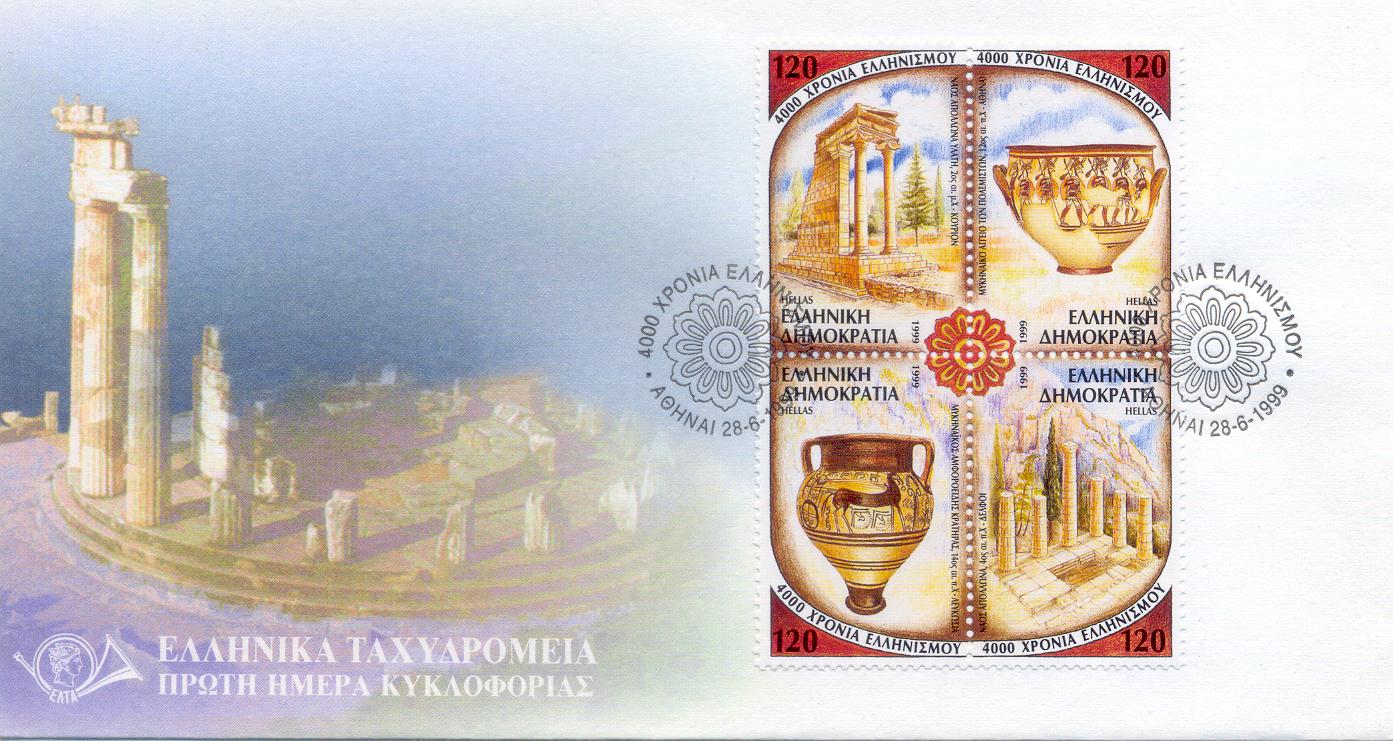
CYPRUS GREECE 4000 YEARS HELLENISM - THE TEMPLE OF APOLLO AT KOURION 28.6.1993


The settlement of the first Greek speaking tribes around 2000B.C. in the area occupied by Greece today is the beginning of a long period of on-going presence of Hellenism on the stage of history. During this period of 4000 years of Greek culture there were important milestones.
The Mycenaean civilization (26th 12th century B.C.) survived in the memory of future generations because of epic poetry. It was a brilliant period of strong kings and heroes, a picture that has been ascertained by archaeological excavations. The Mycenaean Greeks during their period of expansion settled in Cyprus too, another area where Hellenism appeared and continues ever since with unbreakable continuity.
Classical Greece and Athens especially of the 5th century B.C., gave the world together with the incomparable creations of art, speech and intellectualism, everlasting values like democracy, freedom and justice. The conquests of Alexander the Great brought the Greek spirit and civilization to the tour corners of the unknown world at the time.
The Byzantine civilization, the result of the mingling of Hellenism and Christianity - direct continuation of Greco-Roman antiquity - gave to modern Hellenism the basic elements which define its special mark and identity.


Thursday, November 19, 2015

Anniversaries & Events 28.9.1981

(25) 150th Anniversary of the birth of Heinrich von Stephan
On 9th October 1874, on the initiative of Heinrich von Stephan, the Director of the Postal Services of Germany, representatives from 22 countries convened in Berne, Switzerland, and signed the Convention for the establishment of a "General Postal Union" which in 1878 was renamed "Universal Postal Union". Heinrich von Stephan is considered the founder of the U.P.U. and Cyprus, like many other countries, is releasing this stamp of 25 mils to commemorate the 150th anniversary of his birth.

(40) World Food Day
The Food and Agriculture Organization is one of the main agencies of the United Nations. It was set up to provide the member countries with scientific, technical, financial and other assistance to enable them to increase their production of agricultural goods and food supplies. In its attempt to attain its target, the F.A.O. has proclaimed the 16th October as the World Food Day. The stamp of 40 mils has been released on the occasion of its event.

(1.25) International Year for the Disabled
With the slogan "full participation and equality" the General Assembly of the United Nations Organisation proclaimed 1981 as the International Year for the Disabled. It aims at making known, all over the world, the demands of the disabled persons. This consists in the creation of the necessary and proper conditions which will allow the disabled persons to compete on equal terms with their colleagues who are sound of limb. Cyprus has released the stamp of 125 mils contributing to the promotion of these aims.

(1.50) Urban Renaissance
In its efforts to make the public aware of the need for the improvement of living condition in towns, the Council of Europe has proclaimed a European campaign for Urban Renaissance. It aims at improving and reforming the urban environment and providing social, educational, cultural and transportation services for better living conditions in a more human environment. The stamp of 150 mils has been released on this occasion.

Thank you Merja.

Thursday, October 31, 2013

1992 Summer Olympic Games 3.4.1992


The 1992 Summer Olympic Games, officially known as 
the Games of the XXV Olympiad, were an international multi-sport event celebrated in Barcelona, Spain, in 1992.


Cyprus commemorated the games with the issue of these four lovely stamps on the beautiful first day cover.
Thank you Merja for this lovely FDC.

Sunday, October 27, 2013

IMAS 92 - Quality of shipping in the year 2000 9.11.1992

This lovely First Day Cover sent to me by Merja was issued by Cyprus to commemorate an International conference on the quality of shipping in the year 2000, which was held at the Cyprus International Conference Centre, Nicosia, Cyprus, from 11-13 November 1992.

Monday, June 17, 2013

Trees of Cyprus 10.10.1994

Now we come to good ole nature, and its generous natural gifts to Cyprus, as amply illustrated on the stamps on this FDC postmarked on 10.10.1994, so thoughtfully given to me by Merja. A brief description of these Trees of Cyrus is given below.

Black Pine (Pinus nigra ssp. Pallasiana). Black Pine (Pinus nigra ssp. Pallasiana) is an evergreen coniferous tree, reaching up to 17-30 in height with a straight trunk. The foliage is thick and conical in shape, and in older trees becomes flattened. The leaves are needle-like and long and are usually in pairs (occasionally found in threes). Male trees produce flowers and the females have large oval cones, found singly or in clusters. Found on pyrigenic slopes at 1200mm above sea level and as high as the Chionistra peak (1952m). A tree of great ecological and aesthetic value. Apart from the Juniper (Juniper foetidissima) it is the only tree which can survive the low temperatures and heavy snow-fall of the Troodos Mountains. It is used in building, furniture making, the construction of cases, and as firewood. It is highly flammable as it contains resin.

Cyprus Cedar (Cedrus libani ssp. Brevifolia). Cyprus Cedar (Cedrus libani ssp. Brevifolia) is an endemic, evergreen, coniferous tree, 20-30 m high with straight trunk. On mature tees the branches spread out in clear horizontal layers. The leaves are small and needle-like on thick spines; there are male flowers and the female cones are large and oval and stand upright on the branches. Natural clusters of the Cedar are now found only in the Tripylos area in the Paphos forest at 1000-1400m above sea level. This area has been declared a natural reserve for flora and fauna in accordance with the forestry law. The cedar is a strictly protected species, of great ecological and aesthetic value. In the past its wood was used for ship-building and furniture making, and is highly flammable because it contains resin.

Golden Oak (Quercus alnifolia). Golden Oak (Quercus alnifolia) is an endemic evergreen shrub or small tree, growing to up to 10m in height with a multitude of branches and broad irregular foliage. The leaves are thick, hard and leathery, oval in shape, dentate and are golden or brown underneath and dark green on top. The flowers are male and the tree bears acorns. The Golden Oak is found in pyrogenic slopes at 700-1900m, and is the main species, together with the rough pine, of forest vegetation of our country. The Golden Oak is an attractive endemic tree of great ecological and aesthetic value and covers large expanses of our forest land either together with other bushy vegetation or as undergrowth beneath conifers. Its stump is able to regenerate itself should it be cut down or burned. It stabilizes sharp slopes and improves the soil. It is used as firewood and makes excellent coal.

Strawberry tree (arbutus andrachne). Strawberry tree (arbutus andrachne) is an evergreen small tree or large shrub, 3-10m high with broad, irregular foliage and typically smooth, chestnut brown bark. The leaves are thick and leathery, broad, oval in shape. The flowers are white and in clusters. Found at heights of 100-1550 m in forests and is of great ecological and aesthetic value. Its fruit is food for many bird species. It is used for firewood and coal. It is relatively resistant to fire and regenerates from its stump.

Thursday, June 13, 2013

Europa 1994 - Discoveries -Cyprus 1.3.1994

My friend Merja gave me this very nice FDC.
Europa 1994 series of stamps by Cyprus consists of two stamps (10c and 30c) and the theme chosen if "Europe and Discoveries". The Cyprus Postal Services have chosen "copper" as their theme which since ancient times has been closely related to the history of Cyprus.
The stamp on the left (10c) depicts smelting or production of Copper. It is not possible to say with accuracy the period when copper was first smelted or the people who discovered it. Natural copper was known and used in Cyprus since the bronze and stone age (3900- 2500 B.C.).
Around 2500 B.C. metal prospectors from Asia Minor arrived in Cyprus and laid such strong foundations for metallurgy that the names Cyprus and copper became synonymous. The ancient Greeks and subsequently the Romans attributed the discovery of copper to the King of Cyprus Kinyras.
For the smelting of copper a temperature of 1085 Celsius is required. The ancient Cypriots were mainly using bellows made of clay in order to help charcoal set ablaze reach such high temperature. Bellows made of clay and stone as well as air shafts of the Later Bronze Age were found in Alassa, in Engomi and Maa, while scenes showing the way the bellows functioned were found in 14th century B.C. in Thebes in Egypt.
The huge masses of rust found in the foothills of Troodos, called "Mavrovounia", are evidence of an intensive production of copper, starting gradually since First Bronze Age and reached its zenith during the Later Bronze Age.
The stamp on the right (30c) depicts Trade in Copper. For the purpose of easy transportation as well as for administrative and economic reasons the metal was converted into ingots of a certain shape and size.
From the correspondence of Pharaoh Akenaton which was discovered at Tel-El-Amarna, dating back to the 14th century B.C., we learn that the King of Alasia (Cyprus) sent to Pharaoh 200 copper ingots. Another letter mentions that he had sent 500 ingots.
Copper ingots of the so called Cypriot Type, were found throughout the Mediterranean and as far away as the Black Sea area. Along the south coast of Asia Minor two shipwrecks of the Later Bronze Age were found, one near the Helidonia Capte and the other near Ulu-Burun. Both shipwrecks contained hundreds of copper ingots as well as numerous Cypriot objects, bearing witness as to the origin of the vessels. The Tel-El-Amarna letters, which also refer to the Royal vessels of Alasia, are now confirmed by archaeological evidence.
A single consignment of 6 tons of copper, discovered in Ulu-Burun constitutes unshakeable evidence of the position held by Cyprus in the copper trade during the Later Bronze Age.


Friday, May 31, 2013

Cyprus Merchant Marine 4.10.1993

Fom its geographical position which is at the crossroads of three continents, and its proximity to the Suez canal, it is obvious that these circumstances have promoted merchant shipping as an important industry for the island nation of Cyprus. As of 2005 Cyprus holds the 9th largest (by DWT) merchant navy in the world and the 3rd largest in the European Union.
Merchant shipping has long been of great importance to the island, with its roots stretching well back into antiquity. Examples of shipwrecks discovered off the island’s coast (e.g. the Kyrenia ship) plus evidence of ancient ports (e.g. Amathus) give proof to the fact that Cyprus was a major seafaring player in antiquity and located along important trade routes.
Merchant shipping has been actively developed by successive governments since the independence of Cyprus from British rule in 1960 and has since experienced sustained growth. The first shipping hub was created in the port of Famagusta, but since the Turkish invasion of 1974 this port has been occupied by Turkish forces and is currently declared illegal. Most business has since been transferred to Limassol Port and to a lesser extent Larnaca Port.
Shipping makes up approximately 2% of the GDP with an overall contribution in the of CYP£170 million (1999). 3,500 people are employed in the industry, representing 2% of the total gainfully employed population. The total revenue of Cyprus Maritime Administration for the year 2003 was around CYP£5.3 million which mainly consists of tonnage tax from ship owning and ship management companies, registration fees and issue of shipping documents.
The stamp on this FDC commemorates The Cyprus Merchant Marine. It is postmarked on 4.10.1993. Thank you Merja.

Monday, November 12, 2012

12th Meeting of Heads of Governments of the Commonwealth 4.10.1993


In 1993 Cyprus hosted the 12th Meeting of Heads of Governments of the Commonwealth.

Recognising the importance of the Commonwealth, the Department of Postal Services of Cyprus issued two special stamps, to honour this meeting. The designing of the stamps is based on motifs from the decoration of a Cypro-Geometric bowl (1050-750 B.C.) found at the locality of Agia Anastasia, Lapithos and now at the Cyprus Museum in Nicosia.

The Commonwealth is a voluntary union of independent states co-operating in the advancement of international understanding and peace for the common benefit of their peoples. The member countries of the Commonwealth were former colonies of Great Britain which gained their independence. The Commonwealth is characterized by a continuous development process and contributes in a positive way to the solution of problems currently facing the human race. The Commonwealth consists of 50 member countries with a population amounting to one fourth of the world population. It is spread all over the continents embracing peoples of different religions, languages and civilizations, united in their belief in the common principles of freedom, justice and equality irrespective of religion, colour or race. The developing relations between the Governments of the member countries supported and fostered by the Commonwealth Secretariat, the Commonwealth Institute and the Commonwealth Foundation as well as by the activities of a large number of non-Governmental Organizations contribute towards extending the Commonwealth's role to cover every aspect of life of these peoples.
Thank you Merja for this nice FDC.

Sunday, April 29, 2012

Miss Universe 12.5.2000


Miss Universe 2000, the 49th Miss Universe pageant was held at Eleftheria Stadium, Nicosia, Cyprus on May 12, 2000. 79 delegates from around the universe competed for the crown. At the conclusion of the final night, Lara Dutta of India, aged 22, was crowned as the new Miss Universe 2000 by Miss Universe 1999, Mpule Kwelagobe of Botswana. Being the mythological birthplace of Aphrodite (featured on the stamp), the Greek goddess of beauty, and alluding to the Judgement of Paris, the organizers presented a golden apple as a prize to the pageant's winner.
The final competition at the Eleftheria Stadium featured a stage set reproducing the ancient Curium Amphitheatre. It was hosted by American comic Sinbad, with entertainment by Elvis Crespo, Montell Jordan, saxophonist David Koz and Cypriot international star Anna Vissi. The event was held at daybreak in Cyprus so that it could be televised live during the prime-time viewing period in the United States.
The pageant was marked by certain political issues relating to the contestants. Turkey did not send a delegate to the pageant for the first time in thirteen years because of its relations with Cyprus; the Lebanese and Israeli delegates refused to speak to each other; and Corrinne Crewe of Zimbabwe had to deal with the threat of escalating violence in her country. There were also protests from religious and feminist groups on the island who claimed the event was un-Christian and an affront to women. The three finalists, Miss India, Miss Venezuela, and Miss Spain, were asked to respond to these protests and convince people that beauty pageants were good. Lara Dutta of India, aged 22, the winner of the competition, responded by saying she believed beauty pageants were a platform for women to voice their opinions and help them enter the field they wanted to enter, be it entrepreneurship, the armed forces, politics, and so forth. She also said beauty pageants made women the strong, independent individuals they are today because of all the help they give women. This spectacular answer to a difficult question completely impressed the judges and entire audience, showing Lara was not only gorgeous but a highly intellectual individual as well. This answer is believed to have greatly contributed to her victory.
That same year, two other Miss India contestants, Priyanka Chopra and Dia Mirza, won the Miss World 2000 and Miss Asia Pacific 2000 titles respectively. This was the second time a country had won all three major international beauty pageants in the same year, the first being Australia in 1972. This delightful  miniature sheet was given to me by dear friend Merja.

Wednesday, September 14, 2011

Europa 1992 - 500 Years of the discovery of America 29.5.1992


The theme chosen by the European Postal and Telecommunications Organisation (CEPT) for Europa 92 was "500 years since the discovery of America". The Cyprus issue consisted of four stamps, in pairs of two of the same value, as shown on the First Day Cover. The 10c+10c pair depicts Columbus' first voyage and embarkation at Palos. The second pair of 30c+30C depicts a portrait of Columbus with the ships "Santa Maria", "Nina" and "Pinta".
In the 15th century, the Europeans basically carried out their voyages of discovery for economic reasons, i.e. difficulties in free trade with the East, stories about large quantities of gold and the desire of the Europeans to control international trade. The voyages of discovery were possible because of new means such as the building of the caravel - a long, narrow, agile and resistant ship - the discovery of the compass and the use of other instruments such as the astrolabe, sextant and maps.
Christopher Columbus was born, probably at Genoa - there is no agreement as to the date, 1463 or 1446/7 or 1451. He was engaged in trade later with sea voyages. Columbus, convinced of the spherical shape of the Earth, nurtured ambitious plans of discoveries. He tried in vain to convince the king of Portugal John II to assign him the discovery of a new route to the Indies something that could be achieved by traveling westwards all the time. The same thing happened when he initially asked for the help of Ferdinand and Isabella, king and queen of Aragon and Castille.
Finally Columbus got help from the Spanish kings and on August 2, 1492 he set sail the three ships, the "Santa Maria", the "Pinta", and "Nina" from the Andalusian port of Palos to discover the Indies. Traveling continuously westwards he arrived on October 12 in the Antilles. The first island sighted by Columbus was called San Salvator. Today this island is identified with Watling island in the Bahamas. Columbus made three more voyages (1493, 1498, 1502) without finding the quantities of gold he had been dreaming. He died in poverty on May 20, 1506 convinced that he had reached Asia, in the West Indies.
The discovery of Columbus changed the course of humanity and enriched the world with a new continent. It has caused a revision and modernization of science and technology and brought about tremendous development in the economy of the world. My dear friend Merja gave me this lovely cover.

Thursday, July 7, 2011

Fishes of Cyprus


A set of four stamps were issued by Cyprus Post on 6.9.1993 to showcase the fishes abundant in the seas around the Island. I am displaying here two of these fish species on Maxicards sent to me by Merja. The two fish species are the Red Scorpion shown on the top card, and the Painted Comber on the card below.
The Red Scorpion grows to about 60cm in length. It lives on the sea bed, sitting motionless on the bottom, well camouflaged. It feeds mainly on molluscs, small fish and other crustaceans. Dorsal spines on the gill are poisonous. Cases of poisoning can be treated with hot water or compresses. These fish are edible and are used in fish soup.
The Painted Comber grows to only 35cm in length, and lives in shallow rocky areas. It is a hermaphrodite which reproduces in summer (mainly). It is an active predator feeding on small fish, molluscs and crustacea. It is also edible. Merja sent me these two cards.