Showing posts with label History. Show all posts

Friday, November 11, 2016

The Château De La Malmaison 18.4.1976

The Château de Malmaison is a French château. It is located near the western bank of the Seine about 15 kilometres (9.3 mi) west of the centre of Paris in Rueil-Malmaison.
Formerly the residence of Empress Joséphine de Beauharnais, along with the Tuileries it was the headquarters of the French government from 1800 to 1802, and Napoleon's last residence in France at the end of the Hundred Days in 1815.
The Hundred Days, marked the period between Napoleon's return from exile on the island of Elba to Paris on 20 March 1815 and the second restoration of King Louis XVIII on 8 July 1815 (a period of 111 days). This period saw the War of the Seventh Coalition, and includes the Waterloo Campaign, the Neapolitan War as well as several other minor campaigns. The phrase les Cent Jours (the hundred days) was first used by the prefect of Paris, Gaspard, comte de Chabrol, in his speech welcoming the king back to Paris on 8 July.
Napoleon returned while the Congress of Vienna was sitting. On 13 March, seven days before Napoleon reached Paris, the powers at the Congress of Vienna declared him an outlaw, and on 25 March Austria, Prussia, Russia and the United Kingdom, members of the Seventh Coalition, bound themselves to put 150,000 men each into the field to end his rule. This set the stage for the last conflict in the Napoleonic Wars, the defeat of Napoleon at the Battle of Waterloo, the restoration of the French monarchy for the second time and the permanent exile of Napoleon to the distant island of Saint Helena, where he died in May 1821.
The Cover depicts the moment of farewell between Napoleon and Josephine.

Thank you Merja.

Saturday, August 13, 2016

Hippolyte Adolphe Taine 9.7.1966

Hippolyte Adolphe Taine (21 April 1828 – 5 March 1893) was a French critic and historian. He was the chief theoretical influence of French naturalism, a major proponent of sociological positivism and one of the first practitioners of historicist criticism. Literary historicism as a critical movement has been said to originate with him.  Taine is particularly remembered for his three-pronged approach to the contextual study of a work of art, based on the aspects of what he called "race, milieu, and moment".
Taine had a profound effect on French literature; the 1911 Encyclopædia Britannica asserted that "the tone which pervades the works of Zola, Bourget and Maupassant can be immediately attributed to the influence we call Taine's."
The tomb of Hippolyte Taine is in Roc de Chère National Nature Reserve, in Talloires, near the Lake Annecy.

Thursday, May 19, 2016

The Cortes of León 26.9.1988

The stamp on this FDC shows the effigy and stamp of Alfonso IX, King of Léon.

The Cortes of León from year 1188 was a parliamentary body in the medieval Kingdom of León. According to UNESCO was the first sample of modern parliamentarism in the history of Western Europe.
After coming to power, King Alfonso IX, facing an attack by his two neighbors, Castile and Portugal, decided to summon the "Royal Curia". This was a medieval organisation composed of aristocrats and bishops but because of the seriousness of the situation and the need to maximize political support, Alfonso IX took the decision to also call the representatives of the urban middle class from the most important cities of the kingdom to the assembly.
León's Cortes dealt with matters like the right to private property, the inviolability of domicile, the right to appeal to justice opposite the King and the obligation of the King to consult the Cortes before entering a war.
When the Founding Fathers of the United States of America elaborated the American constitution, one of the juridical models they studied were the laws that arose from the Cortes of León. John Adams knew the text of the Fuero of León from his journey to Spain.

Friday, April 1, 2016

Army Of King John III Sobieski of Poland 5.7.1983

The two stamps on this Polish FDC are part of a 5 stamp set of stamps each of which depicts various arms of the Army Of King John III Sobieski of Poland. These to stamps depict infantry non-commissioned officers.
John III Sobieski  (17 August 1629 – 17 June 1696), from 1674 until his death King of Poland and Grand Duke of Lithuania, was one of the most notable monarchs of the Polish–Lithuanian Commonwealth.
Sobieski's military skill, demonstrated in wars against the Ottoman Empire, contributed to his prowess as King of Poland. Sobieski's 22-year reign marked a period of the Commonwealth's stabilization, much needed after the turmoil of the Deluge and the Khmelnytsky Uprising. Popular among his subjects, he was an able military commander, most famous for his victory over the Turks at the 1683 Battle of Vienna. After his victories over them, the Ottomans called him the "Lion of Lechistan"; and the Pope called him the savior of Christendom.

Friday, November 20, 2015

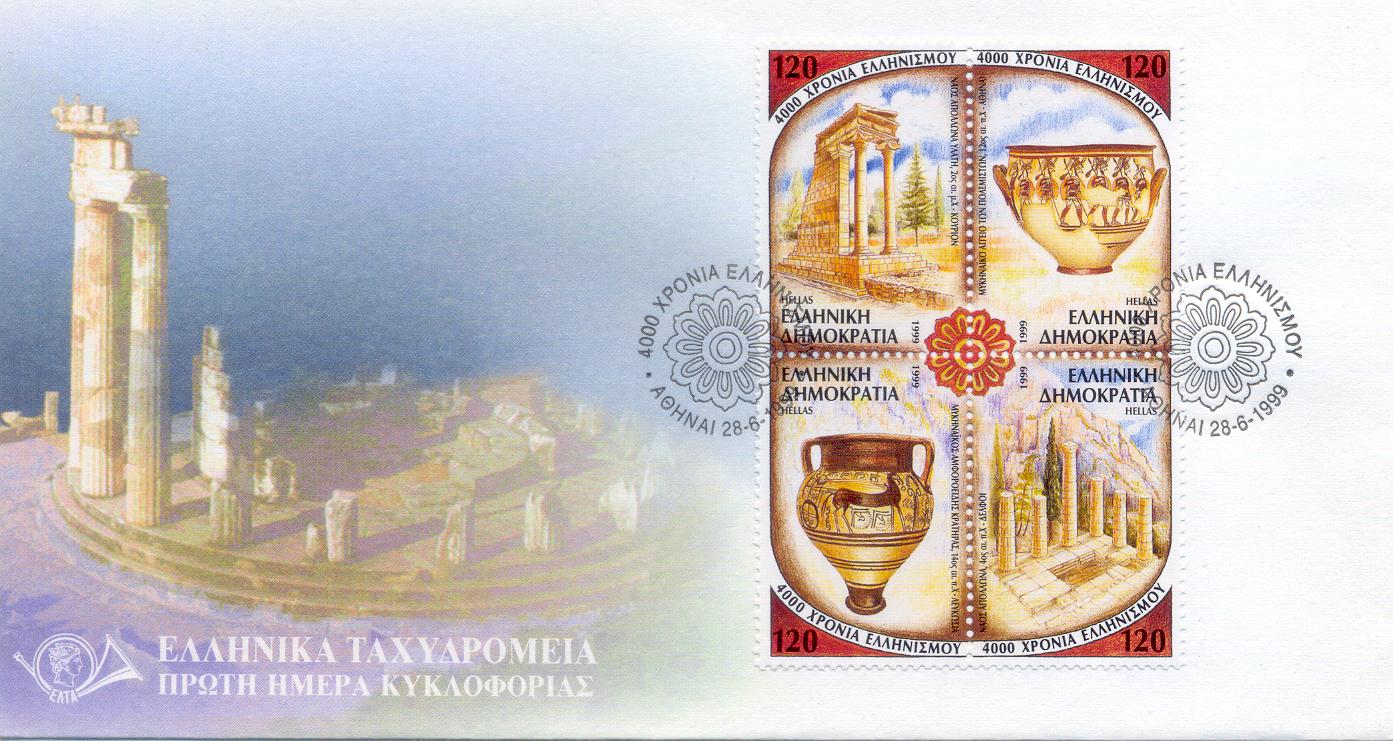
CYPRUS GREECE 4000 YEARS HELLENISM - THE TEMPLE OF APOLLO AT KOURION 28.6.1993


The settlement of the first Greek speaking tribes around 2000B.C. in the area occupied by Greece today is the beginning of a long period of on-going presence of Hellenism on the stage of history. During this period of 4000 years of Greek culture there were important milestones.
The Mycenaean civilization (26th 12th century B.C.) survived in the memory of future generations because of epic poetry. It was a brilliant period of strong kings and heroes, a picture that has been ascertained by archaeological excavations. The Mycenaean Greeks during their period of expansion settled in Cyprus too, another area where Hellenism appeared and continues ever since with unbreakable continuity.
Classical Greece and Athens especially of the 5th century B.C., gave the world together with the incomparable creations of art, speech and intellectualism, everlasting values like democracy, freedom and justice. The conquests of Alexander the Great brought the Greek spirit and civilization to the tour corners of the unknown world at the time.
The Byzantine civilization, the result of the mingling of Hellenism and Christianity - direct continuation of Greco-Roman antiquity - gave to modern Hellenism the basic elements which define its special mark and identity.


Sunday, November 1, 2015

King Philip IV (the Fair) 16.11.1968

The stamp on the FDC depicts King Philip IV (the Fair) and first States-General assembly, 1302.

Philip IV (April–June 1268 – 29 November 1314), called the Fair (Philippe le Bel) or the Iron King, was King of France from 1285 until his death. By virtue of his marriage with Joan I of Navarre, he was also, asPhilip I, King of Navarre and Count of Champagne from 1284 to 1305.
Philip relied on skillful civil servants, such as Guillaume de Nogaret and Enguerrand de Marigny, to govern the kingdom rather than on his barons. Philip and his advisors were instrumental in the transformation of France from a feudal country to a centralized state. Philip, who sought an uncontested monarchy, compelled his vassals by wars and restricted feudal usages. His ambitions made him highly influential in European affairs. His goal was to place his relatives on foreign thrones. Princes from his house ruled in Naples and Hungary. He tried and failed to make another relative the Holy Roman Emperor. He began the long advance of France eastward by taking control of scattered fiefs.

The most notable conflicts of Philip's reign include a dispute with Edward I of England, who was also his vassal as the Duke of Aquitaine, and a war with the County of Flanders, which gained temporary autonomy following Philip’s embarrassing defeat at the Battle of the Golden Spurs (1302). To further strengthen the monarchy, he tried to control the French clergy and entered in conflict with Pope Boniface VIII. This conflict led to the transfer of the papal court to the enclave of Avignon in 1309.

In 1306, Philip the Fair expelled Jews from France and, in 1307, he annihilated the order of the Knights Templar. Philip was in debt to both groups and saw them as a "state within the state".
His final year saw a scandal amongst the royal family, known as the Tour de Nesle Affair, during which the three daughters-in-law of Philip were accused of adultery. His three sons were successively kings of France, Louis X, Philip V, and Charles IV.

Thank you Merja.

Tuesday, September 8, 2015

800th Anniversary of the Founding of the town called Vitoria in Spain 4.9.1981

The stamp on the FDC depicts King Sancius VI of Navarre with City Charter, 12th Century Miniature.
In 1181, Sancho the Wise, King Sancius VI King of Navarre founded the town ofNova Victoria as a defensive outpost on top of a hill at the site of the previous settlement of Gasteiz. The existence of Gasteihiz, apparently inhabited by vasconic people, can be traced back to the lower Middle Ages; it is certain that by the 11th century, prior to the foundation of Nova Victoria, the settlement was already walled. It is assumed that Sancho the Wise gave the new city its name in memory of the old settlement of Victoriacum, which must had long since been abandoned. In 1199, the town was besieged and captured by the troops of Alfonso VIII of Castile, who annexed the town to the Kingdom of Castile. The town was progressively enlarged and in 1431 it was granted a city charter by King Juan II of Castile. In 1463, it was one of the five founding villas of the Brotherhood of Álava alongside Sajazarra, Miranda de Ebro, Pancorbo and Salvatierra/Agurain.

Thank you Merja.

Friday, August 28, 2015

900th Centenary of Abd-al-Rahman III the Emir and Caliph of Córdoba 9.6.1991

Merja sent me this FDC featuring Abd-al-Rahman III who was the Emir and Caliph of Córdoba of the Ummayad dynasty in al-Andalus. He ascended the throne in his early 20s, and reigned for half a century as the most powerful prince of Iberia.

Abd-ar-Rahman III (11 January 889/91 – 15 October 961) was the Emir and Caliph of Córdoba (912–961) of the Ummayad dynasty in al-Andalus. Called al-Nasir li-Din Allah ("the Defender of God's Faith"), he ascended the throne in his early 20s, and reigned for half a century as the most powerful prince of Iberia. Although people of all creeds enjoyed tolerance and freedom of religion under his rule, he repelled the Fatimids, partly by supporting their Maghrawa enemies in North Africa, and partly byclaiming the title Caliph (ruler of the Islamic world) for himself.

Abd-ar-Rahman III's mother Muzna was a Christian captive, possibly from the Pyrenean region. His paternal grandmother Onneca Fortúnez was a Christian princess from the Kingdom of Pamplona. In his immediate ancestry, Abd-ar-Rahman III was Hispano–Basque and Arab.

Saturday, August 22, 2015

Bicentenary of the Unification of Lorraine and Barrois with France 6.5.1966

The County of Bar, from 1354 the Duchy of Bar, was a principality of the Holy Roman Empire comprising the pays de Barrois and centred on the city of Bar-le-Duc. Part of the county—the so-called Barrois mouvant—became a fief of the Kingdom of France in 1301, while the Barrois non-mouvant remained a part of the Empire. From 1480 it was united to the imperial Duchy of Lorraine. Both imperial Bar and Lorraine were ceded to France in 1738. With the death of the last duke, Stanislaus Leszczynski, in 1766 the duchy escheated to the French crown.

On 2 October 1735 the preliminary Treaty of Vienna granted Bar to the deposed king of Poland, Stanislaus Leszczynski, immediately. He had to wait until the death of Grand Duke Gian Gastone of Tuscany on 9 July 1737 to receive Lorraine. In 1738, after the final Treaty of Vienna, he turned over the incomes from Bar and Lorraine to the French crown in exchange for a generous pension, which he used to fund construction projects in the duchies. On his death on 23 February 1766 the duchies passed to royal domain of France.

Tuesday, August 11, 2015

1100th anniversary of Burgos 1.3.1984

Burgos is a city in northern Spain and the historic capital of Castile. It is situated on the confluence of the Arlanzón river tributaries, at the edge of the Iberian central plateau. It has about 180,000 inhabitants in the actual city and another 20,000 in the metropolitan area. It is the capital of the province of Burgos, in the autonomous community of Castile and León. Burgos was once the capital of the Crown of Castile, and the Burgos Laws or Leyes de Burgos which first governed the behaviour of Spaniards towards the natives of the Americas were promulgated here in 1512.

The stamp depicts Santa Maria Arch & amphitheatre and  the Coat of Arms.

Thank you Merja.

Thursday, April 10, 2014

EUROPA 1982 - Portugal - 150th Anniversary of the Bravos do Mindelo 3.5.1982

Maria gave me this first day cover with the impressive minisheet of EUROPA 82 stamps issued by Portugal on 3.5.1982 being the 150th Anniversary of the Historic event in Mindelo. The EUROPA theme for postage stamps in 1982 was “Historic Events”.

Mindelo is a coastal civil parish in Vila do Conde Municipality, along the Green Coast in continental Portugal. In 2001 its population was 3402, in a coastal area that included 5.74 km² (with a population density of approximately 592 citizens per kilometre square.
The village, and in particular the beaches between Mindelo and Pampelido, were important in the being the location for the landing of Liberal forces during the Liberal Wars. Under the command of Peter IV, the troops, later referred to as the Bravos do Mindelo (the Brave of Mindelo), arriving from the Azores, disembarked along the beach on 8 July 1832, before proceeding to Porto.

Monday, March 24, 2014

Centenary of the 1st Boer war


The two stamps on this pretty cover commemorate the Centenary of the 1st Boer war near Volksrust in South Africa. The stamps were aptly released from Volksrust on 27.2.1981.
The Battle of Majuba Hill (near Volksrust, South Africa) on 27 February 1881 was the main and decisive battle of the First Boer War. It was a resounding victory for the Boers.
Although small in scope, the battle is historically significant for three reasons:
  • It led to the signing of a peace treaty and later the Pretoria Convention, between the British and the reinstated South African Republic, ending the first Boer War  .
  • Thefire and movement   ("vuur en beweeg" in Afrikaans) tactics employed by the Boers, especially Sommandant Smit in his final assault on the hill, were years ahead of their time.
  • Coupled with the defeats at Laing’s Nek and Schuinshoogte, this third crushing defeat at the hands of the Boers ratified the strength of the Boers in the minds of the British, arguably to have consequences in the Second Anglo-Boer War. "Remember Majuba"became a rallying cry.
Some notable British historians, although not all agree, claim that this defeat marked the beginning of the decline of the British Empire. Since the American Revolution, Great Britain had never signed a treaty on unfavorable terms with anyone and had never lost the final engagements of the war. In every preceding conflict, even if the British suffered a defeat initially, they would retaliate with a decisive victory.The Boers showed that the British were not the invincible foe the world feared.

Thank you Maria.

Wednesday, November 27, 2013

Boston Tea Party 4.7.1973


This set of four stamps was the second time the post office used four separate designs to create one larger scene. These stamps depict the drama of that fateful night in US History in 1773, when enraged colonists, dressed as Mohawk Indians, dumped chests of tea into Boston Harbor in protest of an English-levied tax. The 8¢ setenant stamps were issued on the American Independence Day in 1973, namely on 4th of July, and very appropriately released at Boston, MA.
The Boston Tea Party (initially referred to by John Adams as simply "the Destruction of the Tea in Boston") was a nonviolent political protest by the Sons of Liberty in Boston, on December 16, 1773. Disguised as Indians, the demonstrators destroyed the entire supply of tea sent by the East India Company in defiance of the American boycott of tea carrying a tax the Americans had not authorized. They boarded the ships and threw the chests of tea into Boston Harbour, ruining the tea. The British government responded harshly and the episode escalated into theAmerican Revolution. The Tea Party became an iconic event of American history, and other political protests often refer to it.
The Tea Party was the culmination of a resistance movement throughout British America against the Tea Act, which had been passed by the British Parliament in 1773. Colonists objected to the Tea Act because they believed that it violated their rights as Englishmen to "No taxation without representation," that is, be taxed only by their own elected representatives and not by a British parliament in which they were not represented. Protesters had successfully prevented the unloading of taxed tea in three other colonies, but in Boston, embattled Royal GovernorThomas Hutchinson refused to allow the tea to be returned to Britain.
The Boston Tea Party was a key event in the growth of the American Revolution. Parliament responded in 1774 with the Coercive Acts, or Intolerable Acts, which, among other provisions, ended local self-government in Massachusetts and closed Boston's commerce. Colonists up and down the Thirteen Colonies in turn responded to the Coercive Acts with additional acts of protest, and by convening the First Continental Congress, which petitioned the British monarch for repeal of the acts and coordinated colonial resistance to them. The crisis escalated, and theAmerican Revolutionary War began near Boston in 1775.

Thank you Very Much indeed Dear Merja for this important FDC’s.

Saturday, November 23, 2013

Marquis de Lafayette Arrives in America.

Issued in 1952, this bright blue 3¢ U.S. stamp issued on 13.6.1952 at Georgetown, SC commemorates the175thanniversary of the arrival of Marquis de Lafayette in America.

Marie Joseph Paul Yves Roch Gilbert du Motier de Lafayette was born in Chavaniac, in Haute Loire, France. His father died on the battlefield when Lafayette was two years old. His mother and grandmother died when he was 13. The young orphan inherited a great fortune. Descended from a long line of soldiers, Lafayette studied at the Military Academy at Versailles. When he was 16, he married Marie Adrienne Françoise de Noailles, the daughter of one of the most powerful families in France. Shortly after his marriage, Lafayette became a captain in the cavalry. However, he disliked court life, and soon grew interested in the events of the American Revolution.

This wealthy French aristocrat believed so strongly in the American independence movement that he purchased a ship with his own money and sailed for America in 1777. He had convinced several French officers to accompany him. On June 13, 1777, he arrived near Charleston, South Carolina, and volunteered his services to the war effort.

At first, the Continental Congress was unimpressed with Lafayette, who spoke little English. But, when he agreed to serve without pay, the cash-poor Continental Congress appointed him a major general. Lafayette joined George Washington’s staff. Washington developed a fatherly affection for the young man, and the two developed a life-long friendship.  Like Washington, Lafayette served in the Continental Army without pay.

Lafayette served with distinction at the battle of Brandywine, where he was wounded. His victory over Hessian troops at Gloucester earned him the command of a division. He served at Valley Forge during part of the terrible winter of 1777-78. Lafayette also fought at the battles of Barren Hill and Monmouth, and during the campaign to capture Rhode Island.

In 1779, Lafayette returned to France to participate in an invasion of Britain. Although the invasion never took place, Lafayette secured French aid for the Americans. He returned to America in April 1780. In 1781, Lafayette played an important role in the American victory at Yorktown. When he returned to France in 1782, Lafayette was received as a“hero to two worlds.”

Thank you Merja.


Saturday, November 2, 2013

Daniel Boone

This stamp issued on 26.9.1968 at Frankfort, KY, remembers the American pioneer Daniel Boone who settled in Kentucky and founded Boonesboro.  His frontier exploits and his adoption by the Shawnee Indians earned him a place in American Folklore.

Boone is one of the greatest pioneers in American history.  This frontiersman paved the way for settlement of Kentucky by leading settlers from North Carolina through the Cumberland Gap into that territory.  Boone founded Boonesborough there, near present-day Lexington.  Boone’s exploits as a frontiersman, hunter, and trapper have earned him a special place in American folklore.
Daniel Boone (November 2, 1734 – September 26, 1820) was an American pioneer, explorer, and frontiersman whose frontier exploits made him one of the first folk heroes of the United States. Boone is most famous for his exploration and settlement of what is now Kentucky, which was then part of Virginia but on the other side of the mountains from the settled areas. Despite some resistance from American Indian tribes such as the Shawnee, in 1775 Boone blazed his Wilderness Road through the Cumberland Gap in the Appalachian Mountains from North Carolina and Tennessee into Kentucky. There he founded the village of Boonesborough, Kentucky, one of the first American settlements west of the Appalachians. Before the end of the 18th century, more than 200,000 European people migrated to Kentucky/Virginia by following the route marked by Boone.
Boone was a militia officer during the Revolutionary War (1775–83), which in Kentucky was fought primarily between the American settlers and the British-aided Native Americans. Boone was captured by Shawnee warriors in 1778, who after a while adopted him into their tribe. Later, he left the Indians and returned to Boonesborough to help defend the European settlements in Kentucky/Virginia.
Boone was elected to the first of his three terms in the Virginia General Assembly during the Revolutionary War, and fought in the Battle of Blue Licks in 1782. Blue Lick was one of the last battles of the Revolutionary War, coming after the main fighting ended in October 1781.

Boone remains an iconic figure in American history. He was a legend in his own lifetime, especially after an account of his adventures was published in 1784, making him famous in America and Europe. After his death, he was frequently the subject of heroic tall tales and works of fiction. His adventures—real and legendary—were influential in creating the archetypal Western hero of American folklore. In American popular culture, he is remembered as one of the foremost early frontiersmen. The epic Daniel Boone mythology often overshadows the historical details of his life.

Saturday, July 27, 2013

1982 EUROPA - Portugal Historic Events 3.5.1982


The stamp on this first day cover was issued on 3rd May 1982 as part of the EUROPA CEPT series of stamps. The theme for 1982 was "Historic Events".
The stamp on the cover depicts  a scene from the presentation of Manuel I (Portuguese  king in that time) to the Pope in Rome, in 1514. It was a very great ceremony, even an Indian elephant took part in the ceremony.
Tristão da Cunha (c. 1460 – c. 1540) was a Portuguese explorer and naval commander. In 1514 he served as ambassador from king Manuel I of Portugal to Pope Leo X leading a luxurious embassy presenting in Rome the new conquests of Portugal. He later became a member of the Portuguese Privy Council.
Hanno (c. 1510 – 8 June 1516) was the pet white elephant given by King Manuel I of Portugal to Pope Leo X (born Giovanni de' Medici) at his coronation. Hanno, actually an Asian elephant, came to Rome in 1514 with the Portuguese ambassador Tristão da Cunha and quickly became the Pope's favorite animal. Hanno died two years later from complications of a treatment for constipation with gold-enriched laxative.
King Manuel had either received him as a gift from the King of Cochin, or had asked Afonso de Albuquerque, his viceroy in India, to purchase him. Hanno was said to be white in colour, and arrived by ship from Lisbon to Rome in 1514, aged about four years, and was kept initially in an enclosure in the Belvedere courtyard, then moved to a specially constructed building between St. Peter's Basilica and the Apostolic Palace, near the Borgo Sant'Angelo (a road in the rione of Borgo). 
Thank you Maria for this lovely FDC.

Tuesday, August 28, 2012

100th anniversary of the Finnish National Board of Antiquities 30.4.1984

This stamp was issued to commemorate the 100th anniversary of the Finnish National Board of Antiquities. The stamp depicts Pottery, 3200 B.C.; a silver chalice, 1416; and a crossbow used in the 16th century. The FDC and the stamp were issued on 30.04.1984. The drawing on the cover is that of the National Museum of Finland located in Central Helsinki. This FDC was given to me by Pia.
The oldest directives concerning antiquities were given in Sweden-Finland in 1666, when prehistoric sites and other antiquarian monuments were declared to be under the protection of the State. The clergy were ordered to compile descriptions of the sites of antiquarian and topographical interest that were to be found in their parishes, and around 20 such descriptions from Finland were eventually sent to the newly founded Antiquities College in Stockholm. In the 1680’s, the law was extended to include precious metal objects found in the ground; these were to be offered to the Crown, which could claim them against a reward.
 In the 1700’s, the antiquities laws were augmented several times, most notably in the legislation of 1734. This period saw the rise of the view that antiquities formed part of the national cultural heritage since they represented the works of the ancestors.
 After the Russo-Swedish War of 1808-1809, Finland became a part of Russia as an autonomous Grand Duchy. Though the Swedish law of 1734 was still in force, no public authority was charged with overseeing the antiquities legislation. As romanticism and nationalism began to awaken, so did general concerns over the gradual deterioration of the medieval castles and stone churches.
 In 1870, the Finnish Antiquarian Society was formed to care for and document national historical monuments. The Antiquarian Society, by its activity, greatly influenced the development of Finnish antiquities legislation and administration. The Decree on the Protection of Ancient Monuments was given in 1883, and the next year saw the founding of the Archaeological Bureau, later renamed the State Archaeological Commission, charged with “the general care of country’s ancient monuments”.
 The Archaeological Commission was reorganized in 1972 and became the National Board of Antiquities.

Friday, July 27, 2012

Areas of Historical Significance 8.8.2011


This stamp issue dated 8th August 2011, consists of four stamps features two prominent old residential neighbourhoods - Joo Chiat and Taman Jurong of the past and present. These two areas used to house the forefathers of the present residents, who were behind the success of Singapore.
Joo Chiat is situated between Marine Parade and Geylang in the eastern coastal region of Singapore. In its earlier days, it was known as Confederate Estate Road, and was renamed in 1917 after Chew Joo Chia, a major land owner there. In July 1993, Joo Chiat was gazetted as a conservation district, resulting in the preservation of many of its old buildings. Today, the shophouses and bungalows in Joo Chiat still retain the typical architectural styles of the early 20th century as depicted in both 50-cents and S$1.00 stamps.
Located at the other end of Singapore is Taman Jurong, one of the oldest residential precincts in Singapore. From a sleepy rural area mainly made up of coastal swamplands with low hills, shrubs and jungle as reflected in the 50-cents stamp, it has grown into a developed suburban area as featured in the S$1.10 stamp.

Wednesday, April 4, 2012

Bhutan's Victory over the Tibetans in 1644.


Drukgyel Dzong, at the upper end of the valley, built to protect against invading Tibetans, but in ruins since a fire in the 1950s. Drukgyel Dzong is situated 14 km from Paro at the end of the road. This Dzong was built in a location chosen for control of the routes to Tibet. In 1647 Shabdrung Ngawang Namgyel erected the Drukgyel Dzong, just north of Taktshang, in commemoration of the victory over the Tibetans in 1644. Thus while Bhutan has many cultural associations with Tibetan cultural areas, it has not been dominated by Tibetan political influence since the 17th century.The name "Drukgyel Dzong" means "Fortress of the Victorious Drukpa". In 1951 it was destroyed by fire. Now the Dzong is closed to all visitors. There have been attempts to renovate the buildings.In the background there is the Jhomolhari mountain, which is the place and embodiment of the female mountain goddess Tsheringma, who watches over the land. The first Tibetan invasion appears to have taken place shortly after the Shabdrung's arrival in 1616. The Tibetan ruler did not want to tolerate the presence of his arch enemy immediately south of his own territory. It was not enough for the Tibetan ruler that the Shabdrung had left Tibet; the opponent had to be destroyed.
In the course of the first Tibetan invasion, the general of the attackers fell and the Tibetan troops were beaten off. The fame of the Shabdrung as superior military strategist started to spread.
In Tibet the power of the ruling Tsang collapsed in 1642. Since then the Gelugpa school, headed by the fifth Dalai Lama, reigned with the support of the Mongolians. The Gelugpas also thought that they could not afford a powerful state on their southern border. In 1644, Tibetan and Mongolian armies attacked Bhutan, but the campaign was not successful. In 1648/49 several Tibetan and Mongolian columns again attacked Bhutan at various points.
They advanced as far as Thimphu, Punakha and Paro, but were ultimately defeated. Another Tibetan invasion took place in 1657, after the Shabdrung's death, but failed to achieve anything. It was the last Tibetan attempt to conquer Bhutan.
This lovely minisheet of four stamps depicting the various scenes during the invasion by the Mongols jointly with Tibet, in which they were routed by the forces of Bhutan,was given to me by Shashi.

Monday, December 5, 2011

EUROPA CEPT 1982 - Historic Events - Finland 29.4.1982


These two lovely stamps and the first day cover were issued on 29.4.1982 to commemorate significant historical events in Finland’s History. The 1.20 stamp is of the statue of Mikael Agricola is in front of the Turku Cathedral. Mikael Agricola, and the Publication of Abc-kirja Abc-book, (1st Finnish book), 1543. The Sculpture of Mikael Agricola translator, is by Oskari Jauhiainen, 1951, and the cover of Agricola's Abckiria.. The 1.50 stamp Fresco depicts the Turku Academy, 1st Finnish university. (Turku Academy Inaugural Procession, 1640, fresco originally painted by Albert Edelfelt. Repainted by Johannes Gebhard after it was destroyed in WWII. Pia gave me this historic FDC.
Now, what was the Abckiria? Abckiria (also sometimes spelled ABC-kiria, and spelled "ABC-kirja" in modern Finnish), in English "The ABC book", is the first book that was published in the Finnish language. It was written by Mikael Agricola, a bishop and Lutheran Reformer, and was first published in 1543. Agricola wrote the book while working on the first Finnish translation of the New Testament (which was eventually finished in 1548 as Se Wsi Testamenti). Abckiria was a primer meant to teach the basics of reading and writing. It contains the alphabet, some spelling exercises, and catechism. The first edition had 16 pages. The second edition, which was written in 1551, had 24 pages. No complete copies of either are known to exist, but general contents of the book have been discerned from the existing material.
Edelfelt, Albert (1854 - 1905). Albert Edelfelt was one of the most important Finnish visual artists of all time. He was above all a painter, but he also worked as a graphic artist and illustrator. In his era he was the most respected Finnish artist abroad. He was also in his time the undisputed leading figure in Finnish art. As a popular portraitist at European courts, he was of much greater social importance than other artists. Above all, he helped to lay the foundations for Finland's cultural prestige abroad.
The mural in the Great Hall of the University of Helsinki took up a considerable portion of Edelfelt's career. A competition was held in 1891 and resulted in Edelfelt's winning the commission for the main picture, Turun akatemian vihkiäiset ('The Inauguration of Turku Academy'). (The Turku Academy was the direct predecessor of the University of Helsinki.) He had researched the subject during his many trips abroad, but he did not complete the painting until 1904. It was an impressive finale to his career as a historical painter. Unfortunately the work was destroyed during the bombing in 1944.