Showing posts with label Russia. Show all posts

Friday, February 26, 2016

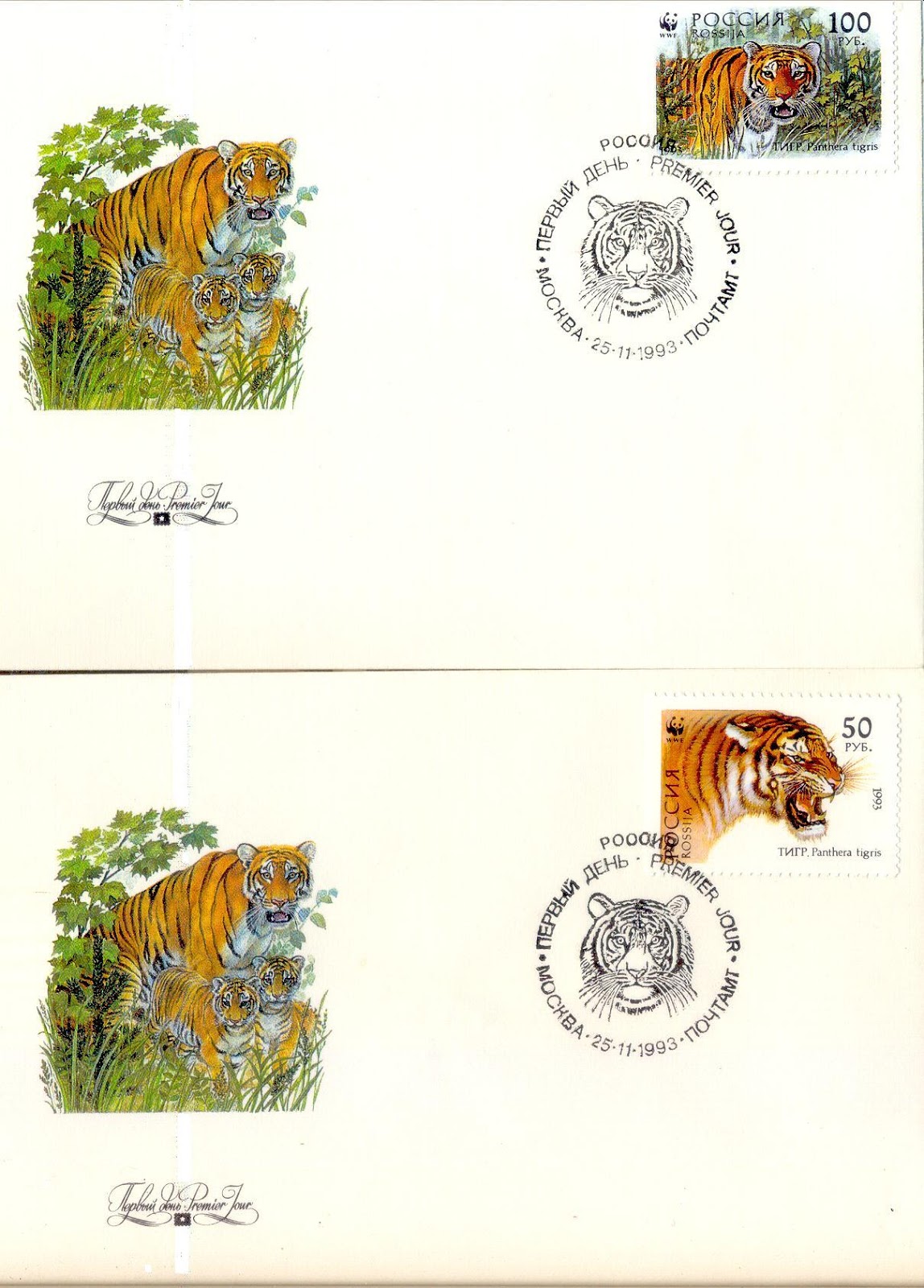
The Siberian tiger 25.12.1993

Add caption

The Siberian tiger (Panthera tigris altaica), also known as the Amur tiger, is a tiger subspecies inhabiting mainly the Sikhote Alin mountain region with a small population in southwest Primorye Province in the Russian Far East. In 2005, there were 331–393 adult and subadult Amur tigers in this region, with a breeding adult population of about 250 individuals. The population had been stable for more than a decade due to intensive conservation efforts, but partial surveys conducted after 2005 indicate that the Russian tiger population was declining. By 2015, the Siberian tiger population has increased to 480–540 individuals in the Russian Far East, including 100 cubs. A more detailed census revealed a total population of 562 wild Siberian tigers in Russia.


The Siberian tiger and Bengal tiger subspecies rank among the biggest living cats. A comparison of data on body weights of Siberian tigers indicates that up to the first half of the 20th century both males and females were on average heavier than post-1970 ones. Today's wild Siberian tigers are lighter than Bengal tigers. Their reduced weight as compared to historical Siberian tigers may be due to a combination of causes: when captured, they were usually sick or injured and involved in a conflict situation with people.

Thank you Merja.

Wednesday, January 13, 2016

50th Anniversary of the World Wildlife Fund

The World Wide Fund for Nature (WWF) is an international non-governmental organization founded on April 29, 1961, working in the field of the biodiversity conservation, and the reduction of humanity's footprint on the environment. It was formerly named the World Wildlife Fund, which remains its official name in Canada and the United States.
It is the world's largest conservation organization with over 5 million supporters worldwide, working in more than 100 countries, supporting around 1,300 conservation and environmental projects. WWF is a foundation, with 55% of funding from individuals and bequests, 19% from government sources (such as the World Bank, DFID, USAID) and 8% from corporations in 2014.
The group's mission is "to stop the degradation of the planet’s natural environment and to build a future in which humans live in harmony with nature." Currently, much of its work focuses on the conservation of three biomes that contain most of the world's biodiversity: oceans and coasts, forests, and freshwater ecosystems. Among other issues, it is also concerned with endangered species, sustainable production of commodities and climate change.

Friday, August 21, 2015

The Moscow Metro - 70th Anniversary 25.4.2005

The Moscow Metro is a rapid transit system serving Moscow, Russia and the neighbouring Moscow Oblast towns of Krasnogorsk and Reutov. Opened in 1935 with one 11-kilometre (6.8 mi) line and 13 stations, it was the first underground railway system in the Soviet Union.

The first line was opened to the public on 15 May 1935 at 07:00 am. It was 11 kilometres (6.8 mi) long and included 13 stations. The line connected Sokolniki to Okhotny Ryad then branching to Park Kultury and Smolenskaya, complete with the first logo, the capital M paired with the text "МЕТРО". There is no accurate information about the author of the logo, so it is often attributed to the architects of the first stations – Samuil Kravets, Ivan Taranov and Nadezhda Bykova. It is noteworthy, however, that even at the opening in 1935, the M letter on the logo had no definite shape.

The first line was opened to the public on 15 May 1935 at 07:00 am. It was 11 kilometres (6.8 mi) long and included 13 stations. The line connected Sokolniki to Okhotny Ryad then branching to Park Kultury and Smolenskaya.


The Moscow Metro is probably the most magnificent subway of the world. It is not only beautiful, but also cheap, reliable and runs on time. In Moscow the Metro is often the fastest way to get around the city compared to other means of public transportation, taxis or driving. During rush hours, metro trains run every one to two minutes.

Friday, October 11, 2013

The Trinity Lavra of St. Sergius


This Russian miniature sheet was issued on 29th August 2012 In commemoration of The Trinity Lavra of St. Sergius is the most important Russian monastery and the spiritual centre of the Russian Orthodox Church. The monastery is situated in the town of Sergiyev Posad, about 70 km to the north-east from Moscow by the road leading to Yaroslavl, and currently is home to over 300 monks.
The monastery was founded in 1345 by one of the most venerated Russian saintsSergius of Radonezh, who built a wooden church in honour of the Holy Trinity on Makovets Hill. Early development of the monastic community is well documented in contemporary lives of Sergius and his disciples.
My Russian friend Irina sent me this lovely mini sheet.

Monday, October 7, 2013

Internationl Polar Year 2008 - A comprehensive study of the Northern Sea Route

The stamps on this minisheet were issued by Russia on 28th August, 2008 in commemoration of the International Polar Year and the launching of A comprehensive study of the Northern Sea Route.
The Arctic policy of Russia is the domestic and foreign policy of the Russian Federation with respect to the Russian region of the Arctic. The Russian region of the Arctic is defined in the "Russian Arctic Policy" as all Russian possessions located north of the Arctic Circle. (About one-fifth of Russia's landmass is north of the Arctic Circle.) Russia is one of five countries bordering the Arctic Ocean. In 2011, out of 4 million inhabitants of Arctic, roughly 2 million lived in arctic Russia, making it thus the largest arctic country by population. However, in recent years Russia's Arctic population has been declining.
The main goals of Russia in its Arctic policy are to use Russia's Arctic as a resource source, protect its ecosystems, use the seas as a transportation system in Russia's interests, and ensure that it remains a zone of peace and cooperation. Russia currently maintains a military presence in the Arctic and has plans to improve it, as well as strengthen the Border Guard/Coast Guard presence there. Using the Arctic for economic gain has been done by Russia for centuries for shipping and fishing. Russia has plans to exploit the large offshore resource deposits in the Arctic. The Northern Sea Route is of particular importance to Russia for transportation, and the Russian Security Council is considering projects for its development. The Security Council also stated a need for increasing investment in Arctic infrastructure.
Russia conducts extensive research in the Arctic region, notably the manned drifting ice stations and the Arktika 2007 expedition, which was the first to reach the seabed at the North Pole. The research is partly aimed to back up Russia's territorial claims, in particular those related to Russia's extended continental shelf in the Arctic Ocean.
Thank you Elena for this lovely set of stamps.

Thursday, October 3, 2013

125th Anniversary of PN Nesterov (1887-1914), military pilot and founder of aerobatics

On February 13, 2012 the stamp on this cover dedicated to the 125th anniversary of the legendary Russian pilot and a hero of the First World War was issued. The stamp depicts a portrait of P.N. Nesterov and an aircraft “Moran-G”.
Pyotr Nikolayevich Nesterov (27 February 1887 in Nizhny Novgorod - 8 September 1914 in Zhovkva, Lviv Oblast was a Russian pilot, an aircraft technical designer and an aerobatics pioneer. The son of a military academy teacher, Pyotr Nesterov chose a military career. In August 1904 he left the military school in Nizhny Novgorod and went to the artillery school, considered one of the best of its kind. He became a second lieutenant and served in the 9th East Siberian artillery brigade in Vladivostok. In 1909, he came into contact with aviation when he was sent to an aircraft manufacturer to work. He built his first glider and learned to fly it.
In 1911 Nesterov began formal training as a pilot and graduated on 11 October 1912. A short time later he also passed the examination to be a military pilot. In May 1913 he became leader of a relay in Kiev, completing night flights at that time.
Nesterov believed an aircraft could fly a loop, a feat not previously performed. Despite the doubts of his peers, Nesterov proved his theory on 9 September 1913 (27 August by the calendar then used in Russia) and became the first pilot to fly a loop.  
The First World War gave Nesterov the opportunity to put his theories to practice and he proved to be particularly adept at controlling the bomb release. Aircraft were unarmed at this early stage, and Nesterov became the first pilot to destroy an enemy airplane in flight. On 25 August 1914 (as the date was reckoned using the Old Style calendar then still used by the Russian Empire), after using a pistol to fire unsuccessfully at the Austrian Albatros B.II reconnaissance aircraft of observer Baron Friedrich von Rosenthal and pilot Franz Malina from FLIK 11, he used his Morane-Saulnier Type G monoplane (s/n 281) to ram it. Eager to destroy enemy aircraft, he probably intended to hit it with a glancing blow but damaged his own aircraft as much as the enemy's and both planes crashed. As was common for the time, Nesterov was not strapped in and he fell from his plane, dying of his injuries the next day. The Austrian pilot and observer also died. The town of Zhovkva (currently in Lviv Oblast, Ukraine) near the famous air fight was renamed Nesterov in 1951, though it has since reverted to Zhovkva.

Thank you My friend Anna for this FDC.

Monday, September 23, 2013

M/S Princess Anastasia - Joint-issue stamps by Aland and Russia 12.8.2013

Passenger Ferries featured on new joint-issue stamps by Aland and Russia
Posten Aland issued a “Passenger ferry” stamp in cooperation with the Russian post on 12th August, 2013.
This year’s second stamp in the passenger ferry series by Aland Post features M/S Princess Anastasia. The ship operates on the route Stockholm-Tallinn-St Petersburg-Helsinki. Ordered by Swedish shipping company Rederi Ab Slite, M/S Princess Anastasia was built in 1986 by Wartsila shipyard in Turku to be placed in the service of Viking Line. She was named M/S Olympia and was sister ship of Viking Line’s M/S Mariella. M/S Olympia operated for Viking Line between Stockholm and Helsinki from 1988 to 1993.
When Rederi Ab Slite went bankrupt in 1993, she was sold to P&O Ferries and, between 1993 and 2010 she served mostly between Portsmouth in England and Bilbao in Spain, now with the name M/S Pride of Bilbao. On 2 April 2011, St Peter Line placed the ship in traffic on the route Stockholm-Tallinn-St Petersburg-Helsinki under her new name M/S Princess Anastasia. From August 2011 until April 2012, Mariehamn (Aland Islands capital) was one of the ports of call on her voyage.
Thank you My Dear Friend Ella for this lovely set of FDCs and the  pretty maxicard with the picture of the Anastasia Ferry and the stamps and postmarks of the two countries, Aland and Russia.

Tuesday, May 21, 2013

Wrangel Island


Ever heard of Wrangel Island? I didn't too till Galya sent me this FDC. It is an island in the Arctic Ocean, between the Chukchi Sea and East Siberian Sea. Wrangel Island liesastride the 180° meridian. The International Date Line is displaced eastwards at this latitude to avoid the island as well as the Chukchi Peninsula on the Russian mainland. The closest land to Wrangel Island is tiny and rocky Herald Island located 60 km (37 mi) to the east. The distance to the closest point on the mainland is 140 km (87 mi). It is believed thatWrangel Island may have been the last place on earth where mammoths survived.
Nearly all of Wrangel Island, and Herald Island, are a federally protected nature sanctuary administered by Russia's Ministry of Natural Resources. The island, and its surrounding waters, were classified as a "Zapovednik" (a "strict nature reserve") in 1976 and, as such, receive the highest level of protection and excludes practically all human activity other than for scientific purposes. The Chukotka Regional government extended the marine protected area out to 24 nautical miles in 1999. As of 2003, there were four rangers who reside on the island year-round. In addition a core of about 12 scientists conduct research during the summer months.
Wrangel Island is about 125 km (78 mi) wide and 7,600 km2 (2,900 sq mi) in area. It consists of a southern coastal plain that is as wide as 15 km (9.3 mi); a central belt of low-relief mountains; and a northern coastal plain that is as wide as 25 km (16 mi). The east-west trending central mountain belt, the Tsentral'nye Mountain Range, is as much as 40 km (25 mi) wide and 145 km (90 mi) long from coast to coast. Typically, the mountains are a little over 500 m (1,600 ft) above mean sea level. The highest mountain on this island is Sovetskaya Mountain with an elevation of 1,096 m (3,596 ft) above mean sea level. The east-west trending mountain range terminates at sea cliffs at either end of the island.
Wrangel Island belongs administratively to the Chukotka Autonomous Okrug of the Russian Federation. This rocky island has a weather station and, formerly, two Chukchi fishing settlements on the southern side of the island (Ushakovskoye and Zvyozdny on the shore of Somnitelnaya Bay).
Wrangel Island was commemorated with the issue of this stamp on the lovely minisheet affixed to this lovely FDC postmarked 27.2.2012. This wonderful first day cover was given to me byGalina.

Thursday, May 9, 2013

The Killer whale and the Humpback

Galina sent me this nice FDC with the setenant pair of stamps showing two of the greatest type of whales. The Killer whale and the Humpback. These stamps and the cover were issued by Russia on 8.2.2012.
Killer whales (Orcinus orca).  Killer whales are the largest dolphins in the world. Males can grow up to 10 meters in length; females are smaller — up to just 8 meters in length. The sex of mature orcas can be discerned by the size and shape of the dorsal fin: the male has an elongated dorsal fin, up to 2 meters high. Females and subadult animals of both sexes have smaller sickle-shaped dorsal fins.
One key species feature of killer whales is their coloration. The back and sides of the large body are black; the lower jaw, throat and belly are white. On the rear part of the body, the white color goes up the sides, sometimes culminating at the back. Two white patches are located before the eyes and above them. Behind the dorsal fin there is an asymmetrical saddle patch, which is used for the photo-identification of individual whales. In Arctic and Antarctic waters, this white color can be masked by algae covering the orca´s skin and these patches appear fawn or brown. Killer whales have 10-14 teeth on the each half of the upper jaw and 8-14 on the lower. When the mouth closes, the teeth of the upper jaw fit into the spaces between the teeth of lower jaw, helping to catch and bite prey.
The Humpback whale (Megaptera novaeangliae) is a species of baleen whale. One of the larger rorqual species, adults range in length from 12–16 metres (39–52 ft) and weigh approximately 36,000 kilograms (79,000 lb). The humpback has a distinctive body shape, with unusually long pectoral fins and a knobbly head. An acrobatic animal known for breaching and slapping the water with its tail and pectorals, it is popular with whale watchers off Australia, New Zealand, South America, Canada, and the United States.
Males produce a complex song lasting 10 to 20 minutes, which they repeat for hours at a time. Its purpose is not clear, though it may have a role in mating.
Found in oceans and seas around the world, humpback whales typically migrate up to 25,000 kilometres (16,000 mi) each year. Humpbacks feed only in summer, in polar waters, and migrate to tropical or subtropical waters to breed and give birth in the winter. During the winter, humpbacks fast and live off their fat reserves. Their diet consists mostly of krill and small fish. Humpbacks have a diverse repertoire of feeding methods, including the bubble net feeding technique.
Like other large whales, the humpback was and is a target for the whaling industry. Once hunted to the brink of extinction, its population fell by an estimated 90% before a moratorium was introduced in 1966. While stocks have since partially recovered, entanglement in fishing gear, collisions with ships, and noise pollution continue to impact the 80,000 humpbacks worldwide.

Thursday, December 27, 2012

Finland - Russia joint issue: Endangered animals 1.3.1995

Finland and Russia issued this Joint Issue of stamps and very sensibly decided to depict endangered animals.
EURASIAN LYNX. The Eurasian lynx (Lynx lynx) is a medium-sized cat native to European and Siberian forests, South Asia and East Asia. It is also known as the European lynx, common lynx, the northern lynx, and the Siberian or Russian lynx. While its conservation status has been classified as "Least Concern", populations of Eurasian lynx have been reduced or extirpated from western Europe, where it is now being reintroduced.
RINGED SEAL. The ringed seal (Pusa hispida), also known as the jar seal and as netsik or nattiq by the Inuit, is an earless seal inhabiting the Arctic and sub-Arctic regions. The ringed seal is a relatively small seal, rarely greater than 1.5 m in length, with a distinctive patterning of dark spots surrounded by light grey rings, whence its common name. It is the most abundant and wide-ranging ice seal in the northern hemisphere: ranging throughout the Arctic Ocean, into the Bering Sea and Okhotsk Sea as far south as the northern coast of Japan in the Pacific, and throughout the North Atlantic coasts of Greenland and Scandinavia as far south as Newfoundland, and include two freshwater subspecies in northern Europe. Ringed seals are one of the primary prey of polar bears and have long been a component of the diet of indigenous people of the Arctic.
Thank you Pia for this FDC with the lovely stamps

Monday, December 24, 2012

Happy New Year

Russian 2012 New Year stamp, issued on December 1, 2011. Thank you Galina for this lovely First Day Cover.

Thursday, March 10, 2011

Åland - Mariehamn 150 years - Jt Åland-Russia Issue 27.2.2011


2011 marks 150 years since the founding of Mariehamn. Åland Post celebrates the anniversary by issuing a miniature sheet featuring Empress Maria Alexandrovna as well as part of the first town plan for Mariehamn. The issue is a joint issue with the Russian Post. The Åland miniature sheet to be issued 21 February is a unique joint issue in cooperation with the Russian Post. The Åland and the Russian miniature sheets will have a similar if not identical design, both featuring the Empress Consort. In connection with the issue, a presentation pack holding both the Åland and the Russian miniature sheets and FDCs will be made available. Åland Post will also be producing an exclusive additional edition of 4000 numbered and gold embossed Åland miniature sheets. a certificate signed on Feb. 20, 1861, establishes the status of the city. On the mail box on a map of Mariehamn is a portrait of Empress Maria Alexandrovna (1857) Brush FK Winterhalter from the Hermitage collection.
In 1859, Tsar Alexander II of Russia recommended that a town be established in Åland close to the Svibyviken bay. Two years later, he issued a charter of foundation and the town was named after Empress Maria Alexandrovna. Maria Alexandrovna was born in 1824 in Darmstadt, Germany, and Empress Consort of Tsar Alexander II of Russia from 1855 until her death in 1880. Mariehamn was founded around the village of Övernäs in the parish of Jomala. County architect Georg Theodor von Chiewitz prepared a four-part town plan with grid-based street network. Ella sent me this wonderful First Day Cover.

Sunday, January 9, 2011

Happy New Year


From Russia, and from Elena With Love – Happy New Year to All.

The stamp on the card is noteworthy. It is in the shape of a snow crystal. Very topical and typical of the place.

Thursday, October 28, 2010

Russia – Vladivostok 150Years


Further to my post on this subject on 27th July 2010, I display a cover and both sides of a card issued during the celebrations. One side of the card shows Vladivostok town and harbour as it is today. And the other side shows the same area as it was in 1910. My good friend Elena sent these to me.

Tuesday, July 27, 2010

Russia - Vladivostok - 150th Anniversary


Vladivostok is Russia's largest port city on the Pacific Ocean and the administrative center of Primorsky Krai. It is situated at the head of the Golden Horn Bay, not far from Russia's border with China and North Korea. It is the home port of the Russian Pacific Fleet. This important city celebrated her 150th Anniversary on 2nd July 2010. The ocassion was graced by the President Mr Medvedev.

The territory on which modern Vladivostok is located had been part of many nations, such as Balhae, Jurchen, the Mongol Empire, and China, before Russia acquired the entire Maritime Province and the island of Sakhalin by the Treaty of Aigun (1858). China, which had just lost the Opium War with Britain, was unable to act to maintain the region. The Pacific coast near Vladivostok was settled mainly by the Chinese, Jurchen, Manchu and Korean during Imperial Chinese Qing dynasty period. A French whaler visiting the Zolotoy Rog in 1852 discovered Chinese or Manchu village fishermen on the shore of the bay. The naval outpost was founded in 1859 by Count Nikolay Muravyov-Amursky, who named it after the model of Vladikavkaz, a Russian fortress in the Caucasus. An elaborate system of fortifications was erected between the 1870s and 1890s. A telegraph line from Vladivostok to Shanghai and Nagasaki was opened in 1871, the year when a commercial port was relocated to this town from Nikolayevsk-on-Amur. Town status was granted on April 22, 1880. The municipal coat of arms, representing the Siberian tiger, was adopted in March 1883.

Yours truly had the good fortune of being a resident of this wonderful city when the people there were preparing to celebrate the Centenary Anniversary. I spent two winters in Vladivostok. This superb card, with the 150th Anniversary Postmark was sent to me by friend Elena.