The Douaumont ossuary is a memorial containing the remains of soldiers who died on the battlefield during the Battle of Verdun in World War I. It is located in Douaumont, France, within the Verdun battlefield. It was built on the initiative of Charles Ginisty, Bishop of Verdun. It has been designated a "nécropole nationale", or "national cemetery".
Welcome to this stamps, first-day covers and postcards gallery of mine euphemistically called Lets Talk Stamps. My desire here, is to show as often as I can, some of my presumed beauties and talk about them. And hopefully make Your Day in the bargain. In case you want a better view, JUST CLICK on the picture and it will be ENLARGED. Please also see my picture postcards blog www.mypicturepostcards.blogspot.in
Showing posts with label 1st World War. Show all posts
Sunday, March 19, 2017
Thursday, February 2, 2017
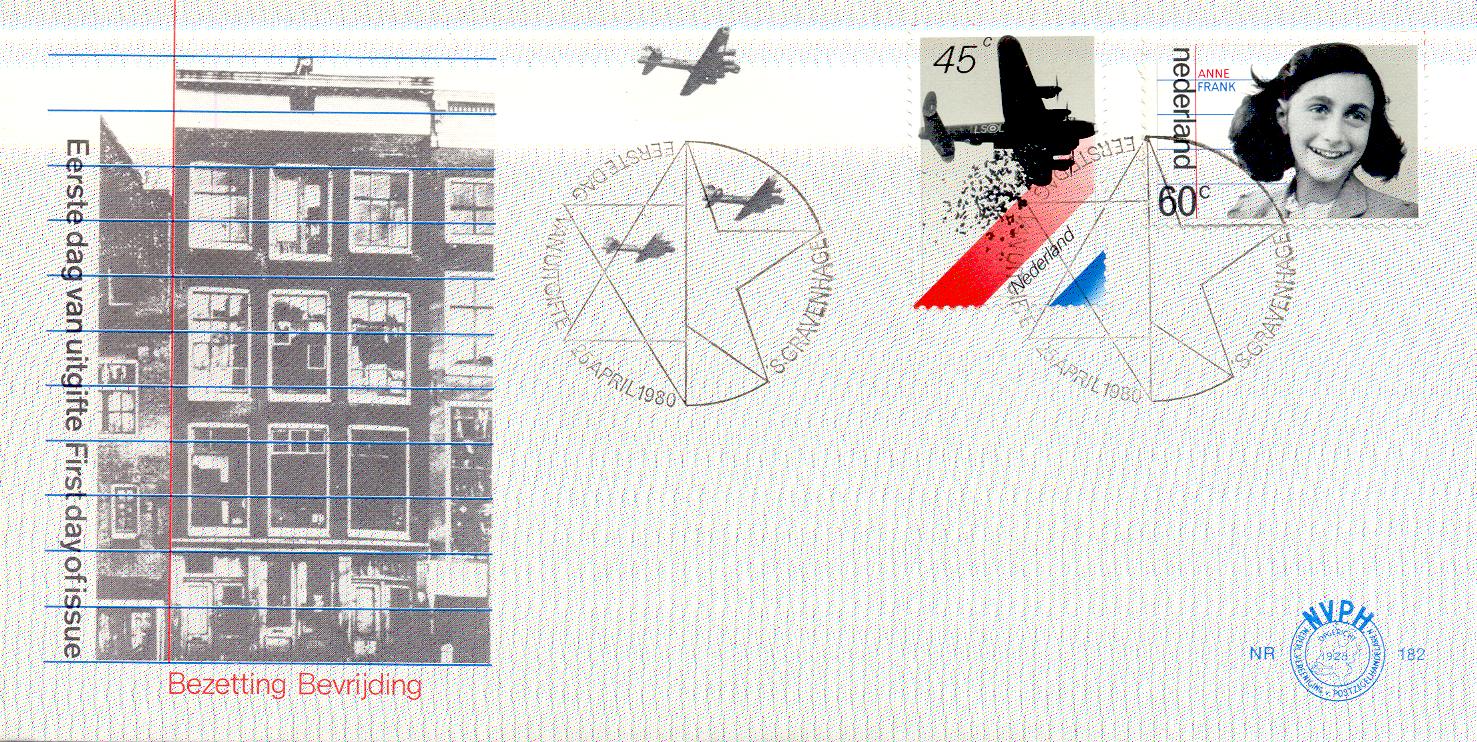
Holland During Occupation and then Liberation 25.4.1980
(45c) British Liberator bomber throws food parcels during the Liberation Phase of the Second World War.
(60c) Family portrait of Anne Frank.
Annelies Marie Frank (12 June 1929 – February or March 1945) was a German-born diarist and writer. One of the most discussed Jewish victims of the Holocaust, she gained fame posthumously following the publication of her diary, The Diary of a Young Girl (originally The Secret Annex),which documents her life in hiding from 1942 to 1944, during the German occupation of the Netherlands in World War II. It is one of the world's most widely known books and has been the basis for several plays and films.
Born in Frankfurt, Germany, she lived most of her life in or near Amsterdam, Netherlands, having moved there with her family at the age of four-and-a-half when the Nazis gained control over Germany. Born a German national, Frank lost her citizenship in 1941 and thus became stateless. By May 1940, the Franks were trapped in Amsterdam by the German occupation of the Netherlands. As persecutions of the Jewish population increased in July 1942, the family went into hiding in some concealed rooms behind a bookcase in the building where Anne's father worked. From then until the family's arrest by the Gestapo in August 1944, Anne kept a diary she had received as a birthday present, and wrote in it regularly. Following their arrest, the Franks were transported to concentration camps. In October or November 1944, Anne and her sister, Margot, were transferred to Bergen-Belsen concentration camp from Auschwitz, where they died (probably of typhus) a few months later. They were originally estimated by the Red Cross to have died in March, with Dutch authorities setting 31 March as their official date of death, but research by the Anne Frank House in 2015 suggests they more likely died in February.
Frank's father, Otto, the only survivor of the family, returned to Amsterdam after the war to find that her diary had been saved by one of the helpers, Miep Gies, and his efforts led to its publication in 1947. It was translated from its original Dutch version and first published in English in 1952 as The Diary of a Young Girl, and has since been translated into over 60 languages.
Labels:
1st World War,
2nd World War,
Netherlands1976-1980
Saturday, March 5, 2016
A Century of Service: Animals in War
In the lead-up to Remembrance Day 2015, Australia Post commemorated the valour and sacrifice made by countless animals during Australia's involvement in war with the release a new stamp issue.
Australia Post Philatelic Manager, Michael Zsolt said: "For over a century, in times of conflict we have relied on animals for transport, logistics, communications and companionship. This stamp issue is the second in a five-year program of military-themed stamps. We trust all Australians and especially animal lovers will take the time to reflect on the extraordinary animals which have served our nation."
Designed by Lisa Christensen of the Australia Post Design Studio, the issue comprises five domestic base rate (70c) stamps featuring:
Mules and donkeys have been vital pack animals in situations of war. The most famous are Simpson's donkeys, who carried first aid and wounded soldiers during the Gallipoli campaign in World War I. The featured photograph used in the stamp design shows a mule and soldier of the 26th Australian Infantry Brigade in Syria in 1942. Photograph: Australian War Memorial.
Dogs have also been indispensable, being used to carry messages, ammunition and medical equipment as well as locate wounded men and enemy soldiers. The featured photograph used in the stamp design was taken in Afghanistan in 2008 and shows a soldier with his explosive ordnance detection dog.
Horses were used by mounted troops known as the Australian Light Horse, first serving in the second Boer War (1899–1902). Millions of horses, including thousands sent from Australia, died on the Western Front during World War I. The featured photograph used in the stamp design was taken in 1914, and shows the original First Light Horse Regiment at Roseberry Park Camp, near Merriwa, NSW, before departure from Australia. Photograph: Australian War Memorial.
Camels served in the Imperial Camel Corps in the Middle East during World War I in their thousands. The featured photograph used in the stamp design was taken in Egypt during World War I and shows a mounted Light Horseman on a fully equipped camel. Photograph: Australian War Memorial.
Saturday, November 28, 2015
Centenary of WWI: Gallipoli 1915
The Gallipoli Campaign, also known as the Dardanelles Campaign, the Battle of Gallipoli or the Battle of Çanakkale, was a campaign of World War I that took place on the Gallipoli peninsula (Gelibolu in modern Turkey) in the Ottoman Empire between 25 April 1915 and 9 January 1916. The peninsula forms the northern bank of the Dardanelles, a strait that provided a sea route to the Russian Empire, one of the Allied powers during the war. Intending to secure it, Russia's allies Britain and France launched a naval attack followed by an amphibious landing on the peninsula, with the aim of capturing the Ottoman capital of Constantinople (modern Ista nbul). The naval attack was repelled and after eight months' fighting, with many casualties on both sides, the land campaign was abandoned and the invasion force was withdrawn to Egypt.
The campaign was one of the greatest Ottoman victories during the war. In Turkey, it is regarded as a defining moment in the nation's history: a final surge in the defence of the motherland as the Ottoman Empire crumbled. The struggle formed the basis for the Turkish War of Independence and the declaration of the Republic of Turkey eight years later under Mustafa Kemal (Kemal Atatürk) who first rose to prominence as a commander at Gallipoli. The campaign is often considered as marking the birth of national consciousness in Australia and New Zealand and the date of the landing, 25 April, is known as "Anzac Day" which is the most significant commemoration of military casualties and veterans in those two countries, surpassing Remembrance Day (Armistice Day).
This Australian stamp issue is the second in a five-year series commemorating World War I and focuses on Gallipoli, a campaign that would in time be seen as crucial in shaping Australian national consciousness. The Gallipoli campaign falls into four phases: the landing, the Turkish counter-attack, the British offensive and the withdrawal. These events spanned from 25 April 1915 to 8 January 1916, and are represented on the stamps on the Miniature Sheet shown above, along with field medicine.
The Landing. In the early hours of 25 April 1915, ground forces landed on the Gallipoli peninsula in an effort to secure the Dardanelles. Anzac troops landed on the beach at what became known as Anzac Cove. Charles Bean, the Australian official correspondent, took the photograph shown in this stamp design. He photographed Divisional Headquarters staff coming ashore as he himself landed.
LCPL Albert Jacka VC. This stamp design shows Lance Corporal Albert Jacka of the 14th Battalion, who here represents the Turkish counter-attack phase of the campaign, which occurred in May 1915. Jacka became the first Australian recipient of the Victoria Cross during the war, a distinction gained for his bravery in recapturing a trench at Courtney’s Post taken by seven Turkish soldiers, five of whom he killed and two he wounded.
Lone Pine. In this stamp design, Australian troops of the 1st Brigade are shown in Turkish trenches seized during the fighting at Lone Pine, carried out under the command of Brigadier General Harold ‘Hookey’ Walker. Lone Pine was taken on the afternoon of 6 August 1915, and was one of the diversionary attacks during the failed August offensive.
Field Medicine. Englishman Private John Simpson Kirkpatrick of the 3rd Australian Field Ambulance represents field medicine at Gallipoli in this stamp design. He and his faithful donkey (possibly more than a single donkey) – variously known as Duffy, Abdul and Murphy – recovered many wounded soldiers from the frontline. Simpson was known at Gallipoli for his bravery and independence in rescuing the wounded. He was killed during service on 19 May, just three weeks after landing at Gallipoli.
The Evacuation. Men of the 9th Battery, 3rd Artillery Brigade load an 18-pound field gun from their sandbagged position. They are firing on Turkish positions in the hours before their evacuation from Gallipoli on 19 December 1915.
Subscribe to:
Comments (Atom)