Showing posts with label Netherlands1986-1990. Show all posts

Saturday, April 1, 2017

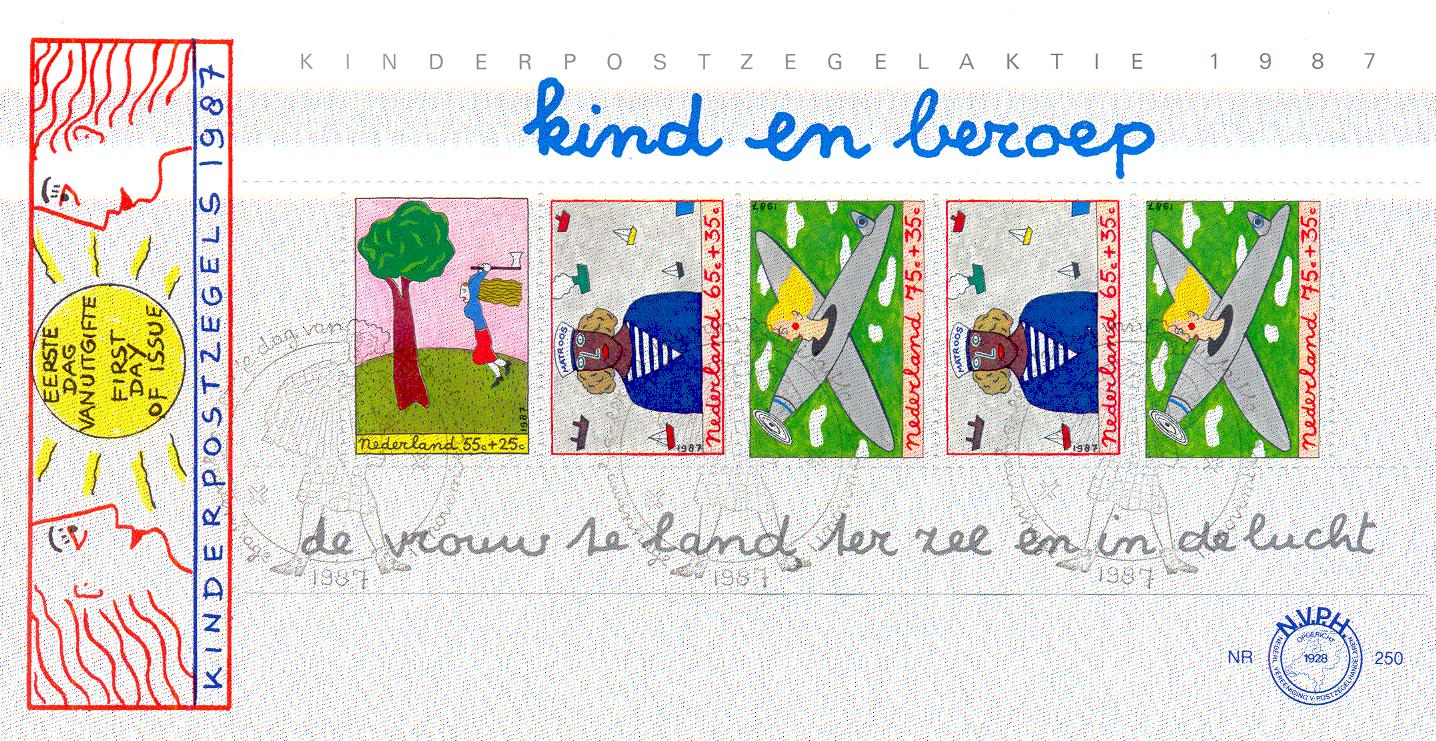
Children’s Stamps – The Girl-child and occupation on land sea and air 11.11.1987

Children’s Stamps – The Girl-child and occupation on land sea and air.

(55+25c) Wood cutter.

(65+35c) Sailor.

(75+35c) Airline Pilot.

Friday, March 31, 2017

Wednesday, March 29, 2017

Monuments of business and technology 7.4.1987

(55+30c) HERTOG REIJNOUT STEAM PUMPING STATION 7.4.1987
The Arkemheense polder is one of the oldest polders in the Netherlands, and for one hundred years, the Hertog Reijnout Steam Pumping Station was responsible for draining it. Even now, the coal-powered steam pumping station is called on to help out when water levels are extreme. The pumping station is open to the public and there is a visitors' centre in the old coal shed.
(75+35c) Foundry for Brass works.

Thursday, March 23, 2017

50th Marriage Anniversary of Princess Juliana and Prince Bernard 6.1.1987

Juliana Louise Emma Marie Wilhelmina; 30 April 1909 – 20 March 2004) was Queen of the Kingdom of the Netherlands from 1948 until her abdication in 1980.
Juliana was the only child of Queen Wilhelmina and Prince Henry. From birth she was heir presumptive to the Dutch throne. She was educated privately. In 1937, she married Prince Bernhard of Lippe-Biesterfeld with whom she had four children: Beatrix, Irene, Margriet, and Christina.
She reigned for nearly 32 years. Her reign saw the decolonization of Dutch East Indies (now Indonesia) and Suriname and their independence from the Kingdom of the Netherlands. Upon her death at the age of 94, she was the longest-lived former reigning monarch in the world.

Saturday, March 18, 2017

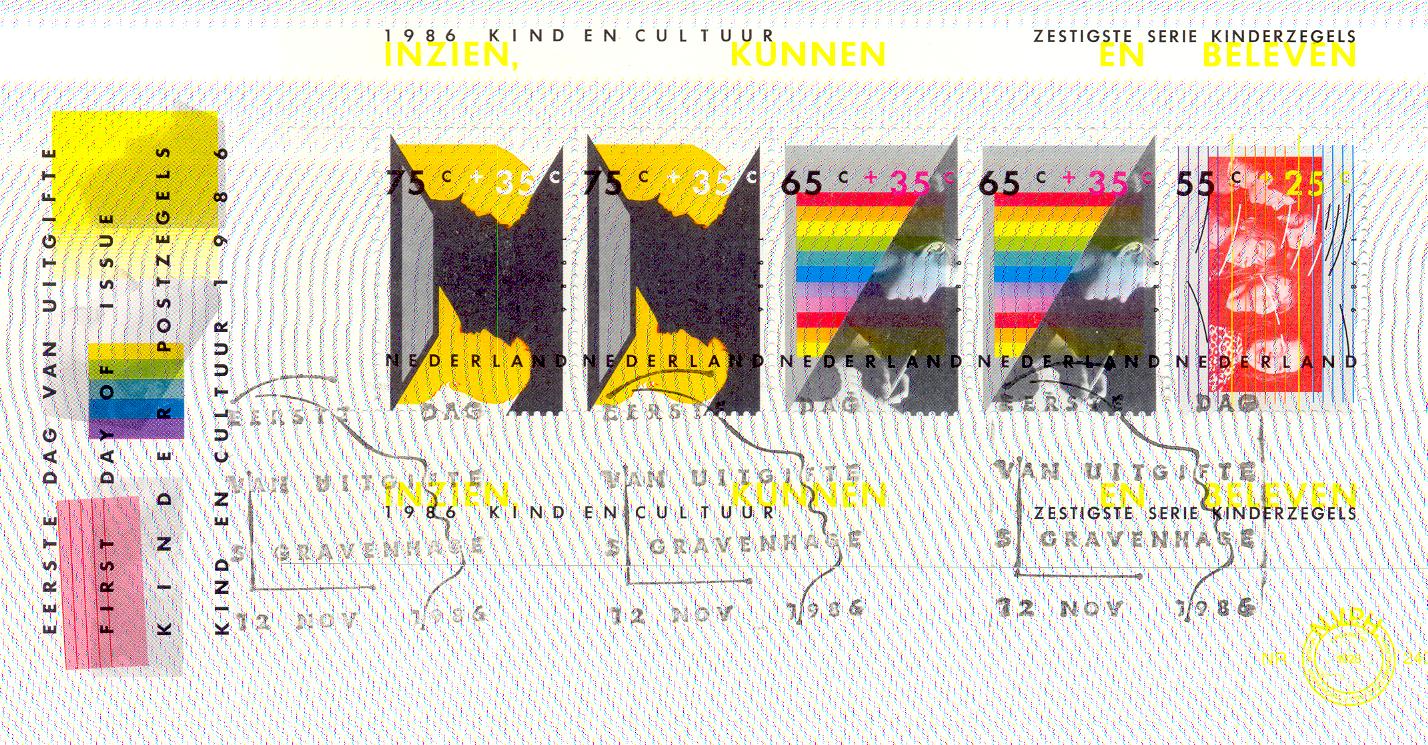
Culture 12.11.1986


(55c) Music and literature "experience".
(65c) Visual arts and architecture "being able to".
(75c) Stage arts "appreciating".

Thursday, March 16, 2017

EUROPA 1986 – Nature 13.5.1986

(50c) Het Loo Palace (meaning "The Woods Palace") is a palace in Apeldoorn, Netherlands. The symmetrical Dutch Baroque building was designed by Jacob Roman and Johan van Swieten and was built between 1684 and 1686 for stadtholder-king William III and Mary II of England. The garden was designed by Claude Desgotz.
The palace was a residence of the House of Orange-Nassau from the 17th century until the death of Queen Wilhelmina in 1962. The building was renovated between 1976 and 1982. Since 1984, the palace is a state museum open for the general public, showing interiors with original furniture, objects and paintings of the House of Orange-Nassau.
(70c) Old Tree.

Tuesday, March 14, 2017

Measuring Instruments 8.4.1986

(50+20c) Weighing scales (or weigh scales or scales) are devices to measure weight or calculate mass. Spring balances or spring scales measure weight (force) by balancing the force due to gravity against the force on a spring, whereas a balance or pair of scales using a balance beam compares masses by balancing the weight due to the mass of an object against the weight of a known mass or masses. Either type can be calibrated to read in units of force such as newtons, or in units of mass such as kilograms, but the balance or pair of scales using a traditional balance beam to compare masses will read correctly for mass even if moved to a place with a different (non-zero) gravitational field strength (but would then not read correctly if calibrated in units of force), while the spring balance would read correctly in force in a different gravitational field strength (but would not read correctly if calibrated in units of mass).
(70+30c) The term Jacob's staff, also cross-staff, a ballastella, a fore-staff, or a balestilha, is used to refer to several things. In its most basic form, a Jacob's staff is a stick or pole with length markings; most staffs are much more complicated than that, and usually contain a number of measurement and stabilization features. The two most frequent uses are:
in astronomy and navigation for a simple device to measure angles, later replaced by the more precise sextants;
in surveying (and scientific fields that use surveying techniques, such as geology and ecology) for a vertical rod that penetrates or sits on the ground and supports a compass or other instrument.
The simplest use of a Jacob's staff is to make qualitative judgements of the height and angle of an object relative to the user of the staff.
Sunday, March 12, 2017

1986 Sexbierum Windmill Test Station Inauguration 4.3.1986

1986 Sexbierum Windmill Test Station Inauguration 4.3.1986

Tuesday, December 13, 2016

1988 FILACEPT Flowers Flora 13.10.1983

Daffodil (Narcissus Cyclamineus "Peeping Tom"). 

Rosa Gallica "Versicolor".

Sea Holly (Eryngium Maritimum).

Wednesday, July 9, 2014

The Christian Institute Effatha 3.10.1988


 The Christian Institute Effatha is a school for the deaf in Zoetermeer onOctober 17 1888 was established as the Christian Institute for the deaf Effatha by Prof. L. Lindeboom, Rev. J. Vonk and Rev. H. Basher.
Prof. L. Lindeboom struggled to find the right teachers to find. The  deaf students were given lessons in his own home. Only in 1891 was Effatha own building  Langebrug 87 in Leiden  . The growth of the number of students Effatha had to move to the former in 1899  orphanage "Bethel" by Rev. Eigeman, the Wolwevershaven to Dordrecht  . The students lived internally. The head of the school and his wife served as house parents. In 1902 Effatha moved to the property "Hainaut" Gravenstraat Dordrecht.
 
In 1926 Effatha bought a large area, Corner Burg and Arentsburg in Voorburg  , for over 100,000 guilders. The 97 students, 10 teachers, the house father and mother and eight servants moved to the new location. There was an auditorium that served as a theater and church. The students were given gifts from donors in Voorburg. Effatha received enough money from the government. Therefore, the foundation "Friends of Effatha" was established to raise funds. Today, this foundation gives money to charities such as schools for the deaf in developing countries.
 
During the Second World War, a coach house Corner Castle was destroyed. A portion of the building Arentsburg also was heavily damaged by a bomb. The auditorium was converted into an emergency hospital for the care of the wounded.

Thank you Maria for this nice Dutch cover.

Sunday, July 14, 2013

100 years of Dutch Criminal Code & Three Centuries of the Normal Amster­dam Level 21.1.1986


This First Day Cover commemorates two things on 21st January 1986. 100 years of Dutch Criminal Code & Three Centuries of the Normal Amster­dam Level 

The stamp on the left(50c) is regarding the 100 years of Dutch Criminal Code of Justice, namely from 1886 to 1986.

The stamp on the Right(60c) is about the three centuries of the Normal Amster­dam Level, or the Amster­dam Ordnance Datum (AOD). Three cen­tur­ies ago a stand­ard ord­nance datum was estab­lished in Ams­ter­dam, based on the aver­age high water mark of the Zuiderzee, which was Amsterdam’s con­nec­tion with the North Sea. This ord­nance datum was – and is – the refer­ral point for all con­struc­tions of any kind in the Neth­er­lands. It was also adop­ted as the stand­ard for the European Union.
The NAP was estab­lished in Ams­ter­dam in the 17th cen­tury. In that cen­tury floods and water­log­ging occurred fre­quently. In 1675 a flood dis­aster ini­ti­ated a huge effort to bet­ter pro­tect vul­ner­able low-lying areas and their inhab­it­ants against floods. The high tide water was hence­forth meas­ured sys­tem­at­ic­ally. Between 1683 and 1684 the high tide water mark was meas­ured daily. The aver­age was called the “Ams­ter­dam level” (acronym A.P.). This aver­age high tide sea level was adop­ted as the zero level (ref­er­ence plane). It was used to improve and where needed to heighten exist­ing dykes and water bar­ri­ers to a safe level. In 1684 the mayor of Ams­ter­dam, Johannes Hudde, had eight marble stones cemen­ted in the sluices around the IJ. Every stone had a hori­zontal groove in the middle with the inscription:
ZEEDIJKSHOOGHTE ZIJNDE  NEGEN VOET VYF DUYM BOVEN STADTSPEYL
(sea dyke height being nine foot five thumbs above town-level).

 Thank you Maria for this nice cover.