Showing posts with label France1961-1970. Show all posts

Saturday, December 24, 2016

“Dancer with a Bouquet” by Edgar Degas 14.11.1970

The stamp on this FDC depicts a painting “Dancer with a Bouquet” by Edgar Degas.
In this painting investigation of light, form, and movement, footlights set aglow a young dancer with a bouquet at centre stage. Behind her stand two groups of ballerinas, who are depicted with lengthy passages of bright orange, blue, and green pastel punctuated by the occasional dot of a bright flower. As a foil to these brilliant colors, Degas bathed the immediate foreground—-a balcony with spectator—-in shadowy brown and black gouache. The spectator’s blue earring relates the foreground to the vibrantly hued passages of the stage. Degas began this composition with a monotype and then covered it with pastel. He affixed a strip of paper at the sheet’s lower edge in order to add the figure and her dramatic fan, which leaves one to wonder if they were compositional afterthoughts.

Edgar Degas (19 July 1834 – 27 September 1917) was a French artist famous for his paintings, sculptures, prints, and drawings. He is especially identified with the subject of dance; more than half of his works depict dancers. He is regarded as one of the founders of Impressionism, although he rejected the term, preferring to be called a realist. He was a superb draftsman, and particularly masterly in depicting movement, as can be seen in his rendition of dancers, racecourse subjects and female nudes. His portraits are notable for their psychological complexity and for their portrayal of human isolation.
At the beginning of his career, Degas wanted to be a history painter, a calling for which he was well prepared by his rigorous academic training and close study of classic art. In his early thirties, he changed course, and by bringing the traditional methods of a history painter to bear on contemporary subject matter, he became a classical painter of modern life.

Tuesday, December 20, 2016

François Boucher 10.10.1970

“Diana Returning from Hunting was painted by François Boucher. 

François Boucher (29 September 1703 – 30 May 1770) was a French painter, draughtsman and etcher, who worked in the Rococo style. Boucher is known for his idyllic and voluptuous paintings on classical themes, decorative allegories, and pastoral scenes. He was perhaps the most celebrated painter and decorative artist of the 18th century. He also painted several portraits of his patroness, Madame de Pompadour.

Friday, December 16, 2016

Jean-Baptiste Carpeaux - Le Triomphe de Flore (The Triumph of Flora) 4.7.1970

Jean-Baptiste Carpeaux (11 May 1827 – 12 October 1875) was a French sculptor and painter during the Second Empire under Napoleon III.
He created the Le Triomphe de Flore (The Triumph of Flora). Which is at the South façade of the Pavillon de Flore, Louvre Palace, Paris.
Carpeaux’s first important public commission was to embellish the attic exterior of the Louvre’s Pavillon de Flore with a high relief of the Triumph of Flora, personifying the benefits of the goddess’s realm over spring and plants, and by implication, the benefits of life under the regime of the Second Empire. Numerous clay models of nubile young women led up to the final configuration in limestone.

Thank you Merja.

Monday, December 12, 2016

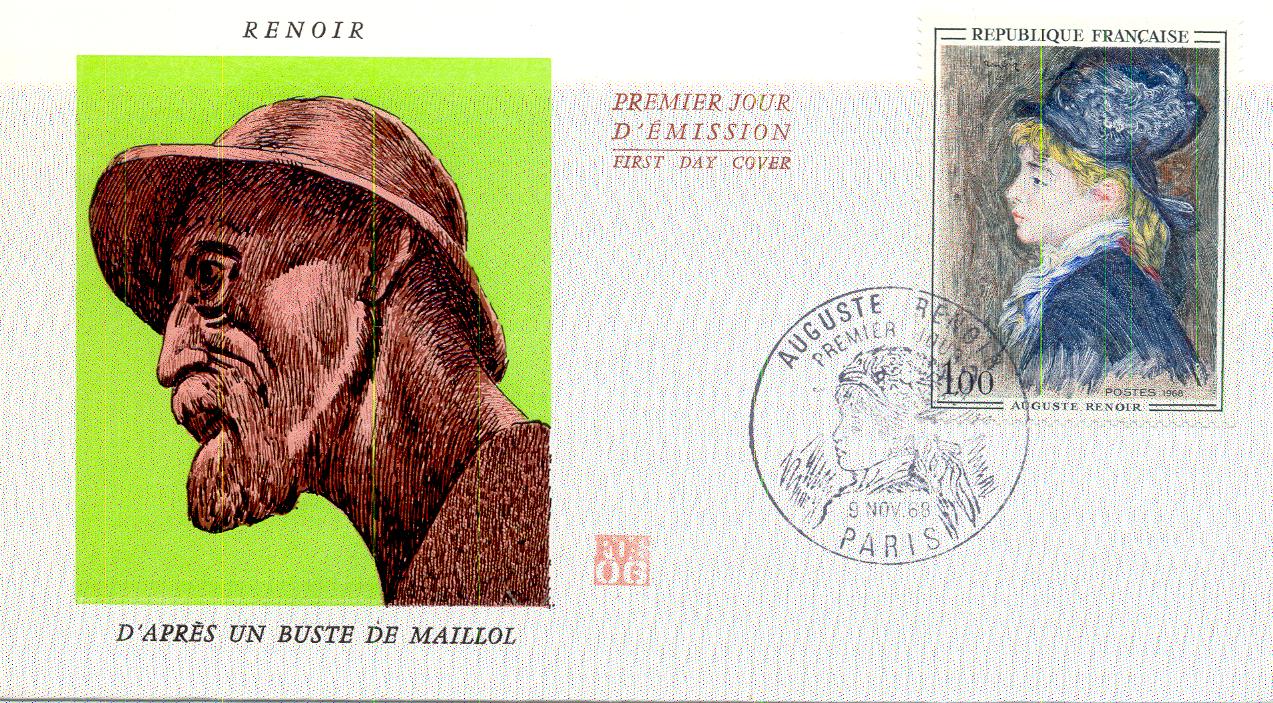
Pierre-Auguste Renoir 5.11.1969

Pierre-Auguste Renoir, commonly known as Auguste Renoir (25 February 1841 – 3 December 1919), was a French artist who was a leading painter in the development of the Impressionist style. As a celebrator of beauty, and especially feminine sensuality, it has been said that "Renoir is the final representative of a tradition which runs directly from Rubens to Watteau."
He was the father of actor Pierre Renoir (1885–1952), filmmaker Jean Renoir (1894–1979) and ceramic artist Claude Renoir (1901–1969). He was the grandfather of the filmmaker Claude Renoir (1913–1993), son of Pierre.
The painting on the stamp is of one of Renoir’s Models.

Thursday, December 8, 2016

Georges Seurat - The Circus 8.11.1969

The Circus (French: Le Cirque) is an oil on canvas painting by Georges Seurat. It was his last painting, made in a Neo-Impressionist style in 1890-91, and remained unfinished at his death in March 1891. The painting is located at the Musée d'Orsay in Paris.
The painting was Seurat's third major work treating the theme of the circus, after his Parade (Circus sideshow) of 1887-88 and Le Chahut of 1889-90. It depicts a female performer standing on a horse at the Circus Fernando (renamed the Circus Médrano in 1890, after its most famous clown). The Circus Médrano was located at the corner of the Rue des Martyrs and the Boulevard de Rochechouart, close to Seurat's studio. It was a popular entertainment in Paris, depicted in the 1880s by other artists such as Renoir (for example, Acrobats at the Cirque Fernando (Francisca and Angelina Wartenberg)), Degas (for example, Miss La La at the Cirque Fernando) and Toulouse-Lautrec (for example, Equestrienne (At the Circus Fernando)).

Sunday, December 4, 2016

Abbey Church of Saint-Savin sur Gartempe 29.6.1969

Known as the 'Romanesque Sistine Chapel', the Abbey-Church of Saint-Savincontains many beautiful 11th- and 12th-century murals which are still in a remarkable state of preservation.

Wednesday, November 30, 2016

Philip the Good 3.5.1969

Philip the Good (31 July 1396 – 15 June 1467) was Duke of Burgundy as Philip III from 1419 until his death. He was a member of a cadet line of the Valois dynasty, to which all the 15th-century kings of France belonged. During his reign, Burgundy reached the apex of its prosperity and prestige and became a leading center of the arts. Philip is known in history for his administrative reforms, his patronage of Flemish artists such as Jan van Eyck and Franco-Flemish composers such as Gilles Binchois, and the capture of Joan of Arc. In political affairs, he alternated between alliances with the English and the French in an attempt to improve his dynasty's position. As ruler of Flanders, Brabant, Limburg, Artois, Hainaut, Holland, Zeeland, Friesland and Namur, he played an important role in the history of the Low Countries.

Saturday, November 26, 2016

1969: Concorde flies for the first time 2.3.1969

The supersonic airliner, Concorde, made a "faultless" maiden flight on 2ndMarch 1969.. 
The Anglo-French plane took off from Toulouse and was in the air for just 27 minutes before the pilot made the decision to land.
The first pilot, Andre Turcat, said on his return to the airport: "Finally the big bird flies, and I can say now that it flies pretty well."
The test flight reached 10,000ft (3,000m), but Concorde's speed never rose above 300mph (480kph). The plane will eventually fly at a speed of 1,300mph (2,080kph).
Mr Turcat, his co-pilot and two engineers taxied to the end of the runway at about 1530GMT. Strong winds meant the test flight was in doubt for much of the day.

Tuesday, November 22, 2016

The Cathedral Basilica of Our Lady of Amiens 22.2.1969

The Cathedral Basilica of Our Lady of Amiens (French: Basilique Cathédrale Notre-Dame d'Amiens), or simply Amiens Cathedral, is a Roman Catholic cathedral and seat of the Bishop of Amiens (currently Jean-Luc Bouilleret). It is situated on a slight ridge overlooking the River Somme in Amiens, the administrative capital of the Picardy region of France, some 120 kilometres (75 miles) north of Paris. It is the 19th largest church in the world.
The cathedral was built between 1220 and c.1270 and has been listed as a UNESCO World Heritage Site since 1981. Although it has lost most of its original stained glass, Amiens Cathedral is renowned for the quality and quantity of early 13th-century Gothic sculpture in the main west façade and the south transept portal, and a large quantity of polychrome sculpture from later periods inside the building.
Thank you Merja.

Friday, November 18, 2016

“The Dance” Sculpture by Antoine Bourdelle (1861-1929) 26.10.1968

Antoine Bourdelle (30 October 1861 – 1 October 1929), born Émile Antoine Bordelles, was an influential and prolific French sculptor, painter, and teacher.
His studio became the Muee Bourdelle, an art museum dedicated to his work, located at 18, rue Antoine Bourdelle, in the 15th arrondissement of Paris, France.
Thank you Merja.

Monday, November 14, 2016

French Annexation of Corsiva 5.10.1968

The French conquest of Corsica took place during 1768 and 1769 when the Corsican Republic was occupied by French forces under the command of the Comte de Vaux.
France received de jure control of the island of Corsica as a pledge from the Genoese Republic via the Treaty of Versailles in 1768. Genoa still claimed ownership of the island, although since 1755, Corsicans had achieved virtual independence and had written a Corsican Constitution (in Italian). After abandoning any hope of recovering Corsica by force, the Genoese chose to sell their rights over the island to France who were keen to gain new territory to replace territory lost during the Seven Years' War.
France's initial offensive failed after a significant defeat was suffered at the Battle of Borgo in October 1768. France dispatched large numbers of reinforcements, swelling the size of their army there to 24,000. The Corsican army suffered a major setback at the Battle of Ponte Novu and the French forces soon overran the island although Corsican forces were not completely subdued until the following year and sporadic outbreaks of rebellion continued.
The French invasion triggered the Corsican Crisis in British politics. Although they sent secret aid to the Corsicans, the British government chose not to act to prevent the island's occupation. The leader of the Corsican Republic, Pasquale Paoli, went into exile in Britain where he remained until the French Revolution allowed him to return to Corsica. British troops subsequently intervened in Corsica between 1794–1796, where they created the Anglo-Corsican Kingdom, and in 1814 when they agreed the Treaty of Bastia. Following the Congress of Vienna control of the islands were returned to the restored French monarchs.

Thursday, November 10, 2016

Nicolas Mignard - Paintings "Autumn"& "Spring" - Red Cross 14.12.1968

Nicolas Mignard (1606–1668) was a French painter. He spent most of his active life in Avignon and was the older brother of Pierre Mignard, and the father of Pierre II Mignard.
Mignard’s spending most of his life in Avignon made his career somewhat overshadowed by his younger brother Pierre, who was installed in Paris. After his death, paintings by Nicolas Mignard mostly stayed in Avignon or in small cities around Avignon. During the French Revolution, as these paintings were taken over, most of them were attributed to Pierre Mignard.
His art is now rediscovered. His style is typical of the Italianate classicizing aesthetic that dominated seventeenth-century France, and obviously was very much influenced by French classical Baroque painter Poussin.
Nicolas Mignard died in 1668 in Paris.

Saturday, October 29, 2016

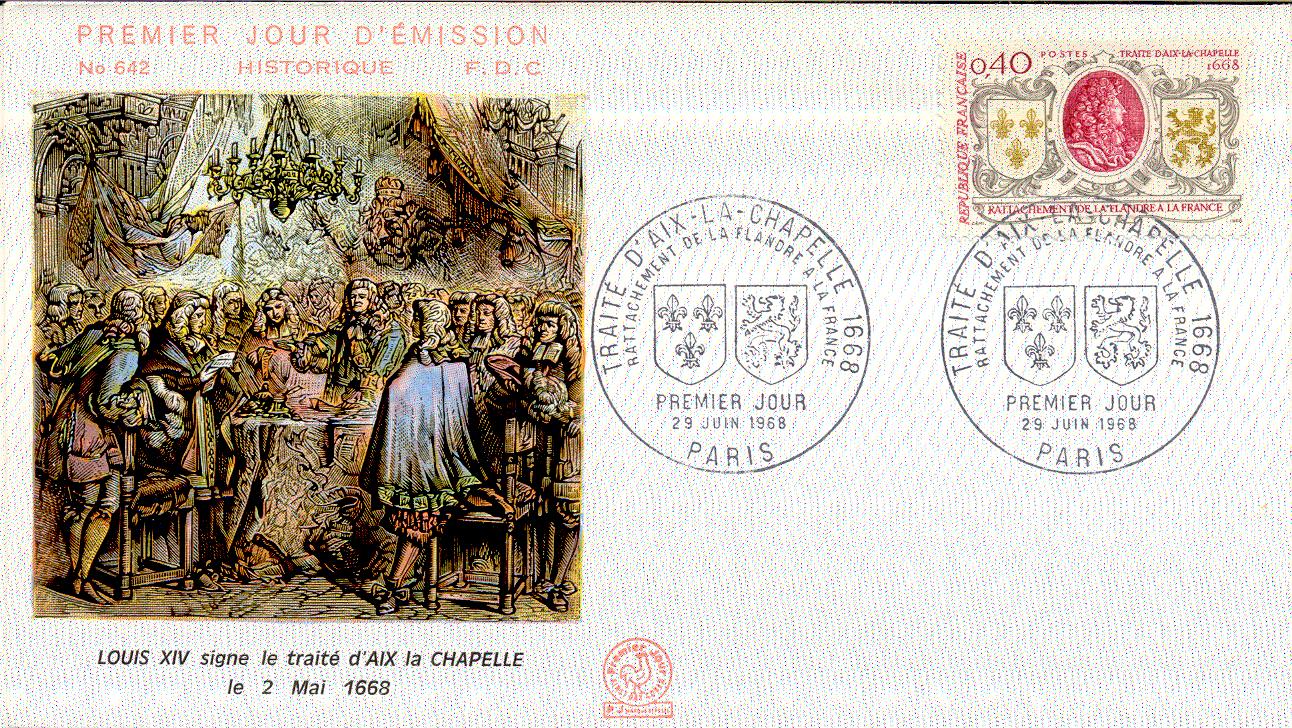
The Treaty of Aix-la-Chapelle or Aachen 29.6.1968

The Treaty of Aix-la-Chapelle or Aachen ended the war of Devolution between France and Spain. It was signed on 2 May 1668 in Aachen(French: Aix-la-Chapelle). Spain acceded on 7 May 1669.
The treaty was mediated and guaranteed by the Triple Alliance of England, the Dutch Republic and Sweden at the first Congress of Aix-la-Chapelle. France was forced to abandon its war against the Spanish Netherlands.

Tuesday, October 25, 2016

650th anniversary of the enclave Valréas (Vaucluse) 25.5.1966

The canton of Valréas, sometimes called the enclave des Papes ("Enclave of the Popes"), is a canton of the Vaucluse département, a part of the Provence-Alpes-Côte d'Azur (PACA) région in southern France. It consists of 4 communes: Grillon, Richerenches, Valréas and Visan. From 1305 to 1378, the Popes lived in Avignon, in what is now France, and were under the influence of the French kings. During this period, known as the Avignon Papacy, the city of Avignon and the adjacent Comtat Venaissin were added to the Papal States.

In 1316, a sickly man, whose reign as Pope one hoped would be short, was chosen by the Cardinals. Pope John XXII surprised them; he died at the age of 89 after 18 years of pontifical reign. All of this, so the story goes, thanks to the excellent wines of the Valreas region. When he had travelled through Valreas, he liked the wine so much that, in 1317, he purchased the estate of Valreas. Pope Clement VI later added the villages of Visan, Grillon and Richerenches. The Enclave des Papes was born.

Papal control persisted until the French Revolution; in 1791, an unauthorized plebiscite was held, and the inhabitants voted for annexation by France. The papacy did not, however, recognise this formally until 1814. The Enclave des Papes was incorporated first into the département of Drôme but was later joined to the département of Vaucluse.

Thank you Merja.

Friday, October 21, 2016

Pierre Athanase Larousse (October 23, 1817 – January 3, 1875) was a French grammarian, lexicographer and encyclopaedist.  He published many of the outstanding educational and reference works of 19th-century France, including the 15 volume Grand dictionnaire universel du XIXe siècle.

Monday, October 17, 2016

Lascaux (Lascaux Caves) 11.4.1968

Lascaux (Lascaux Caves) is the setting of a complex of caves in southwestern France famous for its Paleolithic cave paintings. The original caves are located near the village of Montignac, in the department of Dordogne. They contain some of the best-known Upper Paleolithic art. These paintings are estimated to be circa 17,300 years old. They primarily consist of images of large animals, most of which are known from fossil evidence to have lived in the area at the time. In 1979, Lascaux was added to the UNESCO World Heritage Sites list along with other prehistoric sites in the Vézère valley.
Thank you Merja for this historical fdc.

Thursday, October 13, 2016

St-Madeleine-Church-at-Troyes 7.10.1967

The stamp shows a Stained-glass-window-of-St-Madeleine-Church-at-Troyes.
From the outside, this church is not imposing. But when you enter, you will see straight ahead why it is well worth a visit. Ste-Madeleine holds one of the last intact rood screen in the world and it is stunning. Rood screens, which the Catholic Church began removing in the 17th century, were elaborate iron, wood or marble constructions designed to separate the sanctuary from the nave visually and physically. The idea was that the altar was too sacred to allow common people to approach it. As a result of the Catholic Counter-Reformation, this concept fell into well-deserved disfavor. Unfortunately, instead of just removing these wonders and putting them somewhere else, most all of them were just destroyed by being parceled out for the sculptures, metals, whatever. The Crucifixes at the top of the screens, however, were usually reinstalled behind or above the altars. The rood screen at Ste-Madeleine is just about the height of late Medieval or early Renaissance art.
Thank you Merja for this nice cover.

Wednesday, October 5, 2016

Jean Clouet 1.7.1967

Jean Clouet was undoubtedly a very skillful portrait painter, although no work in existence has been proved to be his. He painted a portrait of the mathematician Oronce Finé in 1530, when Fine was thirty-six years old, but the portrait is now known only by a print. Jean is generally believed, however, to have been responsible for a very large number of the wonderful portrait drawings now preserved at Chantilly, and at the Bibliothèque Nationale, and to him is attributed the portrait of an unknown man at Hampton Court, that of the dauphin Francis, son of Francis I at Antwerp, and one other portrait, that of Francis I in the Louvre.

Saturday, October 1, 2016

Albert Camus 24.6.1967

Albert Camus (7 November 1913 – 4 January 1960) was a French philosopher, author, and journalist. His views contributed to the rise of the philosophy known as absurdism. He wrote in his essay The Rebel that his whole life was devoted to opposing the philosophy of nihilism while still delving deeply into individual freedom. He won the Nobel Prize in Literature in 1957.
Camus did not consider himself to be an existentialist despite usually being classified as a follower of it, even in his lifetime. In a 1945 interview, Camus rejected any ideological associations: "No, I am not an existentialist. Sartre and I are always surprised to see our names linked...".
Camus was born in French Algeria to a Pied-Noir family, and studied at the University of Algiers from which he graduated in 1936. In 1949, Camus founded the Group for International Liaisons to "denounce two ideologies found in both the USSR and the USA".

Friday, September 30, 2016

Alberto Giacometti 7.12.1965

Alberto Giacometti (10 October 1901 – 11 January 1966) was a Swiss sculptor, painter, draughtsman and printmaker. He was born in the canton Graubünden's southerly alpine valley Bregaglia, as the eldest of four children to Giovanni Giacometti, a well-known post-Impressionist painter. Coming from an artistic background, he was interested in art from an early age.