Showing posts with label Animals. Show all posts

Monday, April 3, 2017

Sunday, April 2, 2017

The Monaco International Dog Show 1.3.2005

The Monaco International Dog Show
The Monaco Dog Show, under the patronage of H.S.H. Prince Rainier and officially titled Exposition Canine Internationale, is usually held during the last week of March or the first week of April at Monaco’s Espace Fontvieille. 

Tuesday, March 28, 2017

Family pet animals 22.4.2006


Children and even adults love the pets depicted on the stamps affixed to this FDC, namely puppies and kittens.


Tuesday, February 21, 2017

The Bialowieza Forest 26.11.2005

The Bialowieza Forest in Poland, located between the Baltic Sea and the Black Sea, is one of the largest forests in Europe. It is one of the last and largest remaining parts of the immense primeval forest that once stretched across the European Plain. The forest is home to 800 European bison, Europe's heaviest land animal. UNESCO’s Man and the Biosphere Programme (MAB) designated the Polish Biosphere Reserve Białowieża in 1976 and the Belarusian Biosphere Reserve Belovezhskaya Puschcha in 1993. In 2015, the Belarusian Biosphere Reserve occupied the area of 216,200 ha (2,162 km2; 835 sq mi), subdivided into transition, buffer and core zones. The forest has been designated a UNESCO World Heritage Site and an EU Natura 2000 Special Area of Conservation. The World Heritage Committee by its decision of June 2014 approved the extension of the UNESCO World Heritage site “Belovezhskaya Pushcha/Białowieża Forest, Belarus, Poland”, which became “Białowieża Forest, Belarus, Poland”. It straddles the border between Poland (Podlaskie Voivodeship) and Belarus (Brest and Grodno voblasts), and is 70 kilometres (43 miles) north of Brest, Belarus and 62 kilometres (39 miles) southeast of Białystok, Poland. The Białowieża Forest World Heritage site covers a total area of 141,885 ha (1,418.85 km2; 547.82 sq mi). Since the border between the two countries runs through the forest, there is a border crossing available for hikers and cyclists.

Friday, January 27, 2017

The Greyhound 17.3.2008

This post is surely for dog lovers! The Greyhound is a breed of dog, a sighthound, which has been bred for coursing game and Greyhound racing. Since the rise in large-scale adoption of retired racing Greyhounds, it is seen as a resurgence in popularity as a family pet.

Saturday, March 5, 2016

A Century of Service: Animals in War

In the lead-up to Remembrance Day 2015, Australia Post commemorated the valour and sacrifice made by countless animals during Australia's involvement in war with the release a new stamp issue.
Australia Post Philatelic Manager, Michael Zsolt said: "For over a century, in times of conflict we have relied on animals for transport, logistics, communications and companionship. This stamp issue is the second in a five-year program of military-themed stamps. We trust all Australians and especially animal lovers will take the time to reflect on the extraordinary animals which have served our nation."
Designed by Lisa Christensen of the Australia Post Design Studio, the issue comprises five domestic base rate (70c) stamps featuring:

Mules and donkeys have been vital pack animals in situations of war. The most famous are Simpson's donkeys, who carried first aid and wounded soldiers during the Gallipoli campaign in World War I. The featured photograph used in the stamp design shows a mule and soldier of the 26th Australian Infantry Brigade in Syria in 1942. Photograph: Australian War Memorial.
Dogs have also been indispensable, being used to carry messages, ammunition and medical equipment as well as locate wounded men and enemy soldiers. The featured photograph used in the stamp design was taken in Afghanistan in 2008 and shows a soldier with his explosive ordnance detection dog.
Horses were used by mounted troops known as the Australian Light Horse, first serving in the second Boer War (1899–1902). Millions of horses, including thousands sent from Australia, died on the Western Front during World War I. The featured photograph used in the stamp design was taken in 1914, and shows the original First Light Horse Regiment at Roseberry Park Camp, near Merriwa, NSW, before departure from Australia. Photograph: Australian War Memorial.
Pigeons were used by the Allies during both World Wars, although the Australian Corps of Signals Pigeon Service was not established until World War II. Pigeons were extremely useful when communication was very difficult and limited. The featured photograph used in the stamp design was taken in 1943 and shows a soldier of the 5th Australian Pigeon Section, Advanced Land Headquarters Signals, releasing a pigeon after attaching a message in an aluminium container to its leg. Photograph: Australian War Memorial.
Camels served in the Imperial Camel Corps in the Middle East during World War I in their thousands. The featured photograph used in the stamp design was taken in Egypt during World War I and shows a mounted Light Horseman on a fully equipped camel. Photograph: Australian War Memorial.

Thank you Merja for this fine set of Australian maxi cards issued in 2015.

Friday, February 26, 2016

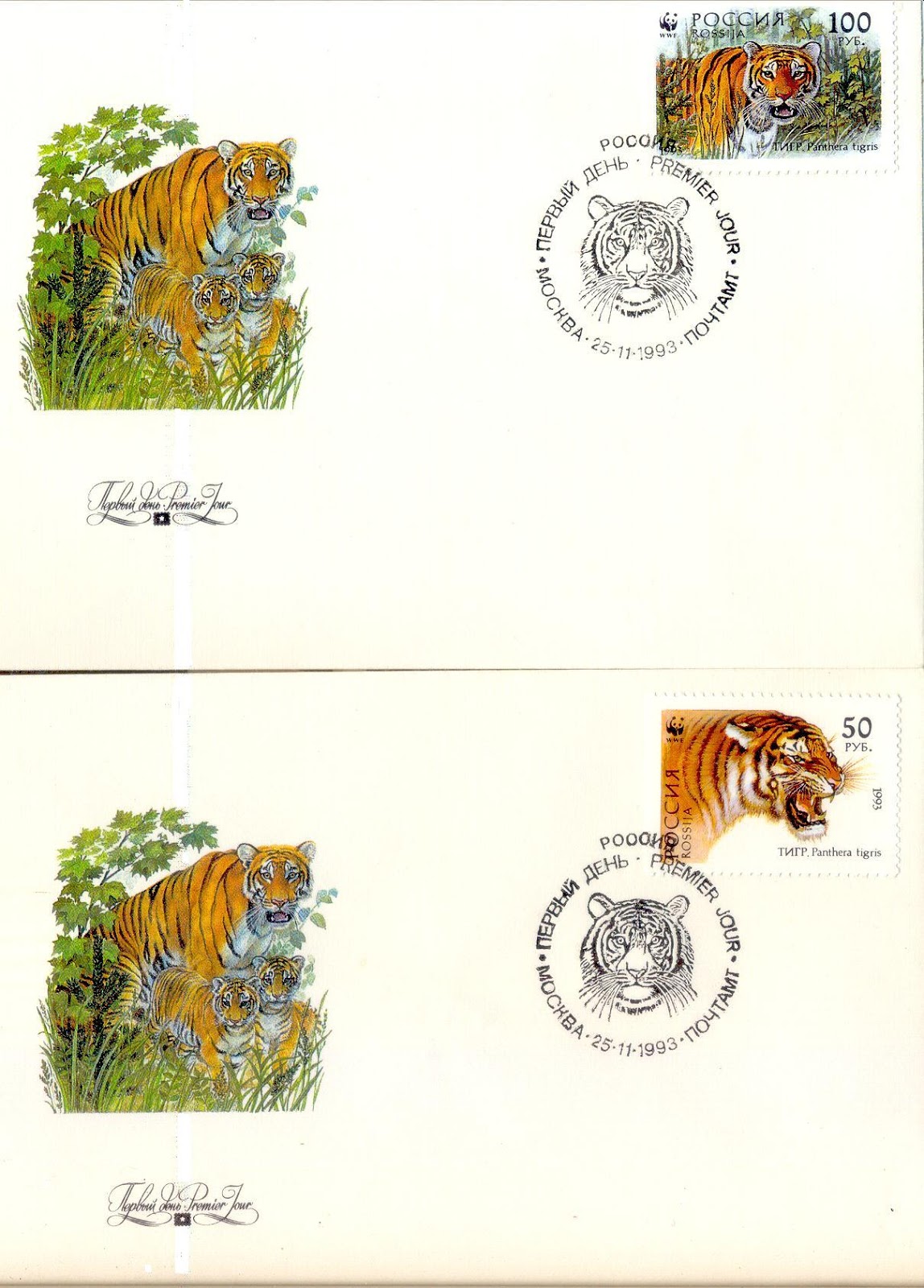
The Siberian tiger 25.12.1993

Add caption

The Siberian tiger (Panthera tigris altaica), also known as the Amur tiger, is a tiger subspecies inhabiting mainly the Sikhote Alin mountain region with a small population in southwest Primorye Province in the Russian Far East. In 2005, there were 331–393 adult and subadult Amur tigers in this region, with a breeding adult population of about 250 individuals. The population had been stable for more than a decade due to intensive conservation efforts, but partial surveys conducted after 2005 indicate that the Russian tiger population was declining. By 2015, the Siberian tiger population has increased to 480–540 individuals in the Russian Far East, including 100 cubs. A more detailed census revealed a total population of 562 wild Siberian tigers in Russia.


The Siberian tiger and Bengal tiger subspecies rank among the biggest living cats. A comparison of data on body weights of Siberian tigers indicates that up to the first half of the 20th century both males and females were on average heavier than post-1970 ones. Today's wild Siberian tigers are lighter than Bengal tigers. Their reduced weight as compared to historical Siberian tigers may be due to a combination of causes: when captured, they were usually sick or injured and involved in a conflict situation with people.

Thank you Merja.

Wednesday, January 13, 2016

50th Anniversary of the World Wildlife Fund

The World Wide Fund for Nature (WWF) is an international non-governmental organization founded on April 29, 1961, working in the field of the biodiversity conservation, and the reduction of humanity's footprint on the environment. It was formerly named the World Wildlife Fund, which remains its official name in Canada and the United States.
It is the world's largest conservation organization with over 5 million supporters worldwide, working in more than 100 countries, supporting around 1,300 conservation and environmental projects. WWF is a foundation, with 55% of funding from individuals and bequests, 19% from government sources (such as the World Bank, DFID, USAID) and 8% from corporations in 2014.
The group's mission is "to stop the degradation of the planet’s natural environment and to build a future in which humans live in harmony with nature." Currently, much of its work focuses on the conservation of three biomes that contain most of the world's biodiversity: oceans and coasts, forests, and freshwater ecosystems. Among other issues, it is also concerned with endangered species, sustainable production of commodities and climate change.

Saturday, December 12, 2015

crustacians, animals and birds of Liechstenstein 11.3.1976

These lovely stamps from Liechstenstein show some rare crustacians, animals and birds. They are:-
(25)Astacus. meaning "lobster" or "crayfish" is a genus of crayfish found in Europe and western Asia, comprising three extant and four extinct species.
Due to the American crayfish plague, crayfish of this genus have been almost wiped out in Europe and have in many European countries been replaced by the North American signal crayfish, which is often more resistant to the plague.
(40) The European pond turtle (Emys orbicularis), also called the European pond terrapin, is a long-living freshwater species of turtle.
(70) The European otter (Lutra lutra), also known as the Eurasian otter, Eurasian river otter, common otter and Old World otter, is a European and Asian member of the Lutrinae or otter subfamily, and is typical of freshwater otters.
(80) The Northern lapwing (Vanellus vanellus), also known as the peewit, pewit, tuit or tew-it (imitative of its cry), green plover (emphasising the colour of the plumage) or (in the British Isles) just lapwing (which refers to its peculiar, erratic way of flying), is a bird in the lapwing family. It is common through temperate Eurasia.

Monday, November 2, 2015

Endangered Australian Animals 15.7.1981


(5c) The southern hairy-nosed wombat (Lasiorhinus latifrons) is one of three species of wombats. It is found in scattered areas of semiarid scrub and mallee from the eastern Nullarbor Plain to the New South Wales border area. It is the smallest of all three wombat species. The young often do not survive dry seasons. It is the state animal of South Australia.
Shown on the FDC is The thylacine (Thylacinus cynocephalus, Greek for "dog-headed pouched one") was the largest known carnivorous marsupial of modern times. It is commonly known as the Tasmanian tiger (because of its striped lower back) or the Tasmanian wolf. Native to continental Australia, Tasmania and New Guinea, it is believed to have become extinct in the 20th century. It was the last extant member of its family, Thylacinidae; specimens of other members of the family have been found in the fossil record dating back to the late Oligocene.
The thylacine had become extremely rare or extinct on the Australian mainland before British settlement of the continent, but it survived on the island of Tasmania along with several other endemic species, including the Tasmanian devil.
(25c) The greater bilby (Macrotis lagotis), often referred to simply as the bilby since the lesser bilby (Macrotis leucura) became extinct in the 1950s, is an Australian species of nocturnal omnivorous animal in the Peramelemorphia order. Other vernacular names include dalgytepinkie, or rabbit-eared bandicoot. Greater bilbies live in arid areas of central Australia. Their range and population is in decline.
(30c) The bridled nail-tail wallaby (Onychogalea fraenata), also known as the bridled nail-tailed wallaby,bridled nailtail wallabybridled wallabymerrin, and flashjack, is an endangered species of macropod. It is a small wallaby found in three isolated areas in Queensland, Australia, and whose population is declining. The total population of the species is currently estimated to be less than 1,100 mature individuals in the wild.
(50c) Leadbeater's possum (Gymnobelideus leadbeateri) is a critically endangered possum largely restricted to small pockets of Alpine Ash, Mountain Ash and Snow Gum forests in the Central Highlands of Victoria (Australia) north-east of Melbourne. It is primitive, relict, and non-gliding, and, as the only species in the petaurid genus Gymnobelideus, represents an ancestral form. Formerly, Leadbeater's possums were moderately common within the very small areas they inhabited; their requirement for year-round food supplies and tree-holes to take refuge in during the day restricts them to mixed-age wet sclerophyll forest with a dense mid-story of Acacia. The species was named after John Leadbeater, the then taxidermist at the Museum Victoria. They also go by the common name of fairy possum. On 2 March 1971, the State of Victoria made the Leadbeater's possum its faunal emblem.
(55c) The greater stick-nest rathouse-building rat (Leporillus conditor) is a species of rodent in the family Muridae. It is found only in Australia on the Franklin Islands and St Peter Island in the Nuyts Archipelago, Reevesby Island, Salutation Island, Faure Island and Heirisson Prong, and a fenced off area at Roxby Downs in South Australia. It was formerly widespread in semi-arid habitat on the mainland, where the soils were shallow with calcereous underlying strata.
It measures 32 to 44 cm in total length, weigthing 180 to 450 g. Its natural habitat is dry savanna.

Friday, October 16, 2015

Hunting Dogs of Åland 3.9.2015

This year’s stamp booklet from Åland Post issued on 3rd September presents the hunting dog species Finnish Hound, Grey Norwegian Elkhound and Wire-haired Dachshund, three species commonly used by hunters in Åland. Hunting is a popular leisure-time activity in .

Bred in Finland since the end of the 1800s for hunting fox and hare, the Finnish Hound is a distinct hunting dog which is still most common in Finland. It is a dog that pursues the quarry with passionate barking.

The Grey Norwegian Elkhound’s object in the hunt is to hold the elk at bay – jumping in and out toward the elk, distracting its attention while signalling to the hunters by barking very loudly – until the hunter can arrive to shoot it. This type of dog is mainly used for hunting elk.

The Wire-haired Dachshund is a versatile hunting dog used to scent, chase and flush out small game and roe deer. This species of dog is also often used when searching wounded game.

The number of hunters in Åland is one of the highest in Europe with some 12 % of the Åland population obtaining a hunting licence every year. The most common type of game is roe deer, but also elk, hare, deer, European pine marten and fox may be hunted all year round or during parts of the year.

The stamp booklet is complemented by three maximum cards with a special postmark showing a dog track.  

Friday, June 12, 2015

Cats 4.5.2006


By the way, this 2006 FDC on Cats was given to me by Ari and his cat Pipo from Finland. Thank you Dear friends.

Saturday, November 22, 2014

Miniature sheet featuring Åland sheep 5.11.2014


Following an interesting co-operation between Åland Post and Postage Stamp Printing Bureau of China Post Group it is now time for the issue of the miniature sheet featuring Åland sheep. 

For several years, well-known stamp engraver Martin Mörck has instructed Chinese youth in the time-consuming craft of producing an engraved stamp. Initiated by Åland Post, the final exam for the trainees was the participation in a design competition designated to produce two hand-engraved, steel-printed stamp motifs for a miniature sheet featuring the species Åland sheep.  

The miniature sheet was issued on 5th November 2014 in both Åland and China. In addition to the miniature sheet, a first day cover and two maximum cards featuring the Åland sheep were available. In connection with the printing, a numbered edition of 5000 exquisite black prints of the engraving has also been produced. A limited 2000 black prints are sold as signed by the engravers. Since 2015 is the Year of the Sheep according to the Chinese zodiac, our choice of motif for the miniature sheet was sheep.

Ella thank you very much indeed for this wonderful FDC.

Thursday, July 10, 2014

Summer Cat 31.5.2014

Buoyant, energetic, sly and pleasure seeking. Ammi Krogius’ animals always have human qualities. On this year’s summer stamp, Ammi has featured a cat with a fishing rod, fishing for dinner. 
"This motif came out of a sensation of sitting on a rock, angling. I was thinking of how much I enjoy the Åland archipelago”, Ammi explains.
Ammi Krogius is a trained ceramist and, together with her husband, she previously ran a pottery for 25 years in Provence. Since 1999, however, she resides in Mariehamn, and the animals that previously took form in clay can now be seen in her paintings.
"I find it difficult to limn people. Instead, I feature animals and give them human qualities,” Ammi explains. She sees her style as somewhat naïve and finds inspiration using her own imagination.“I want my paintings to tell a story, but it must be a positive story, not a sad one. This time, I chose a cat; I like cats. They are bon vivants, sly and wise, indeed, many of their qualities remind very much of us.”

Thank you Ella, for this lovely fdc.

Sunday, May 18, 2014

Reindeer and the Sleigh

The stamp on this fdc is one of three definitives. This one depicts the drawing of Jens Wurtzmann who is also acknowledged on the postmark. The drawing is titled Reindeer and the Sleigh.

The stamp was designed by  Jens Christian Rosing (July 28, 1925 – May 24, 2008), who was a Greenlandic artist notable for designing the coat of arms of Greenland, many Greenlandic postage stamps, as well as illustrated children's books and water colours. Rosing was known as the number one stamp designer for Greenland. Throughout his 50 year career, Rosing produced 130 stamp designs, and his first design was produced in the 1950s. The first design was a commemorative stamp for Greenland. It had a scene featured on it from the Mother of the Sea. There are two versions of the stamp. The first stamp was printed in 1957 in a green-blue colour. The reprint was in 1961, in just a blue colour.

All Greenlandic stamps were printed in only one colour until the 1980s. Beginning in 1985, stamps became printed in offset, or in a combination of offset and recess-type printing. The later versions are brighter. However, they fail to show the appearance of the one colour recess printing stamps.


Thank you Merja.

Tuesday, April 23, 2013

Celebrating the Momentous Arrival of Giant Pandas on Singapore Postage Stamps 6.9.2012

Giant Pandas stamp issue was on 6 September 2012.

This stamp issue was to commemorate the arrival of two pandas, Kai Kai and Jia Jia, on loan to Singapore by China to mark the twentieth anniversary of diplomatic relations between the two countries.

The first day cover is in vertical format. This could be a first as I do not recall any first day cover previously issued in this format by Singapore. 

These two giant pandas began their 10-year stay in Singapore on 6 September 2012. Singapore is the ninth country to receive the loan of giant pandas from China since 1994. 

Artistically illustrated in drawings by local international artiste, Edmund Chen Zhi Cai who is also SingPost’s stamp ambassador, this set of stamps depicts the various poses of Kai Kai and Jia Jia. For example, the S$2 stamp shows Kai Kai and Jia Jia playing with each other. 

First day cover was cancelled with a special Giant Panda postmark specially designed by Edmund’s 12-year-old daughter, Yixin, and the folder cover of the Collectors’ Sheet is designed by his 21-year-old son, Yixi. “It is not easy to draw the pandas. Initially, I could not even differentiate the gender. Although pandas are in black and white, I have found that just for the colour black alone, there are many different shades. It is only through many attempts that I am finally satisfied with my work,” said Edmund. Edmund was also the designer for the Oriental Small-Clawed Otter stamp issue released last year.
                                                                                                                                                       

Monday, February 25, 2013

Health Stamps - New Zealand 1.8.1984

The 1984 Health Stamp Issue of New Zealand issued on 1.8.1984 featured three popular breeds of horses - Clydesdales, Shetlands and Thoroughbreds. The proceeds of the 'Health' value of health stamps were donated to the Children's Health Camps movement.
Two se-tenant stamps depicting a Clydesdales and Shetland Ponies - 24c + 2c x 2
Clydesdales are distinguished by a combination of weight, size and activity, with exceptionally strong feet and limbs.  The history of the Clydesdale breed dates back to the early part of the 18th century.  Flemish stallions were imported into the Clyde valley area in Scotland, in an attempt to increase the size of the native draught horses.
Shetlands are one of the smallest and at the same time one of the strongest members of the equine world.  Their origin is unknown but their existence has been recorded in the Shetland Islands for many centuries.  The Shetland's docile nature and height make it an ideal saddle pony for small children.
Thoroughbred - 30c + 2c
The descriptive name "thoroughbred" is synonymous with racehorses.  All thoroughbreds are reputed to trace their ancestry back to three eastern sires - the Darley Arabian, the Godolphin Barb and the Byerley Turk.  New Zealand's temperate climate is an ideal environment for breeding thoroughbreds and the colour and spectacle of a race day is part of the New Zealand way of life.
Thank you Maria for this pretty FDC with the set of horses’ stamps.

Sunday, February 24, 2013

American Dogs 7.9.1984


These four stamps (one each on the four FDCs), were issued by the United States on September 7, 1984, features eight pedigreed dogsthat represent the types most often bred in the U.S. This stamp issue coincided with the centennial of the American Kennel Club. The following breeds are depicted: Beagle, Boston Terrier, Chesapeake Bay Retriever, Cocker Spaniel, Alaskan Malamute, Collie, Black and Tan Coonhound, and American Foxhound.
Thank you Hemant for this lovely set of FDCs.