
Showing posts with label India. Show all posts
Showing posts with label India. Show all posts
Thursday, March 31, 2016


Monday, March 28, 2016
AIR INDIA First Flight Cover - 1982 BOMBAY- MONTREAL 2.10.1982

AIR INDIA First Flight Cover - 1982 BOMBAY- MONTREAL- BOMBAY AIR INDIA FIRST FLIGHT ON GANDHI JAYANTI.
Thank You Ella.
Thank You Ella.
Saturday, March 5, 2016
The International Fleet Review (IFR) 2016 at Vizag- Bridges of Friendship 6.2.2016

This lovely First Day Cover commemorating The 2nd International Fleet Review (IFR) was given to me by my Dear friend Commodore Bibhu Mohanti.
A Naval Fleet review is a ceremonial and stately inspection of the Naval Warships by the
Supreme Commander of the Armed Forces, the Honourable President. The last
International Fleet Review held off Mumbai in 2001.
The International
Fleet Review (IFR) 2016 was conducted at Vishakhapatnam, Andhra Pradesh from February 5 to February 8, 2016. It
was an International Military Exercise hosted and conducted by Indian Navy on
behalf of the President of India. It's objective was to enhance mutual trust
and confidence with neighbouring navies by inviting their ships to participate in
the event. Indian Navy took this opportunity to display display its maritime
capabilities. The last International Fleet Review by Indian Navy
was conducted in January 2001 at Mumbai.
54 countries participated in IFR2016.
Ships included 24 warships from foreign countries, 24 foreign
Naval chiefs, and 90 foreign delegates.
The Vizag
International Fleet Review 2016 opening ceremony was done by the Chief Minister of Andhra Pradesh, Shri
Chandrababu Naidu on February 4, 2016. The special celebrities who
attend the event were President
Pranab Mukherjee, Governor E.S.L
Narasimhan, Prime Minister Narendra Modi and Shri Manohar Parikkar, Raksha Mantri.
Friday, October 22, 2010
India - A Marvel Of Architecture

Brihadeeswarar Temple is an architectural wonder and reflective of the artistic skills of the erstwhile Chola rulers who ruled peninsular India in the early medieval period. Built by the Chola king Rajaraja I in the 11th century, it is one of the tallest temples in the world. It was so designed that the vimana never casts a shadow at noon. The Brihadeeswarar Temple belongs to the south Indian style of temple architecture: The basic structure of temples in India is a room or the Garbha Griha (sanctum sanctorum) where the idol of the main deity is kept. The temple is approached by a flight of steps and is often built on a platform. A porch covers the entrance to the temples, which is supported by carved pillars. A prominent roof called the shikhara surmounts the top of the Garbha Griha and dominates the surroundings. Gradually, with the passage of time, small temples grew into temple complexes. Thanjavur Brihadeeswara Temple: Thanjavur is "Rice bowl of Tamil Nadu" and a great pilgrim destination of South India. It was the capital of Chola kings who ruled the region during 9th to 13th centuries. Thanjavur is a flourishing centre for bronze sculpture and painting. The temple, dedicated to Nandi, the Bull is a masterpiece of the captivating Chola architecture. The mount of Lord Shiva i.e. Nandi has been made from a single granite rock.
Thanjavur Brihadeeswara Temple is unique to have the tallest tower (216 ft) over the sanctum sanctorum unlike other temples. The Temple, made over a 29 m square base, is surrounded by moat on two sides and Grand Anaicut river on the other side. The compound within its inner wall measures about 500 feet x 250 feet. The walls of the sanctum are adorned with the wall paintings of Chola and Nayak periods. The temple has a soaring vimana and a stunted gopuram. The inner sanctum and the gopuram were constructed over a period of 12 years. It was constructed from a single piece of granite weighing around 80 tonnes. I must thank My friend Kasinath, who designed this wonderful maxicard for sending it to me.
Saturday, March 20, 2010
500th anniversary of Krishna Deva Raya’s coronation

The Vijaynagar Kingdom rose to its highest peak of glory during the reign of Krishna Deva Raya. Not only was he an able administrator and a great warrior, but, he was also a scholar, a poet, a musician and a good king. His subjects loved him, and he even treated his enemies with honour. He is believed to have won all the wars he waged during his rule.
Much information about his reign comes from the accounts of Portuguese travellers Domingo Paes and Fernao Nuniz. Krishna Deva Raya benefited from his able Prime Minister Timmarusu, who was regarded by the king as a father figure and was responsible for his coronation. Krishna Deva Raya was the son of Nagala Devi and Tuluva Narasa Nayaka, an army commander under Saluva Narasimha Deva Raya, who later took control of the empire to prevent its disintegration. The king's coronation took place on the birthday of Lord Krishna, and his earliest inscription is from July 26, 1509 CE. He built a beautiful suburb near Vijayanagara called Nagalapura in memory of his mother. Krishna Deva was the younger brother of Vira Narasimha who defeated the Sulvas to snatch the throne. Krishna Deva succeeded his brother and soon proved his mettle as an able king. He won all the wars he fought and expanded his kingdom. He defeated the king of Orissa and also the Sultan of Bijapur. He defeated the Bahamani ruler Ismail Adil Shah to put an end to the Muslim dominance in Southern India. His empire extended from Cuttack in eastern India to Goa in the west and Raichur Dobe in the north to the Indian Ocean in the south.
During Krishna Deva's reign the European (mainly the Portuguese) traders came to India and he encouraged foreign trade with the visitors. Krishna Deva was a great patron of art, poetry and music. Tenali Ramakrishna - the scholar who was famous for his wisdom, was a prominent member of Krishna Deva's court. He built the famous Vithalswami and Hazara temple in Hampi.
During Krishna Deva's reign the European (mainly the Portuguese) traders came to India and he encouraged foreign trade with the visitors. Krishna Deva was a great patron of art, poetry and music. Tenali Ramakrishna - the scholar who was famous for his wisdom, was a prominent member of Krishna Deva's court. He built the famous Vithalswami and Hazara temple in Hampi.
This Special Cover commemorates the 500th anniversary of Krishna Deva Raya’s coronation. Mr Veeraraghavan sent me this nice philatelic item.
Tuesday, March 2, 2010
UK - India Vs England Cricket Match


75 Years ago this famous cricket match was played between India and England at the Eden Gardens in Calcutta. Bhagyesh Dash got me this First Day Cover and a replica of the score sheet of that match.
Wednesday, January 6, 2010
Ferguson College – Pune


Many of my friends and relatives and some visitors, mainly ex – students of the college wanted more info. Not having studied at these hallowed precincts, I decided to show the full info sheet. Click for an enlarged view.
Tuesday, January 5, 2010
125 years of Fergusson College, Pune

Fergusson College has 125 years of history as the flagship of higher education in Pune. Alma Mater to leaders across the entire spectrum of societal positions: Prime-Ministers, Industrialists, Doctors, Engineers, Academicians, Scientists, Litterateurs, Artistes, and Sportspersons.
Fergusson College is 125 years on 2nd January, 2010.
Wednesday, December 30, 2009
1st World Agriculture Fair

Today is the 50th Anniversary of the First World Agriculture Fair held at the Exhibition Grounds (now called Pragati Maidan) in New Delhi. It was on this Day 50 years ago that the Gates were thrown open to the Public at large. For us younger lot living in India then, this was indeed a very proud moment. For the rest of the World it was a reiteration of the Government Policy of recognizing the fact that India was and is an agricultural country at heart. We urban folk moved around the various stalls, admiring the skills of our farmers in producing grains for the rest of India. The implements used by our farmers was in sharp contrast to the mechanized equipment on display in the stalls of many Western countries. I still maintain that we were proud of what our farmers were doing, despite the obvious disadvantages. It is their effort of those days that have brought India to the brink of Super-Power status today.
Thursday, December 3, 2009
Dr. Rajendra Prasad 1984

Today is the 125th Birth Anniversary of India's 1st President Late Dr. Rajendra Prasad. The Nation pays tribute to this simple man who Graced the Office of President with great Dignity and Humility.
Friday, November 13, 2009
The Sangam Age


This special cover is in commemoration of the Sangam Age and the Maritime Heritage of the Tamil people. Below is a brief description of that Great Period in Indian History.
The Sangam age is one of the greatest periods of tamil Nadu chronology. It might have been produced in the first 3 centuries of the christian era.
Sangam Literature
The most available tamil Work is Tolkappiyam--A work on phonetics and clearly established grammar of Tamil language
Ettuthogai(eight Anthologies)
Pathupattu(ten Idylls)
Pathinenkil kanaku(18 ways of civilization)(this is a post sangam work.
Twin epics
1.Sillapadikaram(talks about ancient madurai city and Metaphor on Women)
2.Manimekali(literature attached with sillapadikaram) talks about Buddhism and Hinduism
Kings during Sangam age
1.the cheras - cheran senguttuvan
2.the cholas - karikalan
3.the pandiyas - Illapervaludi(meaning of name- a person of young and brave)
4. kurunila mannarkal(7 chieftains) were the subordinate kings to the chera, chola, pandiyas. also known as Kadaiyelu vallalkal.
Kingship
1.king is center of administration
2.he had separate identical flag and tree
3.if any king fell down the tree, it symbolizes he wants to have war with that king.
4.more importance to the local govts,ie., decentralized form of governance.
5.there were charismatic, traditional and democratic form of govt.
revenue
1.main source of income was tax
2.1/6th of procuts of land was collected as tax.
3.there was tax exemption also.
4.tributes and court fees were also the sources.
Infrastructure
1.main infrastructure was to tanks and canals
2.cosiderable amount was to education, literature
3.plenty of revenue expended to roads, hospitals and defense
Division of land
the land was divided into 5 types for easy administration, viz,
1.kurinji - hills and forest(hunting place)
2.mullai - pastures and lands(cattle breeding place)
3.marudam - field and plantation(plough cultivation)
4.niethal - seashore(fishing)
5.palai - dry lands(plunder warfare)
(Enlarge the picture on the Right for details of the coins depicted on the cover)
Saturday, October 31, 2009
India - Sardar Vallabhbhai Patel

The Nation salutes this Great son of India. Sardar Vallabhbhai Patel was a patriot and true nationalist par excellence. Today we celebrate this Great Man’s 134th Birth Anniversary.
Saturday, September 5, 2009
Teacher's Day
Today is Teacher’s Day in India. It is observed in memory of our 2nd President Dr. S Radhakrishnan. Dr. S Radhakrishnan was born in the year 1888 in a well-known religious state in Chennai, then called Madras. He was the second son of Veera Samayya, a tehsildar in a zamindari. It was a middle-class, respectable Hindu Brahmin family.
He graduated with a Master's Degree in Arts from Madras University. In partial fulfilment for his M.A. degree, Radhakrishnan wrote a thesis on the ethics of the Vedanta titled "The Ethics of the Vedanta and Its Metaphysical Presuppositions", which was a reply to the charge that the Vedanta system had no room for ethics.
The Origin of Teacher's Day in India
Since 1962, 5th of September has been celebrated as Teacher's Day in India. Dr. Sarvepalli Radhakhrishnan was a philosopher and a teacher par excellence. Some of his students and friends approached him and requested him to allow them to celebrate his birthday. In reply, Dr, Radhakrishnan said, "Instead of celebrating my birthday separately, it would be my proud privilege if September 5th is observed as Teacher's day". The request showed Dr.Radhakrishnan's love for the teaching profession. From then onwards, his birthday is observed as Teacher's Day in India.
In this connection I would like to place before you a First Day Cover and a Brochure issued by the Dept of Posts and Telegraph.
One of the photographs from the brochure is indeed rare as it shows the Past (1st), Present (2nd) and the Future (3rd) President of India.


Saturday, August 15, 2009
India 15.8.1949 - India Two years old
Independent India was Two years old, and I was eight years old. And, that was 60 glorious years ago.

Wednesday, August 12, 2009
China - 1st Anniversary of India's First Individual Olympic Gold Medal
It was indeed a Glorious August 11th 2008 when Abhinav Bindra won for India the first Individual Gold Medal in her Olympic history. This was achieved in Shooting. I was watching it all on TV, and the stunned silence at the end told its own story of how happy we all were. I found a folder of the 2008 Olympic Games and felt it was an appropriate occasion to share it with the sport lovers amongst you.


Thursday, August 6, 2009
SWINE FLU
 (Please Click to Enlarge)
This was published in today's (6th August) Delhi Edition of the Daily Mail. As this issue is far more important than anything concerning Philately, I thought that in public interest I must highlight it on my blog. Any inconvenience caused to the visitors to this blog is deliberate. TAKE CARE.
Tuesday, August 4, 2009
Indo-Soviet Joint Manned Space Flight


This year, namely 2009 is the 25th Anniversary of the Indo-Soviet 1st Space Flight. It was a manned flight and Squadron Leader Rakesh Sharma became the first Indian cosmonaut. Born on 13th January 1949 in Patiala, Sqn Ldr Rakesh Sharma was a test pilot in the IAF. He was selected on 20th September 1982 to become a cosmonaut. In 1984 he became the first citizen of India to go into space when he flew aboard the Russian rocket Soyuz T-11. The take-off from Baikonur in the Soviet Union on April 2, 1984 was a high point in Indo-Soviet relations.
The Soyuz T-11 docked and transferred the three member Soviet-Indian international crew which also included the Ship's Commander Y.V. Malyshev and Flight Engineer G.M. Strekalov (USSR) to the SALYUT-7 Orbital Station. The crew spent seven days aboard the Salyut space station during which they conducted scientific and technical studies, which included 43 experimental sessions. Sharma used Yoga techniques to combat the debilitating effects of weightlessness. His work was mainly in the fields of bio-medicine and remote sensing. The crew held a joint television news conference with officials in Moscow and Prime Minister Indira Gandhi. "Saare jahan se achcha", said Sqn Ldr Sharma when Prime Minister Indira Gandhi asked him how India looked from outer space. That was also a proud moment for millions of Indians who watched India become the 14th nation to send a man to outer space. Sqn Ldr Rakesh Sharma was awarded the Ashoka Chakra, for the successful completion of the Space Mission. As were his Russian companions Malyshev and Strekalov. This is the first and the only time, the Ashoka Chakra was awarded to foreigners.
The Soyuz T-11 docked and transferred the three member Soviet-Indian international crew which also included the Ship's Commander Y.V. Malyshev and Flight Engineer G.M. Strekalov (USSR) to the SALYUT-7 Orbital Station. The crew spent seven days aboard the Salyut space station during which they conducted scientific and technical studies, which included 43 experimental sessions. Sharma used Yoga techniques to combat the debilitating effects of weightlessness. His work was mainly in the fields of bio-medicine and remote sensing. The crew held a joint television news conference with officials in Moscow and Prime Minister Indira Gandhi. "Saare jahan se achcha", said Sqn Ldr Sharma when Prime Minister Indira Gandhi asked him how India looked from outer space. That was also a proud moment for millions of Indians who watched India become the 14th nation to send a man to outer space. Sqn Ldr Rakesh Sharma was awarded the Ashoka Chakra, for the successful completion of the Space Mission. As were his Russian companions Malyshev and Strekalov. This is the first and the only time, the Ashoka Chakra was awarded to foreigners.
You will notice that the Russian First Day Cover has the autographs of the three member Soviet-Indian international crew. I am also displaying the Indian FDC commemorating that historic occasion.
You will also notice the Indian design Sun chariot on the 50k Soviet miniature sheet.
Monday, June 22, 2009
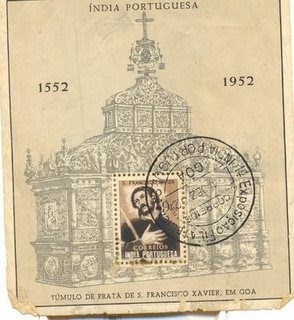
Hi!
I have chosen this particular Miniature Sheet because it’s the oldest one I have. I got it in Panjim, Goa just 15 days after Goa was liberated by the Indian Armed Forces in Dec 1961. I was a cadet then on the training ship the mighty INS Tir. The Mini Sheet depicts the Exposition of St. Francis Xavier in 1952. I believe there are very few of these in circulation. Not even in Portugal.

Subscribe to:
Comments (Atom)