Showing posts with label Relics of the Past. Show all posts

Friday, November 20, 2015

CYPRUS GREECE 4000 YEARS HELLENISM - THE TEMPLE OF APOLLO AT KOURION 28.6.1993


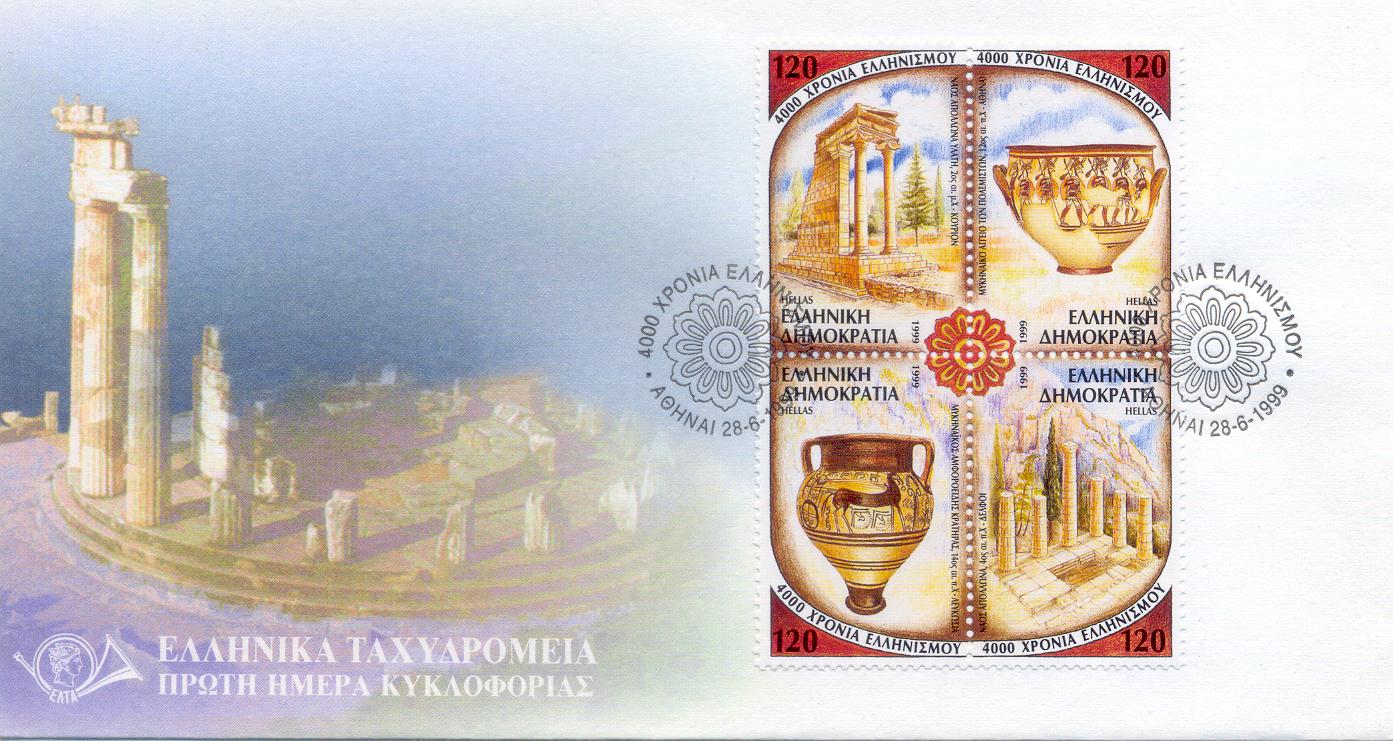
The settlement of the first Greek speaking tribes around 2000B.C. in the area occupied by Greece today is the beginning of a long period of on-going presence of Hellenism on the stage of history. During this period of 4000 years of Greek culture there were important milestones.
The Mycenaean civilization (26th 12th century B.C.) survived in the memory of future generations because of epic poetry. It was a brilliant period of strong kings and heroes, a picture that has been ascertained by archaeological excavations. The Mycenaean Greeks during their period of expansion settled in Cyprus too, another area where Hellenism appeared and continues ever since with unbreakable continuity.
Classical Greece and Athens especially of the 5th century B.C., gave the world together with the incomparable creations of art, speech and intellectualism, everlasting values like democracy, freedom and justice. The conquests of Alexander the Great brought the Greek spirit and civilization to the tour corners of the unknown world at the time.
The Byzantine civilization, the result of the mingling of Hellenism and Christianity - direct continuation of Greco-Roman antiquity - gave to modern Hellenism the basic elements which define its special mark and identity.


Thursday, September 27, 2012

Relics of Ancient Cyprus 3.10.1983


Merja gave me these four FDCs which display a total of 12 stamps, each depicting a relic, way back from the 6thMillenium BC up to a few centuries ago. An interesting aspect of these stamp is that the year printed on them is 1980, but, they were actually released on 3rdOctober 1983, as shown by the postmark on the Covers.
Each of these stamps has two values printed on them. The old value has been struck off. In 1960, when Cyprus was declared independent and the Republic of Cyprus was established, the Cyprus pound became the country’s monetary unit. Initially, the pound was divided into 1.000 mils. In 1983 a new denomination, the cent, was introduced to replace the mil. The numismatic system remained the same as the Cyprus pound continued to be the Republic’s currency, the only difference being its denomination into 100 cent, instead of 1.000 mils. This may perhaps be the reason for the delay in the issue of these stamps.

Tuesday, December 13, 2011

EUROPA - Relics of the Past 3.5.1983


This FDC given to me by Merja has two stamps on it. These Europa stamps were issued by Cyprus on 3.5.1983. One on the left shows a copper ingot, a bronze jug from the Roman period of 2nd century BC and a Copper engraving. The stamp on the right has a Cypro-Syllabic inscription. The Cypro-Syllabic script is, as the name itself indicates, a writing system of a syllabic character found in Cyprus from between the mid 11th c. BC (the Opheltes obelos, ICS2 18g) to the end of the 2nd c. BC It is composed of 56 signs at most, with more or less important local variations in the form of the signs, in the chronology and in the repertory. Almost all the signs, with the exception of ye (present only in the new Paphian syllabary) are found in the most widespread version of the syllabary, known as the “common syllabary”.

Texts written in the common syllabary are usually right to left, and their distribution area is quite large: they can be found in nearly the entire island, with the exception of the south-western region, the Paphos region, characterized by its own peculiar repertory known as the “Paphian syllabary”. This latter, unlike the common syllabary, is usually used in left-to-right texts, and it has its own chronology: the “old Paphian syllabary”, used essentially in texts dating from the 6th c. BC, and the “new Paphian syllabary”, with documents dating above all from the 4th c. BC.
Writing in the Late Bronze Age Writing first appeared in Cyprus around 1500 BC at a time when the island's trading activities brought increased bureaucratic demands. The earliest script was syllabic (each symbol denoting a vowel or a combination of consonant and vowel) and presented obvious similarities to Minoan Linear A. It was probably introduced from Crete and adapted to the needs of the ancient Cypriot language. The script is called Cypro-Minoan but has not been deciphered yet (as is also the case with Linear A). Cypro-Minoan texts have been found on clay tablets at Enkomi in Cyprus and Ugarit in Syria, suggesting that they were used both for administration and commercial transactions. Otherwise, Cypro-Minoan symbols have been occasionally found on clay cylinders (also of administrative use), bronze and ivory objects as well as on clay balls.