Showing posts with label Paintings. Show all posts

Tuesday, April 18, 2017

Vigée-Le Brun, Self-Portrait 12.10.2002

There is an oft-quoted saying mis-attributed to Marie-Antoinette, Queen of France, during a famine suffered by her subjects: If they have no bread, “then let them eat cake.” In fact, this statement (which showed flagrant disregard for the suffering of the people) was never uttered by the Queen that we know from so many sumptuous portraits. These portraits are largely the work of Élisabeth Louise Vigée-LeBrun, a celebrated French artist known especially for her lavish portraits of Marie-Antoinette and other European monarchs and nobles as well as for her many self-portraits.
This particular self-portrait was painted in Rome; one of the first city's in which Vigée-LeBrun stayed during her decade-long exile from France. The artist sits in a relaxed pose at her easel and is positioned slightly off center. She wears a white turban and a dark dress—in the free-flowing style that Marie-Antoinette had made popular at the French court—with a soft, white, ruffled collar of the same material as her headdress. Her belt is a wide red ribbon. Vigée-LeBrun holds a brush to a partially finished work; the subject is probably Marie-Antoinette—perhaps intended as a tribute to her favorite sitter. Slightly used brushes are at the ready along with a palette, she has everything cradled in her arm close to the viewer.
The painting expresses an alert intelligence, vibrancy, and freedom from care. As she painted this portrait, her Queen was being driven from power by revolutionaries who hated the profligate lifestyle of the nobility and would later execute both Marie-Antoinette and her husband, King Louis XVI. Given these circumstances, Vigée-LeBrun—a working painter, wife, and mother—displays an extraordinarily sanguine persona.

Wednesday, March 29, 2017

Paul Cézanne 8.4.2006

Paul Cézanne (19 January 1839 – 22 October 1906) was a French artist and Post-Impressionist painter whose work laid the foundations of the transition from the 19th-century conception of artistic endeavour to a new and radically different world of art in the 20th century. Cézanne's often repetitive, exploratory brushstrokes are highly characteristic and clearly recognizable. He used planes of colour and small brushstrokes that build up to form complex fields. The paintings convey Cézanne's intense study of his subjects.
Cézanne is said to have formed the bridge between late 19th-century Impressionism and the early 20th century's new line of artistic enquiry, Cubism. Both Matisse and Picasso are said to have remarked that Cézanne "is the father of us all."
The stamp depicts The Bathers an oil painting by Paul Cézanne, first exhibited in 1906. The painting is the largest of a series of "Bather" paintings by Cézanne; the others are in the Museum of Modern Art in New York City, National Gallery, London, the Barnes Foundation, Philadelphia, and the Art Institute of Chicago. Occasionally referred to as the Big Bathers or Large Bathers to distinguish it from the smaller works, the painting is considered one of the masterpieces of modern art, and is often considered Cézanne's finest work.


Sunday, March 19, 2017

The Nude in Art 4.12.2009


The nude figure is a tradition in Western art, and has been used to express ideals of male and female beauty and other human qualities. It was a central preoccupation of Ancient Greek art, and after a semi-dormant period in the Middle Ages returned to a central position in Western art with the Renaissance. Athletes, dancers, and warriors are depicted to express human energy and life, and nudes in various poses may express basic or complex emotions such as pathos. In one sense, a nude is a work of fine art that has as its primary subject the unclothed human body, forming a subject genre of art, in the same way as landscapes and still life. Unclothed figures often also play a part in other types of art, such as history painting, including allegorical and religious art, portraiture, or the decorative arts.
The stamp on the FDC depicts Venus.
Thank you Merja.

Monday, February 20, 2017

France – Vatican Joint Issue 10.11.2005


Drawings by Raphael, both preserved in the Louvre Museum in Paris: "St. Catherine of Alexandria" and "Young Draped Man".  

Saturday, December 24, 2016

“Dancer with a Bouquet” by Edgar Degas 14.11.1970

The stamp on this FDC depicts a painting “Dancer with a Bouquet” by Edgar Degas.
In this painting investigation of light, form, and movement, footlights set aglow a young dancer with a bouquet at centre stage. Behind her stand two groups of ballerinas, who are depicted with lengthy passages of bright orange, blue, and green pastel punctuated by the occasional dot of a bright flower. As a foil to these brilliant colors, Degas bathed the immediate foreground—-a balcony with spectator—-in shadowy brown and black gouache. The spectator’s blue earring relates the foreground to the vibrantly hued passages of the stage. Degas began this composition with a monotype and then covered it with pastel. He affixed a strip of paper at the sheet’s lower edge in order to add the figure and her dramatic fan, which leaves one to wonder if they were compositional afterthoughts.

Edgar Degas (19 July 1834 – 27 September 1917) was a French artist famous for his paintings, sculptures, prints, and drawings. He is especially identified with the subject of dance; more than half of his works depict dancers. He is regarded as one of the founders of Impressionism, although he rejected the term, preferring to be called a realist. He was a superb draftsman, and particularly masterly in depicting movement, as can be seen in his rendition of dancers, racecourse subjects and female nudes. His portraits are notable for their psychological complexity and for their portrayal of human isolation.
At the beginning of his career, Degas wanted to be a history painter, a calling for which he was well prepared by his rigorous academic training and close study of classic art. In his early thirties, he changed course, and by bringing the traditional methods of a history painter to bear on contemporary subject matter, he became a classical painter of modern life.

Tuesday, December 20, 2016

François Boucher 10.10.1970

“Diana Returning from Hunting was painted by François Boucher. 

François Boucher (29 September 1703 – 30 May 1770) was a French painter, draughtsman and etcher, who worked in the Rococo style. Boucher is known for his idyllic and voluptuous paintings on classical themes, decorative allegories, and pastoral scenes. He was perhaps the most celebrated painter and decorative artist of the 18th century. He also painted several portraits of his patroness, Madame de Pompadour.

Monday, December 12, 2016

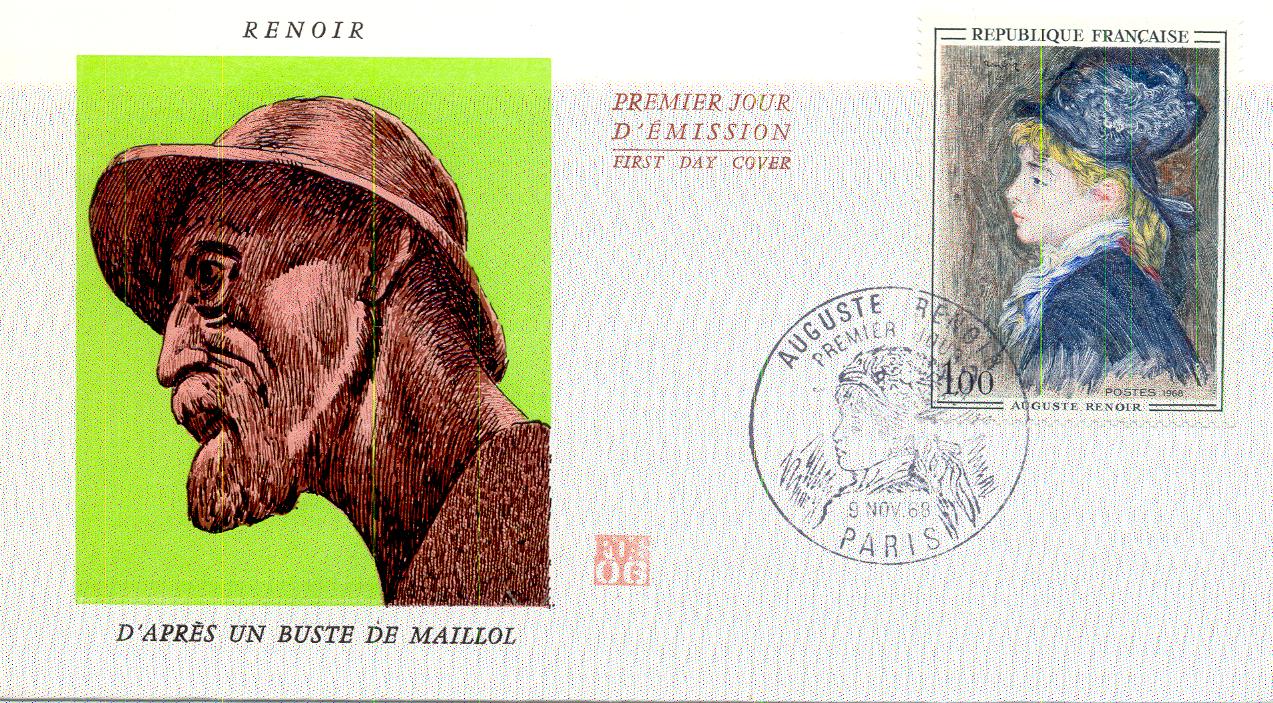
Pierre-Auguste Renoir 5.11.1969

Pierre-Auguste Renoir, commonly known as Auguste Renoir (25 February 1841 – 3 December 1919), was a French artist who was a leading painter in the development of the Impressionist style. As a celebrator of beauty, and especially feminine sensuality, it has been said that "Renoir is the final representative of a tradition which runs directly from Rubens to Watteau."
He was the father of actor Pierre Renoir (1885–1952), filmmaker Jean Renoir (1894–1979) and ceramic artist Claude Renoir (1901–1969). He was the grandfather of the filmmaker Claude Renoir (1913–1993), son of Pierre.
The painting on the stamp is of one of Renoir’s Models.

Thursday, December 8, 2016

Georges Seurat - The Circus 8.11.1969

The Circus (French: Le Cirque) is an oil on canvas painting by Georges Seurat. It was his last painting, made in a Neo-Impressionist style in 1890-91, and remained unfinished at his death in March 1891. The painting is located at the Musée d'Orsay in Paris.
The painting was Seurat's third major work treating the theme of the circus, after his Parade (Circus sideshow) of 1887-88 and Le Chahut of 1889-90. It depicts a female performer standing on a horse at the Circus Fernando (renamed the Circus Médrano in 1890, after its most famous clown). The Circus Médrano was located at the corner of the Rue des Martyrs and the Boulevard de Rochechouart, close to Seurat's studio. It was a popular entertainment in Paris, depicted in the 1880s by other artists such as Renoir (for example, Acrobats at the Cirque Fernando (Francisca and Angelina Wartenberg)), Degas (for example, Miss La La at the Cirque Fernando) and Toulouse-Lautrec (for example, Equestrienne (At the Circus Fernando)).

Tuesday, December 6, 2016

Paul Gustave Louis Christophe Doré 18.6.1983

Paul Gustave Louis Christophe Doré (6 January 1832 – 23 January 1883) was a French artist, printmakerillustrator and sculptor. Doré worked primarily with wood engraving. Doré was born in Strasbourg on 6 January 1832. By age five, he was a prodigy troublemaker, playing pranks that were mature beyond his years. Seven years later, he began carving in cement. At the age of fifteen Doré began his career working as a caricaturist for the French paper Le Journal pour rire, and subsequently went on to win commissions to depict scenes from books by Rabelais, Balzac, Milton and Dante.

Charles Perrault was born more than 300 years ago, in 1628. He wrote many books, but he will be remembered forever for just one: Stories or Tales from Times Past, with Morals: Tales of Mother Goose. The book contained only eight fairy tales, and they have become classics around the world. You have probably heard some of these stories in your own life!
- Sleeping Beauty
- Little Red Riding Hood
- Blue Beard
- Puss In Boots
- The Fairies
- Cinderella
- Ricky With The Tuft
- Little Tom Thumb
Many of these stories were already well-known to people even in Charles Perrault's time, but they had never been written down. They were stories told orally (which means spoken out loud), around the fire or at bedtime, to entertain and teach children. Some stories that Perrault wrote down were popular all over Europe, and some were also written down later in Germany as Grimm Fairy Tales.  st creature in the world."
The stamp depicts Perrault’s tale, the “Blue Beard”. "Bluebeard" is a French folktale, the most famous surviving version of which was written by Charles Perrault and first published by Barbin in Paris in 1697 in Histoiresou contes du temps passé. The tale tells the story of a violent pirate in the habit of murdering his wives and the attempts of one wife to avoid the fate of her predecessors. "The White Dove", "The Robber Bridegroom" and "Fitcher's Bird" (also called "Fowler's Fowl") are tales similar to "Bluebeard".

Wednesday, November 30, 2016

Philip the Good 3.5.1969

Philip the Good (31 July 1396 – 15 June 1467) was Duke of Burgundy as Philip III from 1419 until his death. He was a member of a cadet line of the Valois dynasty, to which all the 15th-century kings of France belonged. During his reign, Burgundy reached the apex of its prosperity and prestige and became a leading center of the arts. Philip is known in history for his administrative reforms, his patronage of Flemish artists such as Jan van Eyck and Franco-Flemish composers such as Gilles Binchois, and the capture of Joan of Arc. In political affairs, he alternated between alliances with the English and the French in an attempt to improve his dynasty's position. As ruler of Flanders, Brabant, Limburg, Artois, Hainaut, Holland, Zeeland, Friesland and Namur, he played an important role in the history of the Low Countries.

Wednesday, November 23, 2016

Edouard Pignon 3.10.1981

Edouard Pignon was a French painter of the new School of Paris,born and died on  May 1993 .
Edouard Pignon, painter was born Bully-les- Mines 12 February 1905. He was married in 1950 to  Helene Parmelin (two sons, one daughter). He died at Couture-Boussey on 14 May 1993. He was one of France's foremost painters, and followed the classic path of the French autodidact intellectual.
The stamp depicts his painting “Divers”.

Thursday, November 10, 2016

Nicolas Mignard - Paintings "Autumn"& "Spring" - Red Cross 14.12.1968

Nicolas Mignard (1606–1668) was a French painter. He spent most of his active life in Avignon and was the older brother of Pierre Mignard, and the father of Pierre II Mignard.
Mignard’s spending most of his life in Avignon made his career somewhat overshadowed by his younger brother Pierre, who was installed in Paris. After his death, paintings by Nicolas Mignard mostly stayed in Avignon or in small cities around Avignon. During the French Revolution, as these paintings were taken over, most of them were attributed to Pierre Mignard.
His art is now rediscovered. His style is typical of the Italianate classicizing aesthetic that dominated seventeenth-century France, and obviously was very much influenced by French classical Baroque painter Poussin.
Nicolas Mignard died in 1668 in Paris.

Monday, October 17, 2016

Lascaux (Lascaux Caves) 11.4.1968

Lascaux (Lascaux Caves) is the setting of a complex of caves in southwestern France famous for its Paleolithic cave paintings. The original caves are located near the village of Montignac, in the department of Dordogne. They contain some of the best-known Upper Paleolithic art. These paintings are estimated to be circa 17,300 years old. They primarily consist of images of large animals, most of which are known from fossil evidence to have lived in the area at the time. In 1979, Lascaux was added to the UNESCO World Heritage Sites list along with other prehistoric sites in the Vézère valley.
Thank you Merja for this historical fdc.

Sunday, October 9, 2016

Andorra 1967 - 23.9.1967

The stamp on this FDC is one of a set of three stamps featuring fresco paintings from the 16th Century. Andorra 1967 Frescoes in House of the Valleys (1st series) 3 value set featuring " The Temptation ", " The Kiss of Judas " and " The Descent from the Cross ".

Andorra is a tiny, independent principality situated between France and Spain in the Pyrenees mountains. It’s known for its ski resorts and a tax-haven status that encourages duty-free shopping. Capital Andorra la Vella has boutiques and jewelers on Meritxell Avenue and several shopping centers. The old quarter, Barri Antic, houses Romanesque Santa Coloma Church, with a circular bell tower.

Wednesday, October 5, 2016

Jean Clouet 1.7.1967

Jean Clouet was undoubtedly a very skillful portrait painter, although no work in existence has been proved to be his. He painted a portrait of the mathematician Oronce Finé in 1530, when Fine was thirty-six years old, but the portrait is now known only by a print. Jean is generally believed, however, to have been responsible for a very large number of the wonderful portrait drawings now preserved at Chantilly, and at the Bibliothèque Nationale, and to him is attributed the portrait of an unknown man at Hampton Court, that of the dauphin Francis, son of Francis I at Antwerp, and one other portrait, that of Francis I in the Louvre.

Saturday, September 24, 2016

Jean-Honoré Fragonard - The Study 22.1.1972

The Painting “The Study” or The Song depicted on the stamp is by Jean-Honore Fragonard (French, 1732-1806). Oil on canvas. It is displayed in the Musée du Louvre.
Jean-Honoré Fragonard (4 April 1732 – 22 August 1806) was a French painter and printmaker whose late Rococo manner was distinguished by remarkable facility, exuberance, and hedonism. One of the most prolific artists active in the last decades of the Ancien Régime, Fragonard produced more than 550 paintings (not counting drawings and etchings), of which only five are dated. Among his most popular works are genre paintings conveying an atmosphere of intimacy and veiled eroticism.

Thursday, September 22, 2016

Alberto Magnelli


Alberto Magnelli (1 July 1888 – 20 April 1971) was an Italian artist who gained some fame in the early 20th century as an artist, despite lacking a formal art education.  When in Paris, he met Picasso and adopted a cubist style of painting around the time when this painting, Virginia, was completed.   He later went onto paint in a futurist style.

Thank you Merja.

Friday, April 8, 2016

Aleksander Gierymski painting "Trumpet Festivity" 20.6.1984

Postage stamp from Poland depicting the Aleksander Gierymski painting "Trumpet Festivity", with a view of the the Vistula River. Painting is of Hasidic Jews performing tashlikh (ritual washing away of sins) on Rosh Hashanah, on the banks of the Vistula River in Warsaw.

Ignacy Aleksander Gierymski (30 January 1850, Warsaw – d. 6–8 March 1901, Rome) was a Polish painter of the late 19th century. He was the younger brother of Maksymilian Gierymski.


Friday, March 25, 2016

Paintings of the brig Altai and the barque Pehr Brahe 2.2.2016


On 2 February 2016, the stamp series featuring Åland sailing ships continues with Allan Palmer's detailed paintings of the brig Altai and the barque Pehr Brahe.

The six-year series started in 2015 with the issues featuring the schooner Lemland and the barquentine Leo. Captain and artist Allan Palmer made a comprehensive research to be able to illustrate the coming sailing ships Altai and Pehr Brahe in a genuine entourage.


The brig Altai was built in 1859 on Vårdö for a jointly owned shipping firm with several part-owners. Altai chiefly transported timber on the North Sea, and she yielded good profits until taken out of use in 1876. On the stamp, Altai lies at anchor outside the port of Copenhagen, a common destination for taking onboard provision and buying gear.


The barque Pehr Brahe was built in 1877 in Parainen for major shipowner Nikolai Sittkoff in Mariehamn. The barque is presumed to be the first actual deep sea ship from Åland and, sailing to Vladivostok and Nikolayevsk on the Pacific Coast in 1879, she became the first Åland ship to reach the Far East. Allan Palmer has depicted Pehr Brahe on a long eastward voyage with a certain sail panel with studding sail described in the ship's logbook.

Monday, February 29, 2016

Selected Artworks of Zheng Banqiao 22.11.1993


Zheng Banqiao (1693-1765), born in Xing Hua, Jiangsu province, is famous for his painting and calligraphy, inscription of stone tablets and poem. He was the magistrate in Fan and Wei Counties in Shandong province when he was 49. Having been dismissed from the office, he returned to his hometown -Yangzhou and made his living by selling paintings. He was good at painting bamboo, orchid and stone. Particularly, the harmonization of poem, calligraphy and paintings gained widely popularity. Based on Chinese regular script, cursive script, official script and seal character, he created a new kind of style of calligraphy combined the characteristic of regular script and official script.
China issued a set of six sprcial stamps on 22.11.1993 entitled “Selected Artworks of Zheng Banqiao". The stamps depict respectively “Fan Painting of Bamboo and Rocks”, “Painting of Orchard”, “Large Central Scroll Painting of Orchard, Bamboo and Rocks”, “Painting of Vase and Chrysanthemum”, Chinese calligraphy on Fan.”

Thank you Merja for this lovely set if FDCs.