Thank you Ella.
Welcome to this stamps, first-day covers and postcards gallery of mine euphemistically called Lets Talk Stamps. My desire here, is to show as often as I can, some of my presumed beauties and talk about them. And hopefully make Your Day in the bargain. In case you want a better view, JUST CLICK on the picture and it will be ENLARGED. Please also see my picture postcards blog www.mypicturepostcards.blogspot.in
Friday, April 14, 2017
Sailing Ships 2.2.2017
Thank you Ella.
Wednesday, April 5, 2017
Golden Age of Sailing Ships 10.6.1989
Saturday, November 12, 2016
Lake Transportation by Ships and boats 11.6.1981
Sunday, September 11, 2016
Friday, March 25, 2016
Paintings of the brig Altai and the barque Pehr Brahe 2.2.2016
On 2 February 2016, the stamp series featuring Åland sailing ships continues with Allan Palmer's detailed paintings of the brig Altai and the barque Pehr Brahe.
The six-year series started in 2015 with the issues featuring the schooner Lemland and the barquentine Leo. Captain and artist Allan Palmer made a comprehensive research to be able to illustrate the coming sailing ships Altai and Pehr Brahe in a genuine entourage.
Wednesday, September 23, 2015
Cape Horner Antoinette 10.4.1971
Wednesday, June 10, 2015
19th century clipper ships that sailed in Australian waters
Thank you Dear Merja for this wonderful set of maxicards.
Monday, May 4, 2015
Åland sailing belles sail again – on stamps
Saturday, February 11, 2012
On the Wheat Route
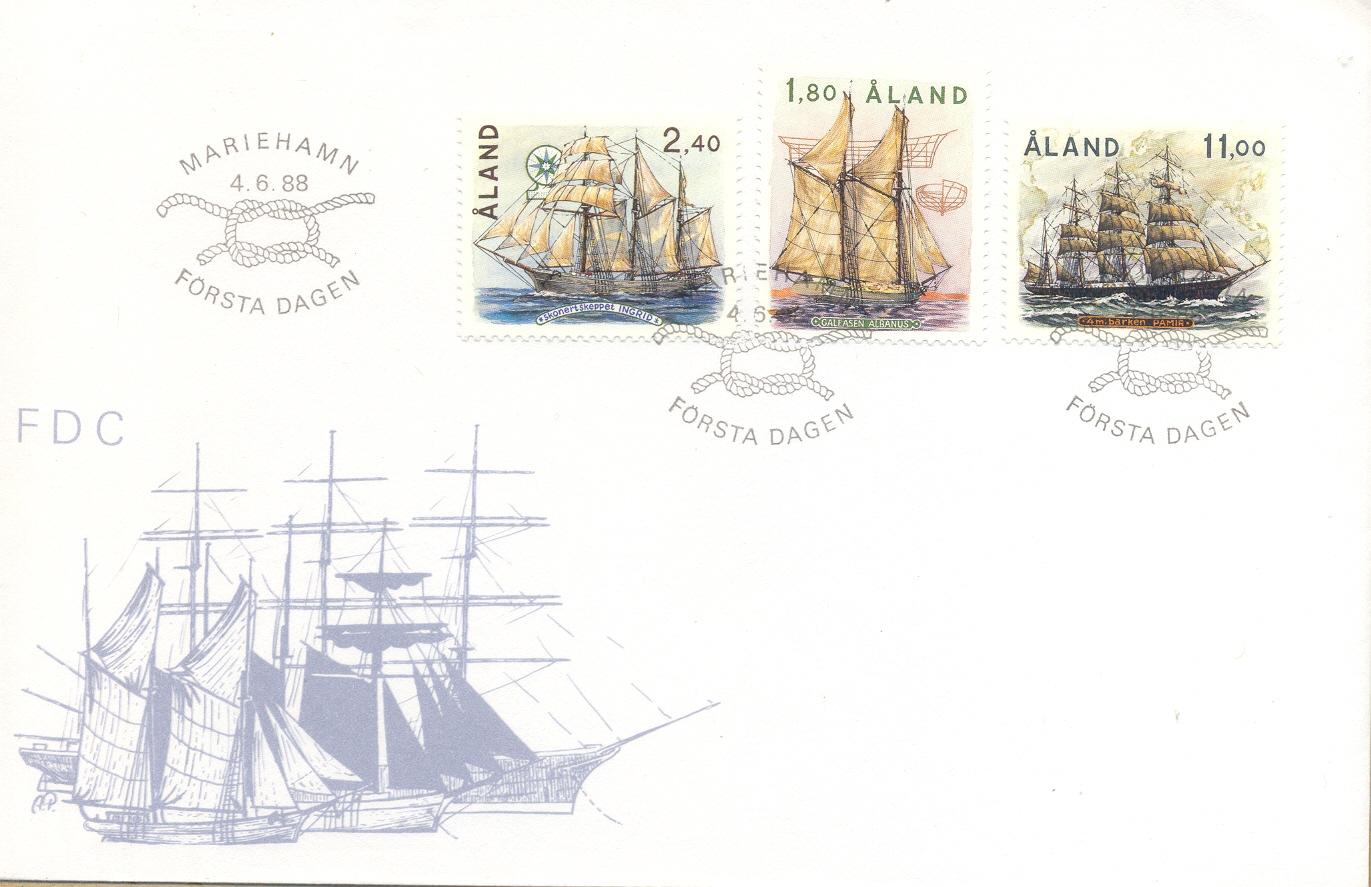
Åland has always immortalized ships and boats of all vintages through her pretty stamps, throughout her philatelic history. The Australian marine artist Robert Carter has immortalized Finnish sailing ships during their last trip on the wheat route in 1949. The Four-masted steel barque Pamir is shown departing from the Port Victoria in the Seychelles. The barque Passat, another vessel of Gustaf Erikson's fleet, is seen in the background with her sails reefed and loading. Although the Passat couldn’t sail away until five days later, she rounded Cape Horn before the Pamir. Pamir thus became the last sailing merchant vessels that rounded Cape Horn on 11.7.1949. Both vessels were sold to Germany. Passat served in Travemünde as a school and museum ship. Pamir was one of the famous Flying P-Liner sailing ships of the German shipping company F. Laeisz. She was the last commercial sailing ship to round Cape Horn, in 1949. Outmoded by modern bulk-carriers, and having severe technical difficulties after her shipping consortium was unable to finance much-needed repairs and recruit sufficient capable officers, on 21 September 1957 she was caught in Hurricane Carrie and sank off the Azores, with only six survivors recovered after an extensive rescue effort. Pia gave me this nice cover.
Friday, December 16, 2011
Tall Ship Pommern
The Aland Postal Service issued a new stamp with postage value of 0,55 Euro named "Pommern” which Celebrated 100 Years" on the 6th of June 2003. The stamp depicts a ship named "Pommern" which was built in 1903 in Glasgow by a German shipping company. Originally the ship was named "Mneme" after the Goddess of Memory Mnemosyne, until it changed ownership in 1906 when it was renamed Pommern. At that time the ship used to sail between Europe and South America. In 1923, Gustaf Erikson from Aland the world's last big sailing ship owner, bought the ship. As with most of his fleet, Pommern sailed in the grain races and carried grain from Australia to Britain. In 1939 Pommern sailed to her homeport Mariehamn and remained there until she finally was donated to the Town of Mariehamn as a museum ship. Pommern is one of four original masted steel barque in the world today. A trip to Australia took almost a year to manage and life was hard. The space on ship you had to share with pigs, sheeps. dogs, cats and rats.....Food and water where strictly rationed, meat stored in salt somethimes even for several years, where called "Old ropes", (strings from hawsers, in old days produced from hemp). And when the rain come, after a long heated trip in the Tropics, the sailors where happy, at least they could have a bath.
Saturday, December 10, 2011
Sailing ships
Thursday, November 17, 2011
The Kruzenshtern
Further to my post dated 2nd June, 2010 under the ‘Tall Ships” group in this blog, Nataliya sent me this lovely FDC dated 29.6.2006. The Kruzenshtern or Krusenstern is a four masted barque and tall ship that was built in 1926 at Geestemünde in Bremerhaven, Germany as the Padua (named after the Italian city). She was surrendered to the USSR in 1946 as war reparation and renamed after the early 19th century Baltic German explorer in Russian service, Adam Johann Krusenstern (1770–1846). She is now a Russian Navy sail training ship.
Of the four remaining Flying P-Liners, the former Padua is the only one still in use, mainly for training purposes, with her home ports in Kaliningrad (formerly Königsberg) and Murmansk. After the Sedov, another former German ship, she is the largest traditional sailing vessel still in operation.
Wednesday, July 20, 2011
Cyprus - Tall Ships

Cyprus issued three stamps on 8th June 2011 to commemorate the Tall Ships – Galleon, Caravel and the Brig. Merja sent me this nice cover.
Friday, June 17, 2011
Tristan da Cunha - TRISTAN DA CUNHA 1983 SHIPS SET OF 4 MNH
Tristan da Cunha is a remote volcanic group of islands in the south Atlantic Ocean and the main island of that group. It is the most remote inhabited archipelago in the world, lying 2,816 kilometres (1,750 mi) from the nearest land, South Africa, and 3,360 kilometres (2,088 mi) from South America. Tristan da Cunha is said to be the "most remote inhabited location on Earth." The territory consists of the main island of Tristan da Cunha itself, which measures about 11.27 kilometres (7.0 mi) across and has an area of 98 square kilometres (37.8 sq mi), along with the uninhabited Nightingale Islands and the wildlife reserves of Inaccessible Island and Gough Island. It has a permanent population of 275 (2009 figures).
Tristan da Cunha is part of the British overseas territory of Saint Helena, Ascension and Tristan da Cunha which also includes Saint Helena 2,430 kilometres (1,510 mi) to its north, and equatorial Ascension Island even farther removed, grouping the British South Atlantic islands into one far-flung centrally administered aggregate.
Maria sent me this lovely set of four sailing ship stamps on the FDC of TRISTAN DA CUNHA. The stamps are 5p "Islander", 20p "Roscoe", 35p "Columbia" and 50p "Emeline"
Tuesday, May 24, 2011
Finland - Tall Ship's Race 1972
The term has been in occasional use since at least Shakespearian times:
Shakespeare - Merchant of Venice
And all I ask is a tall ship and a star to steer her by,
..."
John Masefield - Sea Fever
The Finnish Training Ship Suomen Joutsen is featured on this stamp on the FDC commemorating the Tall Ship Race in 1972. Suomen Joutsen (Swan of Finland in English) (former names are Laënnec, Oldenburg) is a three-mast, steel hull, full rigged ship. She was built in 1902 in St. Nazaire, France to serve in the trade between Atlantic and Pacific ports. In 1930 she was bought by the Government of Finland to serve as Finnish Navy training ship. Before World War II she made eight long ocean voyages. From 1956 she was a stationary Seamen's School for the Finnish Merchant Navy. Since 1991, she has been a museum ship owned by City of Turku, Finland.
Saturday, March 26, 2011
Finland – Sailing Ships

Ship was built in St Nazaire 1902 and sailed as a cargo vessel under French and German flags until 1930. She was purchased by Finland as a training vessel for the Finnish navy in 1930 and renamed Suomen Joutsen (The Swan of Finland).
She made eight training voyages in 1930’s and served as a mothership and support vessel during the WWII.
In 1960’s she was rebuild as a stationed Naval trade School. The Suomen Joutsen became a museum vessel in 1988. She is currently stationed at the Forum Marinum, Turku, Finland.
Tuesday, February 8, 2011
Jersey – Ship Building

During the second half of the 12th century the Channel Islands grew in importance as a stopping off point for travellers between the Plantagenet possessions in England and Aquitaine. As trade increased the islands would have been used by all sorts of merchant shipping. It was during this time that ships in northern waters began to adopt the stern hung rudder, and the old fashioned steering board gradually disappeared. Ships continued to be clinker-built, that is with overlapping planks, as opposed to the more Mediterranean influenced carvel-built tradition of end-on-end planking. It is also about the end of the 12th century that the compass made its appearance although most mariners still followed the old practices of observation. The ships still tended to stay within sight of land which meant that most shipping between England and Gascony would have passed within sight of the Channel Islands and many would have stopped off especially in St Peter Port with its sheltered, deepwater anchorage.
Tickler. This two masted schooner was built in Jersey in 1858 for the Le Boutilier Company. The Tickler with a weight of 93 tons, measured 93 feet long, had a beam of 19 feet and drew some 10 feet of water. She plied the trade routes of northern Europe and the Mediterranean, with occasional voyages to Newfoundland. After ten years in service, the Tickler was mortgaged with the Jersey Joint Stock Bank and was subsequently sold to Charles Robin and Company. Some three years later Robin and Company, a principal ship owning company on the island took control of the Tickler. Because of financial difficulties the schooner, along with other vessels, was sold to France in 1888. She was last mentioned in the Lloyd’s List in 1864.
The Hebe was built by Daniel Le Vesconte of First Tower and owned by the Le Boutilier Company. This brig, launched in January 1861, weighed 236 tons, measured 119 feet long with a beam of 24 feet and had a draft of 13 feet. She plied her trade on the North Sea and the North Atlantic. She was also used to ferry emigrant workers from Europe to Canada. She was wrecked in October 1887 on Bryon Island in the Gulf of St. Lawrence. And by the way, Hebe was the daughter of Hera and Zeus and the sister of Ares and Eleithyia. She is the goddess of youthful beauty and the cupbearer of the Olympus, later to be replaced by Ganymedes. She married Herakles after he won immortality.
Monday, January 24, 2011
USA - Star of India

Sunday, August 29, 2010
Åland – cargo vessels


Wednesday, June 16, 2010
Ireland - Asgard II
This FDC and the special stamp was issued on the commissioning of Asgard II. This tall ship was a 104' long brigantine from Ireland, owned by the state and operated as a sail training ship. She was built in Wicklow, Ireland, and launched in 1981 as a replacement for the original Asgard. She has 372 square-metres of sail and boasts an unusual carved figure-head of Granuaile, the famous 16th century Pirate Queen. Her name comes from Norse mythology and means Home of the Gods. Thanks Hemant lovers of tall ships will love this.