Thank you Merja.
Welcome to this stamps, first-day covers and postcards gallery of mine euphemistically called Lets Talk Stamps. My desire here, is to show as often as I can, some of my presumed beauties and talk about them. And hopefully make Your Day in the bargain. In case you want a better view, JUST CLICK on the picture and it will be ENLARGED. Please also see my picture postcards blog www.mypicturepostcards.blogspot.in
Showing posts with label Australia1971-1980. Show all posts
Saturday, December 17, 2016
Thursday, February 4, 2016
Australian Birds 31.3.1980
(22c) The Nuff-breasted Paradise-kingfisher (Tanysiptera sylvia) is a bird in the tree kingfisher family, Halcyonidae. It is native to Australia, New Guinea and the Bismarck Archipelago and migrates in November from New Guinea to its breeding grounds in the rainforest of North Queensland, Australia. Like all paradise-kingfishers, this bird has colourful plumage with a red bill, buff breast and distinctive long tail streamers.
(28c) The Rainbow Bee-eater (Merops ornatus) is a near passerine bird in the bee-eater family Meropidae. It is the only species of Meropidae found in Australia.
(60c) The Australian King Parrot (Alisterus scapularis) is endemic to eastern Australia found in humid and heavily forested upland regions of the eastern portion of the continent, including eucalyptus wooded areas in and directly adjacent to subtropical and temperate rainforest. They feed on fruits and seeds gathered from trees or on the ground.
Sunday, January 31, 2016
Monday, January 11, 2016
The Green Catbird 17.11.1980
The green catbird (Ailuroedus crassirostris) is a species of bowerbird found in subtropical forests along the east coast of Australia, from southeastern Queensland to southern New South Wales. It is named for its distinctive call which sounds like a cat meowing, although it has also been mistaken for a crying child. The green catbird is extremely similar to the spotted catbird, which is only found in an isolated population in Far North Queensland. They are considered the same species by some commentators.
Monday, November 30, 2015
Sovereign Hill 2.9.1977
The discovery of gold in the 1850s and 60s is the most significant event in the evolution of the state of Victoria. Fuelled by extravagant stories of wealth gained at the 1849 Californian gold rush, gold fever hit Victoria following the early gold discoveries in and around Clunes, Warrandyte and Ballarat.
But the real rush began with the discovery of the Mount Alexander goldfield 60 kilometres north-east of Ballarat.
This First Day Cover and the postmark on the stamp depict Sovereign Hill, an open-air museum in Golden Point, a suburb of Ballarat, Victoria, Australia. Sovereign Hill depicts Ballarat's first ten years after the discovery of gold there in 1851. It was officially opened on 29 November 1970 and has become a nationally acclaimed tourist attraction. It is one of Victoria's most popular attractions and Ballarat's most famous.
Second largest gold nugget in the world—was also found in Ballarat in the Red Hill mine which is recreated in Sovereign Hill. The Welcome Nugget weighed 69 kg,(2,200 ounces) and contained 99% pure gold, valued at about 10,500 pounds when found, and worth over US$3 million in gold now, or far more as a specimen.
Friday, October 3, 2014
150th Anniversary of Western Australia 6.6.1979
This stamp commemorates
the 150th year since Captain James Sterling arrived at mouth of the Swan River
aboard the "Parmelia" with a party of settlers, the design on the
stamp shows the states "Official" anniversary symbol, the symbol was
designed by Norman Wilson of Perth, Western Australia.
The cover depicts The Old Mill (Shenton’s
Mill) which is a restored tower mill located on Mill Point in South Perth, Western
Australia. Today, restored to its original 1830s
condition, it is one of Perth's best known historic landmarks and serves as a
sightseeing attraction.
Western Australia is
a state occupying
the entire western third of Australia. It is bounded by the Indian
Ocean to
the north and west, the Great Australian Bight and Southern
Ocean to
the south, the Northern
Territory to
the north-east and South
Australia to
the south-east. Western Australia is Australia's largest state with a total
land area of 2,529,875 square kilometres (976,790 sq mi), and the second-largest
country subdivision in
the world – however, a significant part of it is sparsely populated. The state
has about 2.5 million inhabitants (around 11% of the national total), and
92% of the state's population lives in the south-west corner of
the state.
The
first European visitor to Western Australia was the Dutch explorer Dirk
Hartog, who visited the Western Australian coast in 1616. The first European
inhabitants were the crew of the British East Indiaman Tryall,
who were wrecked on Tryal
Rocks in
May 1622. They spent a week camped on the Montebello Islands before
sailing on to Batavia. The New
South Wales colonial
government established a convict-supported military garrison at King
George III Sound, at present-day Albany, in 1826, which was followed
by the establishment of the Swan River Colony in
1829, including the site of the present-day capital, Perth. York was
the first inland settlement in Western Australia. Situated 97 kilometres east
of Perth, it was settled on 16 September 1831.
Western
Australia achieved responsible
government in
1890, and later federated with
the other British colonies in Australia in 1901. Today Western Australia's economy mainly
relies on mining, agriculture and tourism. The state produces 46% of Australia's
exports. Western Australia is the
second-largest iron
ore producer
in the world.
Thank you Dear Maria for this nice FDC.
Thursday, September 25, 2014
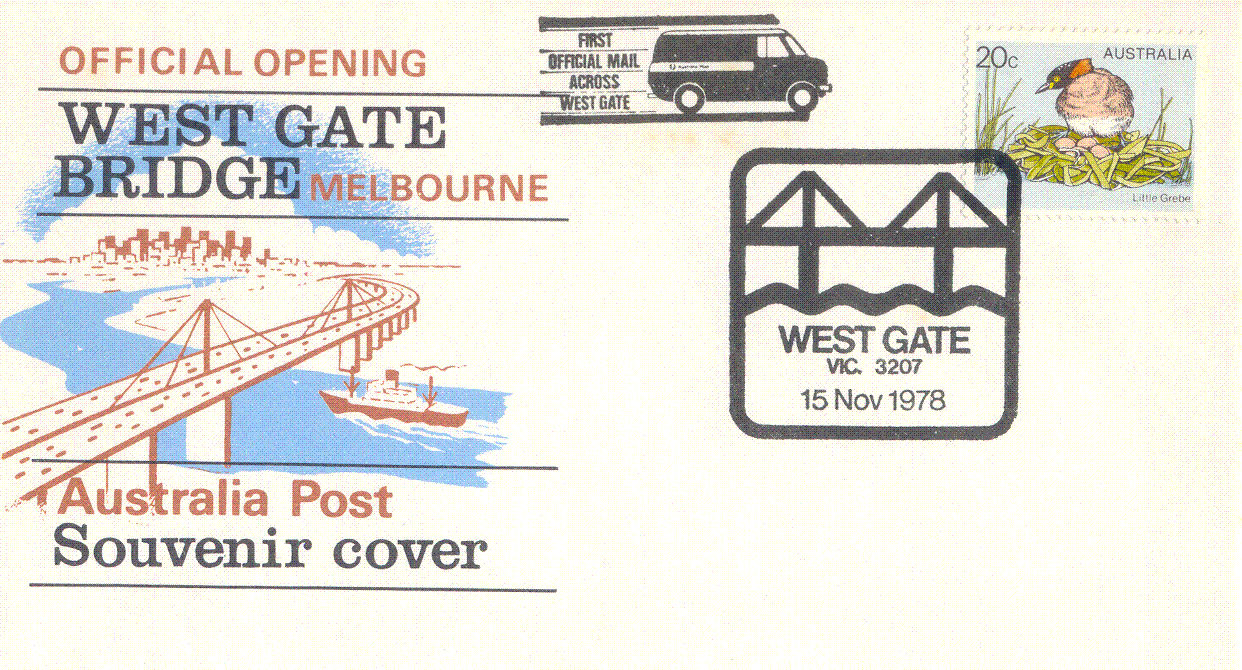
Opening of the West Gate Bridge in Melbourne 15.11.1978
Souvenir postal cover issued by Australia Post on 15 Nov
1978, to commemorate the official opening of the West Gate Bridge in Melbourne.
Includes 20c "Little Grebe" stamp, a postal stamp incorporating
official West Gate Bridge Authority logo and a stamp of an Australia Post mail
van with the words the "First Official Mail Across West Gate".
The West
Gate Bridge is a steel box girder cable-stayed bridge in
Melbourne, Victoria, Australia. It spans the Yarra River, just
north of its mouth into Port Phillip, and is a vital link between the
inner city (CBD) and Melbourne's western suburbs; with the industrial suburbs
in the west and with the city of Geelong, 80 kilometres (50 mi) to the
south-west. It is one of the busiest road corridors in Australia.
The main
river span is 336 metres (1,102 ft) in length, and the height above the
water is 58 metres. The total length of the bridge is 2,582.6 metres
(8,473.1 ft). It is the second longest in Australia behind
the Houghton Highway and its twin the Ted Smout Memorial Bridge,
and is twice as long as theSydney Harbour Bridge. It is one of the highest
bridges in Australia, most notably trailing that of the more
iconic Sydney Harbour Bridge.
The
bridge passes over Westgate Park, a large environmental and recreational
reserve created during the bridge's construction. The bridge carries up to
200,000 vehicles per day.
Thank you
Maria.
Sunday, September 21, 2014
Solar Eclipse over Australia 23.10.1978
The special postmark by Australian post was used to mark the Solar Eclipse in Australia on 23rd October 1978 when the zone of totality passed over SE Australia. Many scientific experiments were conducted during this period.
Thank you Maria.
Thank you Maria.
Sunday, August 24, 2014
Australian Council of Trade Unions (ACTU) 9.5.1977
The Australian Council of Trade Unions (ACTU) is
the largest peak body representing workers in Australia. It is a national trade union centre of 46 affiliated unions.
The ACTU was formed in 1927 as the
"Australian Council of Trade Unions". It was one of the earliest
attempts by trade unions to apply the principles of One Big Union earlier
explored by more radical syndicalist unions like the CNT or
revolutionary industrial unions like the IWW.
In the Australian case, agitation for One Big
Union occurred from 1911 from two different sectors: from the revolutionary
Australian section of the IWW and from the pro-arbitration Australian
Workers Union (AWU). At that time the AWU was the largest single
Australian union. In 1918 after the collapse of the Australian IWW, a group of
militant trade unions (which were opposed to the AWU) attempted to form One Big
Union under the name Workers Industrial Union of Australia (WIUA).
The hostility between the WIUA and the AWU prevented the formation of One Big
Union in Australia. It was the attempts of Stanley Bruce's federal
government in 1927 to dismantle the Australian Industrial Relations
Commission which impelled the Australian trade unions to form a national
council.
Melbourne Trades Hall in Victoria is
the "birthplace" of the ACTU.
The ACTU's Australian trade union "peak
body" precursors include state labour councils like the Victorian Trades Hall
Council (originating in 1856 as the 'Melbourne Trades Hall Committee'),
the Labour Council of New South Wales (originally formed in 1870 as
the 'Sydney Trades and Labour Council') and the Inter-Colonial Trade Union
Congress (formed in 1879).
The ACTU has not achieved the ideals expressed
for One Big Union: it remains a council organisation, but it does however
represent the majority of Australian trade unions. At its formation in 1927 the
ACTU was only seen as representing blue collar trades unions, and only managed
to achieve the support of trades unions. From 1948 peak bodies of white collar
associations existed, and from 1969 peak bodies of government employees. The
white collar bodies were: the Council of Professional and Commercial Employees
Association (1948), which became the Council of White Collar
Associations (1954), which amalgamated with the Salaried Employees
Consultative Council of New South Wales (1954) to become the Australian
Council of Salaried and Professional Associations(ACSPA) in 1956. The
government employee bodies were: the Council of Commonwealth Public
Service Organisations (1969) which became the Council of Australian
Government Employee Organisations (CAGEO) in 1975. The ACTU successfully
integrated these bodies in 1981. After 1981 the ACTU was generally viewed by
the Australian media and public as the organisation representing all workers'
organisations.
Wednesday, August 20, 2014
50th Anniversary of Opening of Parliament House 13.4.1977
This stamp and the first day cover were issued on 13.4.1977
commemorating the 50th annniversary of
Parliament House, Canberra, in 1977. Now know as Old Parliament House, it
is situated between Parliament House and Lake Burley Griffin. Although
initially built as a temporary parliament house, government stayed there from
1927 right until 1988, when a new Parliament House opened.
Thank you Maria.
Friday, August 8, 2014
Scenic Australia
These are three of the set of six pretty stamps
issued in 1976 highlighting important scenes in Australia.
(85c) Uluru, also known
as Ayers Rock and officially gazetted as Uluru
/ Ayers Rock, is a large sandstone rock formation in the
southern part of the Northern Territory in central Australia. It lies
335 km (208 mi) south west of the nearest large town, Alice
Springs, 450 km (280 mi) by road.
Kata Tjuta and Uluru are the two major
features of the Uluṟu-Kata Tjuṯa National Park. Uluru is sacred to
the Anangu, the Aboriginal people of the area. The area around
the formation is home to a plethora of springs, waterholes, rock caves,
and ancient paintings. Uluru is listed as a UNESCO World Heritage
Site.
(25c) Broken
Bay, a semi–mature tide dominated drowned
valley estuary, is a large inlet of the Tasman Sea located
about 50 kilometres (31 mi) north ofSydney central business
district on the coast of New South Wales, Australia; being one
of the bodies of water that separate greater Metropolitan Sydney from
the Central Coast. Broken Bay is the first major bay north of Sydney
Harbour.
Broken Bay has its origin at
the confluence of the Hawkesbury River, Pittwater,
and Brisbane Water and flows openly into the Tasman Sea.
The total catchment area of the bay is
approximately 17.1 square kilometres (6.6 sq mi).
(5c) The Richmond
Bridge is a heritage listed arch bridge located on the B31
("Convict Trail") in Richmond, 25 kilometres (15.5 mi)
north of Hobart in Tasmania, Australia. It is the
oldest bridge still in use in Australia.
The foundation stone for the Richmond Bridge was
laid on 11 December 1823 and construction continued using convict
labour until completion in 1825. The bridge was originally named Bigge's
Bridge after Royal Commissioner, John Thomas Bigge, who recognised the
need for the bridge in 1820. In 2005, the bridge was recognised as an
outstanding historic place and added to the Australian National Heritage
List.
Murder of George Grover.In 1832 an employee of
the Richmond Gaol was murdered at Richmond bridge. George Grover was
employed as a gaoler whose duties including flogging the prisoners. He was
unpopular due to his ferocity and was pushed off the edge of Richmond Bridge
after drunkenly falling asleep. No one was convicted of his murder.
Thank you Maria.
Thursday, July 31, 2014
National Stamp Week 27.9.1976
An
18c stamp and a miniature sheet of four 18c stamps were issued at all
Australian post offices and philatelic sales centres on the opening day of National
Stamp Week, 27th September, 1976.
This
was only the third miniature sheet in Australian philatelic history. The
previous two miniature sheets were issued in 1928 during an international
philatelic exhibition in Melbourne and in 1970 to mark the Cook Bicentenary
celebrations.
Mr.
Ray Honisett's National Stamp Week designs feature a portrait of Blamire
Young (1862-1935)
an English-born water colourist who played a leading part in the design of the
1913 Kangaroo
and Map stamp series, Australia's first uniform stamp issue.
The
miniature sheet is intended to illustrate progressive colour steps in
photogravure stamp printing. The
first stamp is printed in yellow, the second has red added to the yellow base
and a further colour effect is achieved in the third stamp by the addition of
blue
The Kangaroo stamps of Australia, commonly known
as Roos, were the Kangaroo and Map series of definitive
stamps of the Australian
Commonwealth first issued in 1913. They were issued in 1913, over 12 years
after Federation. Although the delay had several causes, one of the major
reasons was political wrangling regarding the design. There was a considerable
amount of opposition to any inclusion of British royal symbols or profiles.
A design completion was announced in 1911, and several designs,
including royal profiles were chosen. The government decided on having only one
design, and Charles Frazer, then postmaster-general, inspired the basic
outline of the new design.
Blamire Young, a local watercolour
artist, was commissioned to produce the final design. There was some criticism
and minor changes made, and the first issues were released in January
1913. The stamps were issued in 16 values ranging from a halfpenny to a
two pound value.
When Joseph Cook took over as Prime
Minister in mid-1913, he promptly had issued a series of stamps featuring
the profile King George V. However, the Kangaroo and Map series continued
to be issued, and was not removed from sale for over thirty years.
Thank
you Maria.
Saturday, July 19, 2014
50th Anniversary of Regular Radio Broadcasting 21.11.1973
The stamp on this
cover and the cover itself were issued to commemorate the 50th Anniversary of Regular Radio Broadcasting in Australia.
Radio is a way of
transmitting signals without wires. It uses electromagnetic radiation to transmit
sounds made in one place to listeners in many places. Radio is also known as
'wireless telegraphy', or 'wireless', as earlier methods for sending signals
(such as the telegraph and telephone) used wires. Australia adopted radio for
communications at sea and in lighthouses, and wireless telegraphy gradually
replaced the Overland telegraph which
had been completed in 1872.
From the first public
radio broadcast in 1923, public and domestic radio sets encouraged communities
of listeners. Families and groups gathered around a wireless box or radiogram.
Then as radios became cheaper and more portable – particularly with the
introduction of transistor radios from the 1950s – personal radios became
common, and individuals could listen according to their own preferences.
In December 1922, the Australian Government issued “The Regulations: radio
laws for the amateur”. The first licensed broadcast station in Australia, under these new
regulations, was 2CM, owned by Charles
MacLurcan. The licence (number one) was signed by the Prime Minister, The
Rt Hon Billy Hughes. Callsign 2CM is listed by the Federal Government as “Never
to be Reissued”, in recognition of the pioneering achievements of Charles
MacLurcan. 2CM was the first radio station in Australia to publish a regular
program guide.
Thank you Maria.
Friday, July 11, 2014
Sydney Opera House 17.10.1973
The Sydney Opera House is a multi-venue performing arts centre in Sydney,
New South Wales, Australia. Situated on Bennelong Point in Sydney Harbour,
close to the Sydney Harbour Bridge, the facility is adjacent to the Sydney
central business district and the Royal Botanic Gardens, between Sydney and Farm
Coves.
Designed by Danish architect Jørn Utzon, the facility formally opened on 20
October 1973 after a gestation beginning
with Utzon's 1957 selection as winner of an international design competition.
The NSW Government, led by Premier Joseph Cahill, authorised work to begin in
1958, with Utzon directing construction. The government's decision to build
Utzon's design is often overshadowed by circumstances that followed, including
cost and scheduling overruns as well as the architect's ultimate resignation.
The Opera House was formally opened by Elizabeth II, Queen of Australia, on 20 October 1973. A large crowd
attended. Utzon was not invited to the ceremony, nor was his name mentioned.
The opening was televised and included fireworks and a performance of
Beethoven's Symphony No. 9.
Thank you Maria.
Monday, July 7, 2014
50th Anniversary of the Australian Legacy Welfare Organisation 5.9.1973
This stamp was issued
to commemorate the 50th Anniversary of the Australian Legacy
Welfare Organisation on 5th September, 1973.
Legacy is an independent organisation founded in 1923 by a small group of World War 1 veterans. They believed they had to accept a legacy of responsibility for the welfare of the wives and children of their comrades who were killed in war or died subsequently. Legacy also supports the dependants of today's Australia Defence Force who lose their lives as a result of service.
Each year ADCU is a
Gold Sponsor for the annual Big Band Sound Concert fundraiser held in Canberra
at the Royal Military College Duntroon.
This event aims to
maintain and raise awareness of Legacy and helps to raise much needed funds so
that they might continue their vital work.
Legacy is a charity
providing services to Australian families suffering financially and socially
after the incapacitation or death of a spouse or parent, during or after their
defence force service. It currently cares for around 100,000 widows and 1,900
children and disabled dependants throughout Australia.
Thank you Maria.
Thursday, July 3, 2014
Australia 16.10.1972 - Tenth International Congress of Accountants
A 7c stamp was issued on 16th October, 1972, to mark the
Tenth International Congress of Accountants which was opened in Sydney on that
date.
The stamp design shows a grouping of numerals and portions
of an abacus and a computer circuit representing the advances made in
accountancy techniques. Main background colours in the stamp are blue and
green-blue. Other colours used in the stamp are orange and black.
The 7c Tenth International Congress of Accountants stamp was
designed by Mr. Gordon Andrews of Sydney and was printed by multicolour
photogravure in sheets of 100 stamps on paper incorporating luminescence at the
Note Printing Branch of the Reserve Bank of Australia, Melbourne.
Mr. Andrews also designed two official first day covers for
this stamp issue using themes from his stamp design. One cover showed the
abacus with a background of computer circuitry and the other first day cover
design presents a pattern of numerals.
A special postmarker was provided from 16th to 21st October,
1972, at a temporary post office at the venue of the Tenth International
Congress of Accountants.
Sunday, June 29, 2014
Centenary of Overland Telegraph line in Australia. 22.8.1972
This First Day
Cover and the stamp on it commemorate the Centenary of Overland Telegraph line
in Australia.
The Australian
Overland Telegraph Line was a 3200 km telegraph line that
connected Darwin with Port
Augusta in South
Australia. Completed in 1872 the Overland Telegraph
Line allowed fast communication between Australia and the rest of the world. An additional section was
added in 1877 with the completion of the Western
Australian section of the line. It was one of the great engineering feats of 19th century Australia and probably the most significant
milestone in Australia's
telegraphic history.
Tuesday, June 3, 2014
54th Birthday of Her Majesty Queen Elizabeth II 21.4.1980
This 22c stamp issue was released by Australia on 21.4.1980 to
mark the 54th Birthday of Her
Majesty Queen Elizabeth II. The cover depicts the gate to the Windsor
Castle.
Since then, Australia Post has celebrated the birthday of
Her Majesty Queen Elizabeth II with a stamp issue release every year since
1980.
Thank you Maria.
Monday, November 2, 2009
Subscribe to:
Comments (Atom)