Showing posts with label Faroe Islands. Show all posts

Wednesday, February 17, 2016

Faroese costumes 10.4.1989

This set of two stamps shows Faroese costumes for special occasions.
(350) Sjóstuka and Stavnhetta.
(600) Stakkur.
The Faroese costume is still common among the people of the Faroe Islands at holidays, weddings, graduations, and other occasions, often accompanied by the Faroese dance.

Thank you Merja.

Monday, February 8, 2016

Faroese Flowers 17.3.1980

This stamp on the FDC is one of a set of four stamps depicting Faroese Flowers.

Thank you Merja.

Tuesday, February 2, 2016

Risin og Kellingin 2.1.1996

This stamp was voted the most beautiful Faroese stamp of 1996 in a poll of Faroe Islands collectors. 

Risin og Kellingin (Risin and Kellingin) are two sea stacks just off the northern coast of the island of Eysturoy in the Faroe Islands close to the town of Eiði. The name Risin og Kellingin means The Giant and the Witch (or Hag) and relates to an old legend about their origins. The Giant (Risin) is the 71m stack further from the coast, and the witch (Kellingin) is the 68m pointed stack nearer land, standing with her legs apart.

A legend tells how, once upon a time, the giants in Iceland were envious and decided that they wanted the Faroes. So the giant and the witch (his wife in some versions of the story) were sent down to the Faroe Islands to bring them back.
They reached the north-westernmost mountain Eiðiskollur, and the giant stayed in the sea while the witch climbed up the mountain with a heavy rope to tie the islands together so that she could push them onto the giant's back. However, when she attached the rope to the mountain and pulled, the northern part of the mountain split. Further attempts were also unsuccessful, and they struggled through the night, but the base of the mountain was firm and they could not move it.
If the sun shines on a giant or witch, it turns to stone. So it was that as they continued to struggle they didn't notice time passing, and as dawn broke a shaft of sunlight put a stop to their efforts by turning them to stone on the spot. They have stood there ever since, staring longingly across the ocean towards Iceland.

Thursday, January 28, 2016

EUROPA1985 - "Year of the Music" 1.4.1985

The EUROPA-CEPT Motto for 1985 was "Year of the Music", and the Faroes contributed with a set of two, showing youngsters playing instruments. The fitst one (on the FDC) was (280) youngsters Playing flute, cello and piano, and the second one was Playing saxophone, drums and guitar. Date of issue was 1 April 1985.

Note, that the Faroese instrumental tradition is quite young, as first in the beginning of the 20th century the baker Hansen began to play and train others. Before, Faroese music was only oral. When these stamps came out, the faroese music scene, as we know it today, was just beginning its development.  

Thank you Merja.

Monday, January 25, 2016

The Faroe Islands 7.6.1996

The stamp on this FDC depicts a physical map of the Faroe Islands showing all the islands that constitute the Faroes.

Thank you Merja.

Thursday, January 21, 2016

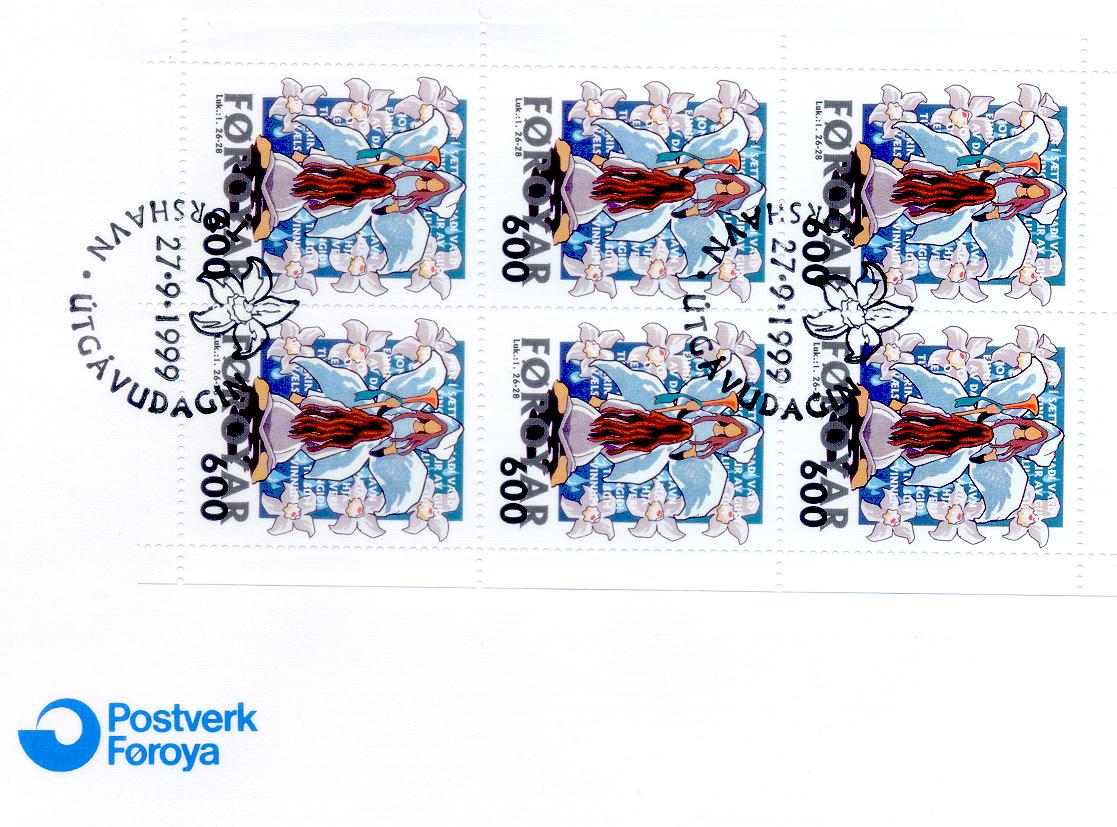
The Annunciation 27.9.1999

The stamps on this FDC depict The Annunciation (from the Vulgate Latinannuntiatio (or nuntiatio) nativitatis Christi), also referred to as the Annunciation to the Blessed Virgin Mary, the Annunciation of Our Lady or the Annunciation of the Lord, is the Christian celebration of the announcement by the angel Gabriel to the Virgin Mary that she would conceive and become the mother of Jesus, the Son of God, marking his Incarnation. Gabriel told Mary to name her son Yehoshua , meaning "YHWH is salvation".
According to Luke 1:26, the Annunciation occurred "in the sixth month" of Elizabeth's pregnancy with John the Baptist. Many Christians observe this event with the Feast of the Annunciation on 25 March, an approximation of the northern vernal equinox nine full months before Christmas, the ceremonial birthday of Jesus. In England, this came to be known as Lady Day. It marked the new year until 1752. The 2nd-century writer Irenaeus of Lyon regarded the conception of Jesus as 25 Marchcoinciding with the Passion.
The Annunciation has been a key topic in Christian art in general, as well as in Marian art in the Catholic Church, particularly during the Middle Ages and Renaissance.

Thank you Merja.

Tuesday, January 19, 2016

Fish in Faroese Waters 19.9.1983


(All fish names are: Faroese (zoologic) - English - German – Danish)
Brosma (Brosme brosme) - Tusk - Lumb - Brosme.
Hýsa (Melanogrammus aeglefinus) - Haddock - Schellfisch - Kuller.
Kalvi (Hippoglossus hippoglossus) - Halibut - Heilbutt - Helleflynder.
Steinbítur (Anarhichas lupus) - Catfish - Katfisch - Havkat.

The Faroese Fishing Industry. The fishing fleet consists of about 240 vessels above 20 GRT, ranging from small, wooden coastal vessels to the most sophisticated ocean-going factory trawlers. There are also about 1.000 smaller craft.
The main commercial species of fish caught in Faroese waters, are demersal (ground fish) species such as cod, haddock, coalfish, and redfish, pelagic species as herring and mackerel, and semi-pelagic or deepwater species like argentine and blue whiting.

Most of these catches are landed in the Faroe Islands. In distant waters (Barents Sea, Svalbard, Canada, Greenland) the main species are cod and shrimp, which are processed on board. In middle waters, notably the North Sea west of Britain the main species are blue whiting, mackerel, herring, Norway pout and sand eel, which are landed in the Faroe Islands or abroad. In Icelandic waters various demersal species are caught, as well as capelin and herring.

The catches of demersal fish landed in the Faroe Islands are either exported fresh or processed into fresh fillets, frozen fillets or wet salted fish. Other species are processed into fish meal and oil, or feed for the fish farms. The primary export markets are Denmark (shrimp), Great Britain (Cod and haddock), Germany, France (coly, redfish, black halibut), the Mediterranean countries (salted fish), USA (frozen cod and haddock) and Japan (shrimps, trout).

Friday, January 15, 2016

The Pew ends from the St. Olav Church in Kirkjubøur 6.10.1980

Kirkjubøur is the southernmost village on Streymoy, Faroe Islands and the country's most important historical site with the ruins of the Magnus Cathedral from around 1300, the Saint Olav's Church from 12th century and the old farmhouse Kirkjubøargarður from 11th century. In 1832 a runestone was found near the Magnus Cathedral in Kirkjubøur. The stone which is referred to as the Kirkjubøur stone dates back to the Viking Ages.
The village is located on the south-west coast of Streymoy and has a view towards the islands Hestur and Koltur towards west and to Sandoy towards the south.
The little islet just of the coast, Kirkjubøhólmur contains an eiderduck colony.
To the village belongs the islet Trøllhøvdi, just 100 m of the northern tip of Sandoy 9 km away from Kirkjubø, it was given as payment to the villagers as it was their duty to ferry people across to Sandoy in medieval times.
The stamps affixed to these two FDC’s feature The Pew ends from the St. Olav Church in Kirkjubøur, which were carved the Middle Ages. In total there are 14, this series starts with the first four ones. Today they are back in the Faroes, after they were for a long time in the National Museum of Copenhagen.
(140) St. John the Baptist
(150} St. Peter
(250) St. Paul
The islet of Kirkjubøhólmur and St. Olav's church are depicted on the FDCs.  In the distance the island of Hestur can also be seen.

Sunday, December 6, 2015

Butterflies


These four lovely stamps from the Faroe Islands feature different kinds of Butterflies. They are :-

(700) The Red Admiral (Vanessa atalanta) is a well-known colourful butterfly, found in temperate Europe, Asia and North America. The Red Admiral has a 45–50 mm (1.8–2.0 in) wing span. The species is resident only in warmer areas, but migrates north in spring, and sometimes again in autumn.
(900) The Grass RivuletPerizoma albulata, is a moth of the genus Perizoma in the family Geometridae. It is found in most of Europe including Russia East to the Urals and Transcaucasia, and further East in Siberia.
(350) Apamea zeta or Exile Moth is a moth of the family Noctuidae. It has a Holarctic distribution, and can be found throughout the Northern Hemisphere. It occurs throughout Europe and the northern half of North America.
(400) The ghost moth (Hepialus humuli), also known as the ghost swift, is a moth of the family Hepialidae. It is common throughout Europe except for the far south-east.

Thank you Merja.

Monday, November 16, 2015

Fish 7.2.1994


(0.10) The three-spined stickleback is a fish native to most inland coastal waters north of 30°N.
(4.00) False Boarfish (Neocyttus helgae).
(7.00) The brown trout (Salmo trutta) is a European species of salmonid fish that has been widely introduced into suitable environments globally.
(10.00) The Orange Roughyred roughyslimehead, or deep sea perch (Hoplostethus atlanticus) is a relatively large deep-sea fish belonging to the slimehead family (Trachichthyidae).

Thank you Merja.

Sunday, November 8, 2015

Sunday, August 16, 2015

Mail Boats of Faroe Islands 10.2.1992

Posta is the postal service of the Faroe Islands and was founded on 1 April 1976 under the Home Rule of the Faroe Islands. On 16 December 2005, it became a public joint stock company under the name P/F Postverk Føroya (retroactive from 1 January 2005).
The postage stamps and postal history of the Faroe Islands began in the 1860s with a message exchange system called Skjúts, which was before a regular boat service was established between the islands. Postage is now under the control of Postverk Føroya, the Postage Stamp Department of which has taken over all the work relating to Faroese postage stamps.
The Faroese name Postverk Føroya uses the genitive form of the country's name Føroyar (Faroes), thusFøroya without the final r. The name means literally "Postal works of the Faroes", while the word for post or mail is postur. In 2010 Postverk Føroya changed name to Posta. A ram's horn was chosen as the institution's logo.

Tuesday, June 23, 2015

SS Smyril II

Smyril II was built in Frederikshavn in Denmark in 1931, arriving in the Faroe Islands in 1932. It was much more modern than the first Smyril, it had a large saloon with sofas, and it even had a small saloon for smokers. The ferry was welcomed with song and music on the harbour of Tórshavn. Two days after arrival, the ferry started to sail on route between the islands. It sailed from Tórshavn, the capital, to many villages, i.e. to the villages on the eastern side of Eysturoy, to the villages on the eastern side of Sandoy and to several of the villages on the eastern side of Suðuroy, to the village Vestmanna, which is on the west coast of Streymoy and to Vágar island and sometimes also to smaller island like Mykines and Nólsoy. Smyril II also sailed to Klaksvík. Smyril I left the Faroe Islands on the same day as the new ferry started on her route, after sailing between the islands in 35 years.
Thank you Merja.

Sunday, July 20, 2014

Faeroe Islands 21.2.1983 – Old Steam Ships

The stamp on the cover is one of three depicting old steam ships. The First Day Cover, shows the "Arcturus" on the 700c stamp.   

In 1856, a small steam-powered cargo ship known as the Victor Emanuel set sail in the Mediterranean. Privately owned and operated, she weighed only 331 tons and spanned a mere 156 feet in length. For several years she was used exclusively on a route between England and Glasgow. However, when the Faro Islands began to emerge as an important industrial power, the Victor Emanuel and many other cargo ships served to transport the many imports the Faroe Islands needed. It was at this point that the Victor Emanuel was purchased by Koch and Henderson -- a Scottish shipping company. The new owners re-christened their ship the S.S. Arcturus ... named after the brightest star in the northern celestial hemisphere. Most vessels would make the hazardous journey to the Faroe Islands only in Spring and in late Summer. However, the rugged Arcturus made five to seven trips a year for over ten years. Even though she was the most reliable ship to service the Islands, her small size always put her at a disadvantage to the many larger cargo ships of her day. Thus, in 1867 the Arcturus was torn down and rebuilt into a vessel of much greater size. She then faithfully served the needs of the Faroe Islands for some twenty more years.


Both the Faeroe- and Iceland-stamp show two masts which date the source drawings to before 1872, the year in which "Arcturus" gained a third mast and new steam engine.  Koch & Henderson merged with two other shipping companies in 1867 to form DFDS (United Steamship Company), for whom "Arcturus" continued to sail on the Faeroes-Iceland run continually until 1870.  She collided with the British steamship "Savona" on 5th April 1887 and sank.  


Thank you Merja.

Monday, June 23, 2014

Faroe Islands 5.6.1969 - Island Olympics


The third Island Games ("Island Olympics") of the IGA were held 1989 in the Faroe Islands, 5-13 July. A set of four postal stamps shows the most popular Faroese sports. Artist was Olivur við Neyst. Ste stamps were issued on 5th June 1989.
Thank you Merja.

Saturday, June 21, 2014

Faeroe Islands 9.2.1987 - Farmhouses

The grass roofs are probably the first things you notice, and these have been a feature of the houses since the islands were first settled. In the Viking Age farmhouses had curved stone walls and the roof was supported by two rows of posts in a large common room with a longfire in the centre. Along the outer walls benches or seats were placed, a Faroese home today is still called a sethús (seat house) after these seats. And there is a good reason that the ancient name has survived, for on the Faroes the original longhouse lasted longer than any other place in Scandinavia. 

Thank you Merja.

Tuesday, June 10, 2014

Faeroe Islands 30.1.1984 - The National Museum of the Faroe Islands


The stamps on these two covers from the Faroe Islands depict The pew ends from Kirkjubøur, Faroe Islands: St. Thomas.

Kirkjubøur, is a cultural heritage village on the island of Streymoy, Faroe Islands. It is the southernmost village on Streymoy, Faroe Islands and the country's most important historical site. It is located on the west coast and has a view towards the islands Hestur and Koltur.

The National Museum of the Faroe Islands has exhibitions in the museum building on Brekkutún 6 in Tórshavn. There are items which tell the history of the Faroe Islands, the culture etc. from the Viking Ages and the Middle Ages. There are items from the farming live and the maritime live in the Faroe Islands. The famous Kikjubøstólarnir, which are parts of the original benches from the Ólavskirkjan (St. Olav's Church) of Kirkjubøur are amongst the most valued items of the National Museum on Brekkutún 6. These were in Denmark for many years but have now returned to the Faroe Islands.

The medieval pew ends from Saint Olav's church at Kirkjubøur (mentioned above) featured in three series of Faroese stamps, engraved by Czeslaw Slania. These two stamps are about St John, the Evangelist and St James.

Thank you Merja.

Tuesday, May 27, 2014

The Grey Seal

The grey seal (Halichoerus grypus, meaning "hooked-nosed sea pig") is found on both shores of the North Atlantic Ocean. It is a large seal of the family Phocidae or "true seals". It is the only species classified in the genus Halichoerus. Its name is spelled gray seal in the US; it is also known as Atlantic grey seal and the horsehead seal.

The Faroe Islands issued this stamp and the lovely fdc on 9.6.1992.

Thank you Merja.

Monday, May 19, 2014

10th Anniversary of The Nordic House - The Torshavn Folk Music and Jazz Festival.

The Nordic House is the most important cultural institution in the Faroe Islands. Its aim is to support and promote Nordic and Faroese culture, locally and in the Nordic region.
Erlendur Patursson (1913-1986), Faroese member of the Nordic Council, brought forward the idea of a Nordic cultural house in the Faroe Islands. A Nordic competition for architects was held in 1977, where 158 architects participated. Winners were Ola Steen from Norway and Kollbrún Ragnarsdóttir from Iceland. By staying true to folklore the architects built the Nordic House to resemble an enchanting hill of elves. The building is considered to be one of the most beautiful in Scandinavia. The house opened in Tórshavn in 1983.
The Nordic House is organized as a cultural organization under the Nordic Council of Ministers. The Nordic House is run by a steering committee of 8, of which 3 are Faroese and 5 from the outside Nordic countries. Also there is a local advisory body of 15 members, representing the Faroese cultural organizations. For a 4-year period, the steering committee appoints a director of the house.
The stamp on this fdc is one of a set of three issued to commemorate the 10th Anniversary of The Nordic House, Torshavn on 8.2.1993. The three stamps of this set are about The Torshavn Folk Music and Jazz Festival. 

Thank you Merja.