Showing posts with label Christianity. Show all posts

Tuesday, January 26, 2016

"Primitif De Savoie XVth Century" 9.5.1970

The stamp on this FDC depicts a painting of The Annunciation (from the Vulgate Latinannuntiatio (or nuntiatio) nativitatis Christi), also referred to as the Annunciation to the Blessed Virgin Mary, the Annunciation of Our Lady or the Annunciation of the Lord, is the Christian celebration of the announcement by the angel Gabriel to the Virgin Mary that she would conceive and become the mother of Jesus, the Son of God, marking his Incarnation. Gabriel told Mary to name her son Yehoshua.  The painting is believed to be the work of an unknown native of Savoy in the 15th Century, thus the name given to the painting.

Thank you Merja.

Thursday, January 21, 2016

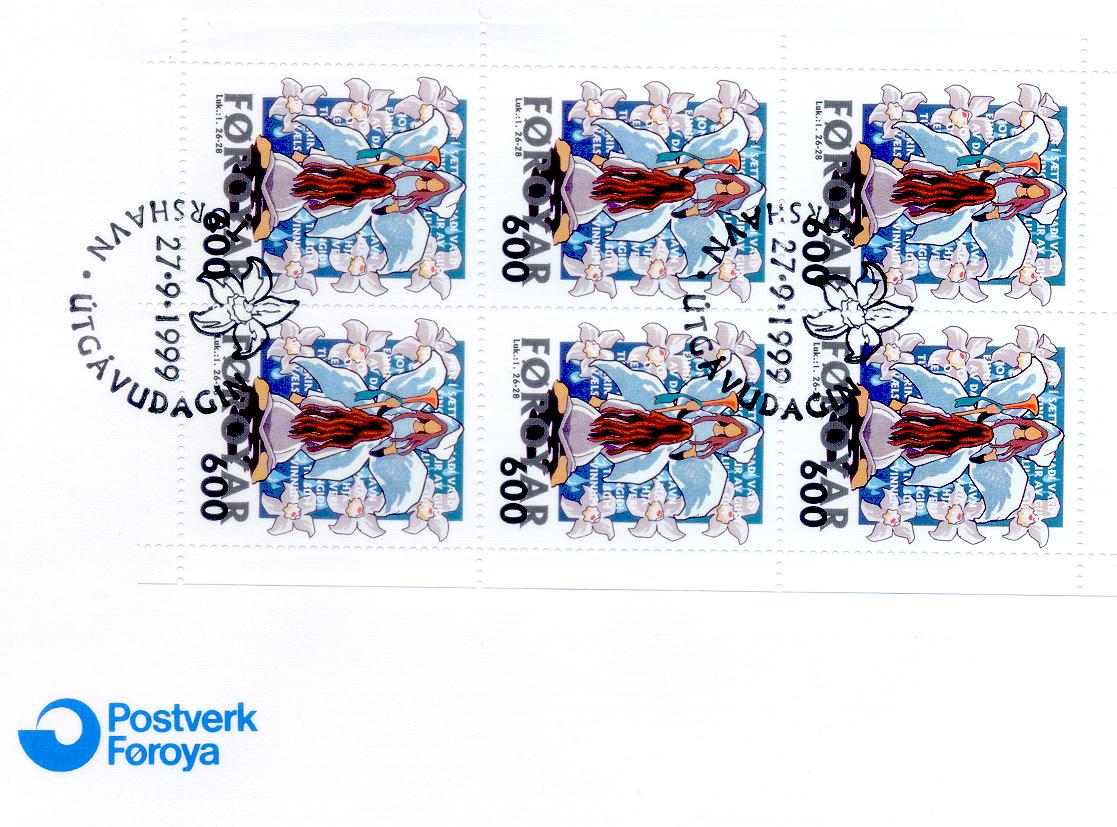
The Annunciation 27.9.1999

The stamps on this FDC depict The Annunciation (from the Vulgate Latinannuntiatio (or nuntiatio) nativitatis Christi), also referred to as the Annunciation to the Blessed Virgin Mary, the Annunciation of Our Lady or the Annunciation of the Lord, is the Christian celebration of the announcement by the angel Gabriel to the Virgin Mary that she would conceive and become the mother of Jesus, the Son of God, marking his Incarnation. Gabriel told Mary to name her son Yehoshua , meaning "YHWH is salvation".
According to Luke 1:26, the Annunciation occurred "in the sixth month" of Elizabeth's pregnancy with John the Baptist. Many Christians observe this event with the Feast of the Annunciation on 25 March, an approximation of the northern vernal equinox nine full months before Christmas, the ceremonial birthday of Jesus. In England, this came to be known as Lady Day. It marked the new year until 1752. The 2nd-century writer Irenaeus of Lyon regarded the conception of Jesus as 25 Marchcoinciding with the Passion.
The Annunciation has been a key topic in Christian art in general, as well as in Marian art in the Catholic Church, particularly during the Middle Ages and Renaissance.

Thank you Merja.

Sunday, November 15, 2015

Abbey of Our Lady of Bec 25.3.1978


Bec Abbey, formally the Abbey of Our Lady of Bec (French: Abbaye Notre-Dame du Bec), is a Benedictine monastic foundation in the Eure département, in the Bec valley midway between the cities of Rouen and Bernay. It is located in Le Bec Hellouin, Normandy, France, and was formerly the most influential abbey of the 12th-century Anglo-Norman kingdom.


Like all abbeys, Bec maintained annals of the house but uniquely its first abbots also received individual biographies, brought together by the monk of Bec, Milo Crispin. Because of the abbey's cross-Channel influence, these hagiographic lives sometimes disclose historical information of more than local importance.

Thank you Merja.

Monday, September 21, 2015

Pope Visits Milan 20.5.1983


This Italian cover and the special postmark on it is to commemorate the Inauguration of the XXth Eucharistic Congress in Milan, Italy by Pope Paul II.

Tuesday, September 15, 2015

The Magi - Christmas 13.11.1969

The stamp on the FDC is of  Berlin, West Germany and depicts one of a  Pewter Model set of figures. Some of the proceeds of these stamps went for Humanitarian Relief Funds.  The stamp is one of a set of five stamps.  

This stamp shows The Magi, also referred to as the (Three) Wise Men or (Three) Kings were, in the Gospel of Matthew and Christian tradition, a group of distinguished foreigners who visited Jesus after his birth, bearing gifts of gold, frankincense and myrrh. They are regular figures in traditional accounts of the nativity celebrations of Christmas and are an important part of Christian tradition.

Thank you Merja.

Monday, September 14, 2015

Route of Santiago de Compostela 18.9.1993


The Camino de Santiago, also known by the English names Way of St. JamesSt. James's WaySt. James's PathSt. James's TrailRoute of Santiago de Compostela, and Road to Santiago, is the name of any of the pilgrimage routes (most commonly the Camino Francés or French route) to the shrine of the apostle St. James the Great in the Cathedral of Santiago de Compostela in Galicia in northwestern Spain, where tradition has it that the remains of the saint are buried. Many take up this route as a form of spiritual path or retreat for their spiritual growth.

They are the Holy Years of Compostela, those years in which the 25th of July falls on a Sunday allowing for the celebration of the martyrdom of St. James. In these years, believers can obtain a plenary indulgence, leaving them completely absolved of all their sins.

This year occurs on a fixed pattern of 6, 5, 6, and 11 years and if the 25th of July is a Sunday, this happens -14 times each century, then the Catholic Church has the power to grant plenary indulgence – the forgiveness of all sins- to the faithful who visit the tomb of the Apostle in the cathedral of Santiago, the mass involves praying for the intentions of the Pope and receiving the sacraments of confession and communion. It is recommended that pilgrims attend Mass in order to receive a complete divine absolution. They are the named Jacobean or Holy saint years of Compostela, the motive behind hundreds of pilgrimages that throughout history which have led walkers from all over the world to the tomb of St. James to “cleanse” their souls. The last was in 2010 and the next will be in 2021.

Thank you Merja.

Monday, August 24, 2015

Saint John of the Cross - 400 Death Anniversary 6.6.1991

Saint John of the Cross, O.C.D. (1542 – 14 December 1591), was a major figure of the Counter-Reformation, a Spanish mystic, a Roman Catholic saint, a Carmelite friar and a priest who was born at Fontiveros, Old Castile.

John of the Cross was a reformer of the Carmelite Order and is considered, along with Saint Teresa of Ávila, as a founder of the Discalced Carmelites. He is also known for his writings. Both his poetry and his studies on the growth of the soul are considered the summit of mystical Spanish literature and one of the peaks of all Spanish literature. He was canonized as a saint in 1726 by Pope Benedict XIII. He is one of the thirty-six Doctors of the Church.

Thank you Merja for this FDC.

Saturday, April 12, 2014

Polish Millennium 30.7.1966

The 5¢ Polish Millennium stamp on the cover Honours the Millennium (1000) anniversary of the adoption of Christianity by the Polish nation in 966 A.D. The stamp was released at Washington, DC on July 30, 1966.
The Christianization of Poland refers to the introduction and subsequent spread of Christianity in Poland. The impetus to the process was the Baptism of Poland, the personal baptism of Mieszko I, the first ruler of the Polish state, and much of his court. The ceremony took place on the Holy Saturday of 14 April 966, although the exact location is still disputed by historians, with the cities of Poznań and Gniezno being the most likely sites. Mieszko's wife, Dobrawa of Bohemia is often credited as a major influence on Mieszko's decision to accept Christianity.
While the spread of Christianity in Poland took centuries to finish, the process was ultimately successful, as within several decades Poland joined the rank of established European states recognized by the papacy and the Holy Roman Empire. According to some historians the baptism of Poland marks the beginning of Polish statehood.
Thank you Merja.

Sunday, December 15, 2013

Nativity Scene 7.11.2013

The minisheet was issued by Aland, and the FDC shown above were issued by the Vatican on 7th November 2013 as part of Christmas celebration there, and the stamps depict the Nativity scene in far away Babylon on that fateful day in the life of Man.
Thank you Ella.

Saturday, December 14, 2013

Raphael’s Sistine Madonna celebrates a 500th birthday


This lovely minisheet was issued by Germany in August 2012 to commemorate the 500th Anniversary of the Sistine Madonna.
It’s not often that a major exhibition is dedicated to just one painting, but then it’s not every day that a work of the artistic calibre, historical interest and contemporary relevance of Raphael’s Sistine Madonna which celebrated its 500th birthday in 2012. One of only a handful of Raphaels found outside Italy, the extraordinary altarpiece is a high point of the wonderful Old Masters collection at the Staatliche Kunstammlungen Dresden (SKD).
In early 1754, an almost unknown altarpiece was removed from the Church of San Sisto in the small northern Italian city of Piacenza, carried over the Alps and presented at the court of August III, Elector of Saxony and King of Poland. Such a journey would normally be postponed until the arrival of spring, but negotiations for the purchase of the Sistine Madonna had been so fraught with difficulty that when the sale finally went through, even the driving rain and bitter cold of the Alps in winter couldn’t stop August III’s agent from dispatching his precious cargo.
By the beginning of the 19th century, says Henning, the work was “the most famous painting by Raphael in Europe”, but when the Sistine Madonna was first exhibited in Dresden in 1754, another Italian artist, Antonio di Correggio, was the flavour of the day in Germany. While everyone was aware of Raphael’s masterworks such as the Vatican ‘Stanze’ in Rome, the Sistine Madonna had languished out of the public eye in Piacenza for more than 200 years. Unlike Rome, Milan and Venice, Piacenza was not a Grand Tour destination, so no one except the Benedictine monks of San Sisto, for whom the work was commissioned in 1512, ever saw the painting. It was also barely written about: Giorgio Vasari, the great chronicler of the lives of Italian artists in the 16th century, wrote only one line about the painting, calling it “a truly rare and extraordinary work”.
The pair of winged cherubs at the base of the Sistine Madonna are an interesting story in themselves. Appearing first in paintings before being reproduced as prints and on porcelain, they had a life of their own from as early as the end of the 18th century. Now, of course, their little faces can be found on kitsch stationary and homeware the world over. “A lot of our visitors”, says Henning, “are surprised to see they’re small and only two of the angels in the painting”.
The Sistine Madonna: Raphael’s iconic painting turns 500 contains over 250 works of art and historical artefacts. Henning was very keen that the show have an international feel, so there are numerous examples of the work’s reception in different cultures and markets, from England to Russia. Given the painting’s significance worldwide today, it is extraordinary to consider the absolute obscurity of those early years as a humble altarpiece in Piacenza. Happy birthday Sistine Madonna.
The Sistine Madonna: Raphael’s iconic painting turns 500 is running at the Staatliche Kunstammlungen in Dresden, Germany until August 26, 2012.

Thank you my friend Holger for this fantastic miniature sheet. 

Friday, October 11, 2013

The Trinity Lavra of St. Sergius


This Russian miniature sheet was issued on 29th August 2012 In commemoration of The Trinity Lavra of St. Sergius is the most important Russian monastery and the spiritual centre of the Russian Orthodox Church. The monastery is situated in the town of Sergiyev Posad, about 70 km to the north-east from Moscow by the road leading to Yaroslavl, and currently is home to over 300 monks.
The monastery was founded in 1345 by one of the most venerated Russian saintsSergius of Radonezh, who built a wooden church in honour of the Holy Trinity on Makovets Hill. Early development of the monastic community is well documented in contemporary lives of Sergius and his disciples.
My Russian friend Irina sent me this lovely mini sheet.

Thursday, July 28, 2011

Åland – Hammarland church5.10.1992


Hammarland’s stone church is consecrated to St. Catherine. It was built at the end of the 13th century, and is oblong in shape, the sturdy tower during the following century and the new kordel in 1400. The church is situated on the mail route based on Eckerö and it is located in an area that in ancient times consisted of pagan buildings. On the church's west side is about thirty old burial mounds, among them also barrows. It was destroyed by fire in the beginning of the 15th century. The wall paintings are from 15th century, and the pulpit was placed in 1650. The church has been reconstructed in the 1830s, and the alterpiece was painted by R.W. Ekman in 1869. Pia sent me this lovely cover.

Thursday, December 24, 2009

Season's Greetings

A sovenir sheet wishing everyone season's greetings from Austria. Very thoughtfully sent by Anita.