Showing posts with label EUROPA1981-1990. Show all posts

Thursday, March 16, 2017

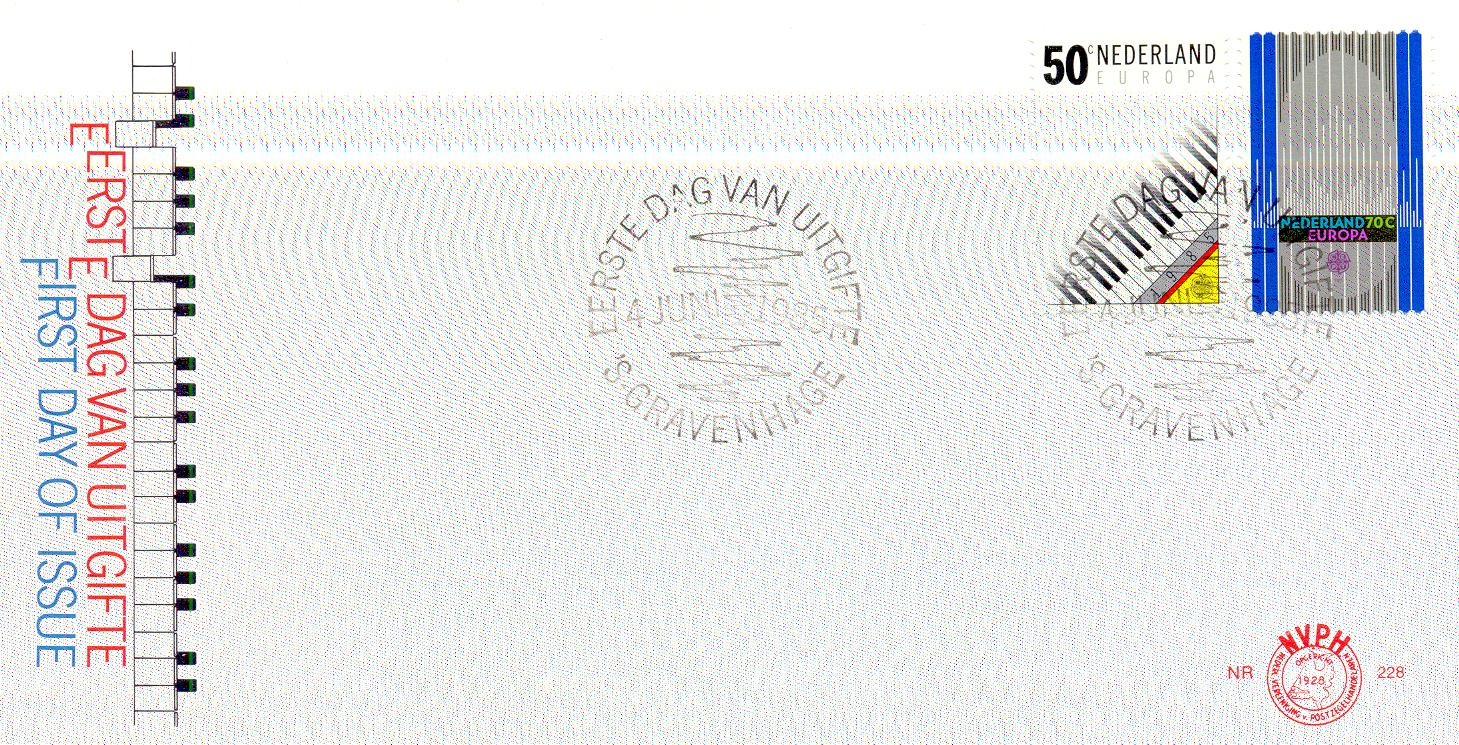
EUROPA 1986 – Nature 13.5.1986

(50c) Het Loo Palace (meaning "The Woods Palace") is a palace in Apeldoorn, Netherlands. The symmetrical Dutch Baroque building was designed by Jacob Roman and Johan van Swieten and was built between 1684 and 1686 for stadtholder-king William III and Mary II of England. The garden was designed by Claude Desgotz.
The palace was a residence of the House of Orange-Nassau from the 17th century until the death of Queen Wilhelmina in 1962. The building was renovated between 1976 and 1982. Since 1984, the palace is a state museum open for the general public, showing interiors with original furniture, objects and paintings of the House of Orange-Nassau.
(70c) Old Tree.

Monday, December 5, 2016

EUROPA 1982 Historic Events – Netherlands - Cities in Holland with fortifications and defensive walls 16.9.1982

(50 ct) Defensive works of Enkhuizen. Enkhuizen is a municipality and a city in the Netherlands, in the province of North Holland and the region of West-Frisia.
A defensive wall (or a "Rampart") is a fortification used to protect a city or settlement from potential aggressors. In ancient to modern times, they were used to enclose settlements.

(70 ct) Defensive works of  Coevorden which is a municipality and a city in the northeastern Netherlands. During the municipal reorganisation in the province in 1998, Coevorden merged with Dalen, Sleen, Oosterhesselen and Zweeloo.
A star fort, bastion fort or trace italienne, is a fortification in a style that evolved during the age of gunpowder when the cannon came to dominate the battlefield. It was first seen in the mid-15th century in Italy.

Tuesday, August 2, 2016

EUROPA C.E.P.T - Bridge - 25th anniversary 28.4.1984


France 1984  European Post and Telecommunications Conference 25th Anniversary 2 value set depicting Bridge and River. 

Thursday, January 28, 2016

EUROPA1985 - "Year of the Music" 1.4.1985

The EUROPA-CEPT Motto for 1985 was "Year of the Music", and the Faroes contributed with a set of two, showing youngsters playing instruments. The fitst one (on the FDC) was (280) youngsters Playing flute, cello and piano, and the second one was Playing saxophone, drums and guitar. Date of issue was 1 April 1985.

Note, that the Faroese instrumental tradition is quite young, as first in the beginning of the 20th century the baker Hansen began to play and train others. Before, Faroese music was only oral. When these stamps came out, the faroese music scene, as we know it today, was just beginning its development.  

Thank you Merja.

Sunday, August 23, 2015

EUROPA81 - Bailiwick of Guernsey - Folklore 22.5.1981

12pence stamp is about Sailors paying respect to 'Le Petit Bonhomme Andriou' (rock resembling head of a man)

Jerbourg Point or the Jerbourg Peninsula is the southeastern point of the Bailiwick of Guernsey in the English Channel off the coast of Normandy, lying within St Martin Parish. It marks the end of the east coast cliffs and beginning of the south coast cliffs. It provides scenic views of the Little Russel and many other islands.

A folk legend that is narrated in Le Petit Bon Homme Andriou in Guersney is about the Archdruid, the last person to convert to Christianity. Druid was not willing to convert to Christianity when all his fellow people had already done so. He, therefore, decided to retire to a secluded cave in the cliff of Jerbourg Point. From this point, as was his regular habit to watch the sea during severe storm, he saw a ship at a distance approaching, heaving heavily towards the rocks of the peninsula to its utter doom. Druid, frightened by this scene, offered prayers to his pagan gods to save the ship and its passengers. As the gale did not abate and the crash became imminent, he prayed to the Christian God with a vow that if the ship was saved he would convert to Christianity and would build a chapel for the Virgin Mary, the Mother of God. As providence would have it, the storm abated and the disaster of ship wrecking against the Jerbourg Peninsula was averted.


The 18pence stamp depicts Fairies and the Legend of the Guernsey Lily
One day, the king of the fairies arrived at Vazon in Guernsey in his boat and, after he had landed, he found that he was very tired and so he lay down under a hedge and went to sleep. A beautiful young girl called Michele passed by and saw him fast asleep. Whilst she watched him, he opened his eyes and at the moment that he saw her he fell deeply in love with her. He persuaded her to go with him to his kingdom of the fairies to be his queen, but she asked him if she could leave something for her parents. She knew that they would miss her and she didn’t want to be forgotten. The little man gave her a bulb, and she planted it in the sand at the edge of the beach. Then they went off together in the boat to the fairy kingdom. Michele never came back to Guernsey.

Later her mother, completely beside herself, was searching for her daughter along the beach when she saw a beautiful flower growing in the sand. It was so lovely, scarlet with fairy gold which powdered its petals. At that moment, she knew that she would not find her daughter and that the magnificent flower had taken her place.

Thank you Merja for this wonderful FDC.

Saturday, August 30, 2014

1983 EUROPA CEPT - Historic Events - Notker of Saint Gall 7.3.1983

The theme for CEPT stamps in 1983 was "Historic Events". Liechtenstein decided to honour Notker the Stammerer (Notker Balbulus) ( 840 – 6 April 912), Also called Notker INotker the Poet or Notker of Saint Gall, was a musician, author, poet, and Benedictine monk at the Abbey of Saint Gall in modern Switzerland. He is commonly accepted to be the "Monk of Saint Gall" (Monachus Sangallensis) who wrote De Carolo Magno, a book of anecdotes about the Emperor Charlemagne.
Notker was born around 840, to a distinguished family. He would seem to have been born in the modern canton of Saint Gall in Switzerland.  He became a monk there and is mentioned as librarian in 890 and as master of guests in 892–4. He was chiefly active as a teacher, and displayed refinement of taste as poet and author. 
He completed Erchanbert's chronicle, arranged a martyrology, composed a metrical biography of Saint Gall, and authored other works.  
Thank you Merja.

Tuesday, July 8, 2014

1988 EUROPA CEPT – Liechtenstein – Transport and Communications

The EUROPA CEPT theme for postage stamps in Europe in 1988 was ”Transport and Communications”. Liechtenstein issued these two stamps and the cover to portray this theme on 7.3.1988.  
The stamp on the left depicts Satellite Communications, and the stamp on the right depicts a monorail train, which greatly aid providing high speed convenient transportation.  

Thank you Merja.

Saturday, July 5, 2014

1990 EUROPA - Post Offices - Switzerland 22.5.1990

The EUROPA CEPT theme for 1990 was "Post Offices". Switzerland issued these two stamps featuring the historic buildings housing the Post Offices at Lucerne and Geneva.

Thank you Maria.

Tuesday, July 1, 2014

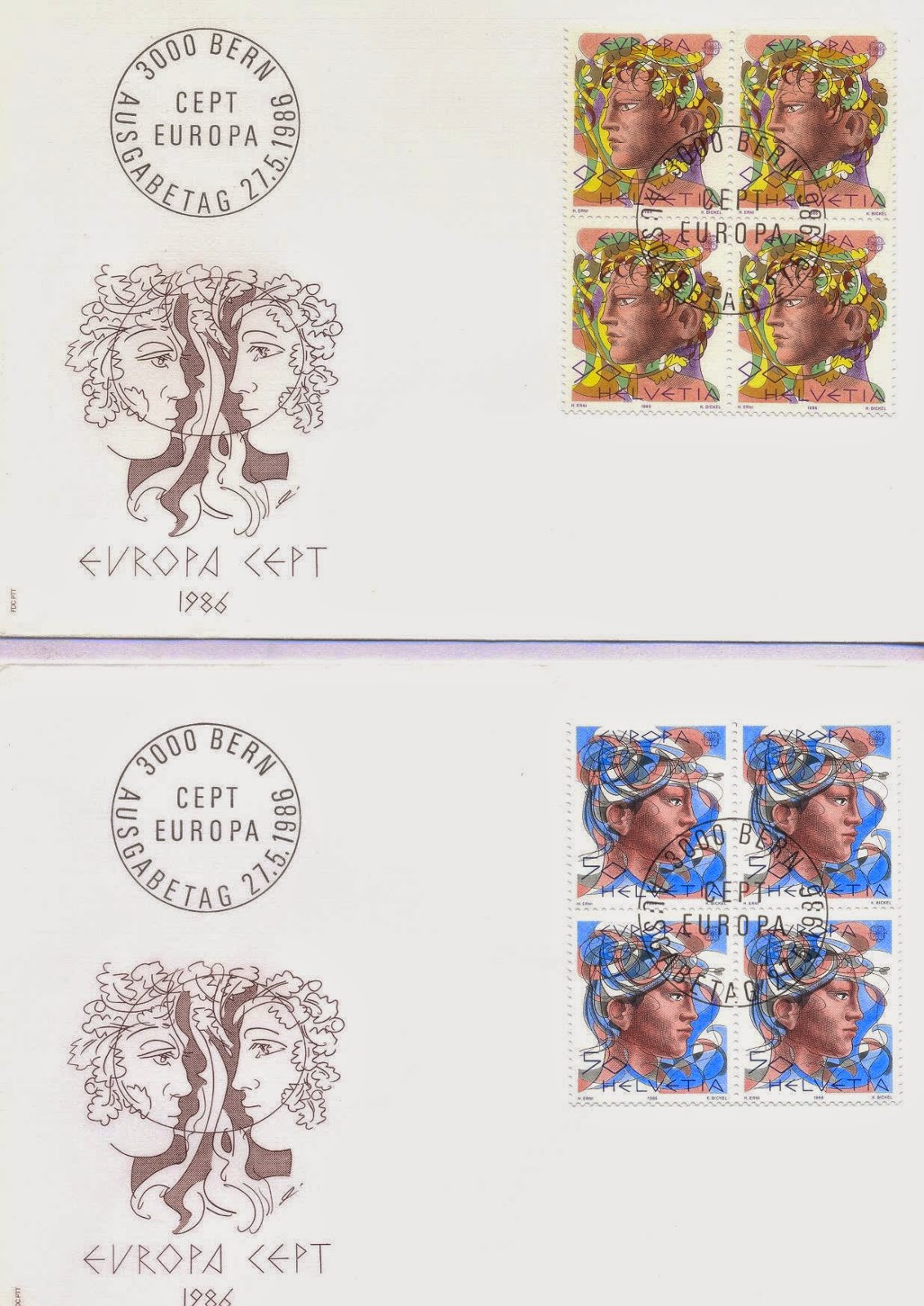
1986 EUROPA - Switzerland - Nature Conservation 27.5.1986

The set of two Swiss stamps on these two FDCs were issued as per the theme of EUROPA CEPT stamps in 1986, name "Nature Conservation".

Thank you Maria.

Sunday, April 27, 2014

EUROPA 1982 - Historic Events - Danish women were granted the right to vote on 3.5.1982

The theme for EUROPA stamps in 1982 was "Historic Events". And what could be more important than the event Denmark chose to portray on the special stamp and cover - Women's Right to Vote.

The stamp on this Danish first day cover commemorates that momentous day in 1915 when the tightening from 1866 was reversed, Women's suffrage was introduced in Denmark, and women were given the right to vote in Rigsdag elections.

Danish women were granted the right to vote on June 5, 1915. Female enfranchisement was part and parcel of a major overhaul of the 1849 Danish Constitution. To mark the occasion, more than 12,000 women marched in procession to the square in front of the Amalienborg royal palaces. A declaration signed by 36 leading women from a wide range of women’s societies was handed in to the King and the leader of parliament. The declaration included the statement:

“On this for us so momentous a day, when Danish women’s right to vote in parliamentary elections has become an irreversible reality, we speak on behalf of thousands of women in expressing to the Danish Government and Parliament our delight at the full political rights of citizenship granted to women by the new Constitution.” Kvinden og Samfundet (Woman and Society), no. 12, 1915.

The women who formulated the declaration had deliberately not used the word ‘thank’. They wanted to emphasise that parliamentary enfranchisement was a civil right and not a charitable act necessitating gratitude.

Women from all strata of society and from every grouping within women’s associations took part in the procession (shown graphically on the cover), which was the largest manifestation of women’s political activism in Denmark at the time.

The march on June 5 1915 was the culmination of a long and persistent struggle, both in and outside parliament, for women’s enfranchisement.

Thank you Merja.

Thursday, April 10, 2014

EUROPA 1982 - Portugal - 150th Anniversary of the Bravos do Mindelo 3.5.1982

Maria gave me this first day cover with the impressive minisheet of EUROPA 82 stamps issued by Portugal on 3.5.1982 being the 150th Anniversary of the Historic event in Mindelo. The EUROPA theme for postage stamps in 1982 was “Historic Events”.

Mindelo is a coastal civil parish in Vila do Conde Municipality, along the Green Coast in continental Portugal. In 2001 its population was 3402, in a coastal area that included 5.74 km² (with a population density of approximately 592 citizens per kilometre square.
The village, and in particular the beaches between Mindelo and Pampelido, were important in the being the location for the landing of Liberal forces during the Liberal Wars. Under the command of Peter IV, the troops, later referred to as the Bravos do Mindelo (the Brave of Mindelo), arriving from the Azores, disembarked along the beach on 8 July 1832, before proceeding to Porto.

Saturday, March 22, 2014

EUROPA 1983 - Cyprus - The Great Achievements of the Human Genius 3.5.1983

Ever since 1961 Cyprus has been releasing Europa stamp series. The common subject decided by CEPT for this year refers to "The Great Achievements of the Human Genius". One of the two stamps released by Cyprus is dedicated to the Cypriot syllabary and the other to the mining, smelting, marketing and use of cooper and bronze.

Copper and Bronze. The 200 mils stamp depicts a piece of copper ore, a copper ingot of the Mycenean period (1450-1250 B.C.) found at Engomi and a bronze jug of the Roman period (2nd century A.D.).

Copper and bronze, well known to the Cypriots since the Chalcolithic Age (4000-2500 B.C.), became a main product of mining and smelting during the Early and Middle Bronze Ages (2500-1650 B.C.). In the Late Bronze Age (1560-1050 B.C.) bronze was massively exported in the form of ingot. The copper mines and smelting workshops found everywhere in Cyprus show the high exploitation of copper and bronze, while the various tools, weapons, utensils, coins, jewellery, statues etc found in almost every archaeological excavation indicate their use in every day life.

Cyprus Syllabary. The 50 mils stamp depicts a lime tombstone of the 6th century B.C., found at Yialia, Paphos. It bears an inscription in the Cypriot syllabary with the name of Timokypra, daughter of Onasikypros, read from right to left.

The Cypriot syllabary, according to recent archaeological research, was in use in the 10th century B.C., although its extensive use was during the 5th and 4th century B.C. It was abolished in 312 B.C. when Ptolemy A' introduced the Greek alphabet. It consists of about 55 symbols, each one representing either a vowel or a syllable, and has been deciphered through the comparative study of the Greek and the Cypriot syllabary texts of the bilingual inscriptions.

Thank you Merja.

Saturday, July 27, 2013

1982 EUROPA - Portugal Historic Events 3.5.1982


The stamp on this first day cover was issued on 3rd May 1982 as part of the EUROPA CEPT series of stamps. The theme for 1982 was "Historic Events".
The stamp on the cover depicts  a scene from the presentation of Manuel I (Portuguese  king in that time) to the Pope in Rome, in 1514. It was a very great ceremony, even an Indian elephant took part in the ceremony.
Tristão da Cunha (c. 1460 – c. 1540) was a Portuguese explorer and naval commander. In 1514 he served as ambassador from king Manuel I of Portugal to Pope Leo X leading a luxurious embassy presenting in Rome the new conquests of Portugal. He later became a member of the Portuguese Privy Council.
Hanno (c. 1510 – 8 June 1516) was the pet white elephant given by King Manuel I of Portugal to Pope Leo X (born Giovanni de' Medici) at his coronation. Hanno, actually an Asian elephant, came to Rome in 1514 with the Portuguese ambassador Tristão da Cunha and quickly became the Pope's favorite animal. Hanno died two years later from complications of a treatment for constipation with gold-enriched laxative.
King Manuel had either received him as a gift from the King of Cochin, or had asked Afonso de Albuquerque, his viceroy in India, to purchase him. Hanno was said to be white in colour, and arrived by ship from Lisbon to Rome in 1514, aged about four years, and was kept initially in an enclosure in the Belvedere courtyard, then moved to a specially constructed building between St. Peter's Basilica and the Apostolic Palace, near the Borgo Sant'Angelo (a road in the rione of Borgo). 
Thank you Maria for this lovely FDC.

Thursday, June 27, 2013

1983 EUROPA - Inventions - Iceland 5.5.1983

The theme for EUROPA CEPT stamps in 1983 was "Inventions”. Iceland chose the inventions made in that country for using geothermal energy, for these two impressive stamps.
Due to the special geological location of Iceland, the high concentration of volcanoes in the area is often an advantage in the generation of geothermal energy, the heating and production of electricity. During winter, pavements near these areas (such as Reykjavik and Akureyri) are heated up. This causes heat to come to the surface.
Five major geothermal power plants exist in Iceland, which produce approximately 26.2% (2010) of the nation's energy. In addition, geothermal heating meets the heating and hot water requirements of approximately 87% of all buildings in Iceland. Apart from geothermal energy, 73.8% of the nation’s electricity is generated by hydro power, and 0.1% from fossil fuels.
Consumption of primary geothermal energy in 2004 was 79.7petajoules (PJ), approximately 53.4% of the total national consumption of primary energy, 149.1 PJ. The corresponding share for hydro power was 17.2%,petroleum was 26.3%, and coal was 3%. Plans are underway to turn Iceland into a 100% fossil-fuel-free nation in the near future. For example, Iceland's abundant geothermal energy has enabled renewable energy initiatives, such as Carbon Recycling International’s carbon dioxide to methanol fuel process.  

Thank you Dear Maria for this very interesting FDC.

Thursday, October 4, 2012

EUROPA - inventions - Finland -Temppeliaukio Church


This Finnish FDC (EUROPA CEPT) postmarked 2.5.1983 is about Pieces of work of human genius and “inventions” which was the theme for EUROPA stamps in 1983.
The stamp which is one of a set of two depicts the Temppeliaukio Church. Temppeliaukio Church is a Lutheran church in the Töölö neighborhood of Helsinki. The church was designed by architects and brothersTimo and Tuomo Suomalainen and opened in 1969.
The Temppeliaukio/Tempelplatsen (Temple square) was selected as a location for a church in the 1930s, but the plan by J. S. Siren, the winner of the second competition to design the architecture of the church, was interrupted in its early stages when World War II began in 1939. After the war, there was another architectural competition, which was won by Timo Suomalainen and Tuomo Suomalainen in 1961. For economic reasons, the suggested plan was scaled back and the interior space of the church reduced by about one-quarter from the original plan. Construction finally began in February 1968, and the rock-temple was completed for consecration in September 1969.
The interior was excavated and built into the rock but is bathed in natural light entering through the glazed dome. The church is used frequently as a concert venue due to its excellent acoustics. The acoustic quality is ensured by the rough, virtually unworked rock surfaces. Leaving the interior surfaces of the church exposed was not something that was in the original plans for the church. Conductor Paavo Berglund told the brothers of his experiences in the best music halls, and the acoustical engineer Mauri Parjo set out requirements for the wall surfaces. The architect brothers discovered that they could fulfill all the requirements by realising their own idea of leaving the rock walls exposed in the Church Hall. This idea the brothers already had when planning the competition entry, but they had been afraid to present it thinking it too radical for the competition jury.
The Temppeliaukio church is one of the most popular tourist attractions in the city; half a million people visit it annually. The stone-hewn church is located in the heart of Helsinki. Maintaining the original character of the square is the fundamental concept behind the building. The idiosyncratic choice of form has made it a favorite with professionals and aficionados of architecture.
The church furnishings were designed by the architects. Organ builder Veikko Virtanen manufactured the church organ, which has 43 stops. There are no bells at the church; a recording of bells composed by Taneli Kuusistois played via loudspeakers on the exterior wall. Thank you Merja for this nice FDC.

Tuesday, January 3, 2012

1985 EUROPA CEPT - Cyprus - European Music Year 6.5.1985


The theme for the Europa CEPT stamps for 1985 was that the year would be dedicated as the “European Music Year”. In keeping with this theme Cyprus issued these two stamps. One featuring two traditional musical instruments, and the other clay model figures depicting ancient musicians. And a well-illustrated cover celebrating this great cause on 6th May, 1985. Merja sent me this nice and pretty First Day Cover.

Friday, December 23, 2011

EUROPA CEPT 1988 – Finland - Transport and Communications


The Europa CEPT theme for postage stamps in Europe in 1988 was ”Transport and Communications”. Finland issued these two stamps and the cover to portray this theme on 23.5.1988. This FDC was given to me by Merja.
The stamp on the left depicts Electronic Communications. In telecommunication, communications-electronics (C-E) is the specialized field concerned with the use of electronic devices and systems for the acquisition or acceptance, processing, storage, display, analysis, protection, disposition, and transfer of information.
C-E includes the wide range of responsibilities and actions relating to:
  • Electronic devices and systems used in the transfer of ideas and perceptions;
  • Electronic sensors and sensory systems used in the acquisition of information devoid of semantic influence;
Electronic devices and systems intended to allow friendly forces to operate in hostile environments and to deny to hostile forces the effective use of electromagnetic resources.
The stamp on the right shows a horse drawn tram which was prevalent in Finland in the late 19th and early 20th Centuries. Horse Drawn Tram. Trams in Finland go back to a horse-drawn Turku tramway network, which opened in 1890. Electric tramway traction started in Finland in 1900, and the horse-drawn trams last operated in 1917.
  • Although there were three Finnish tramway networks between 1912 and World War II, the number of networks had dwindled to just one, in Helsinki, by 1972. Since then, the Helsinki network has remained Finland's only tramway network. However, there have been, and still are, a number of proposals to set up new networks, in the form of light rail, elsewhere in the country.