Showing posts with label New Zealand1981-1990. Show all posts

Monday, February 1, 2016

Vintage Transport 6.3.1885

Trams and cable cars initially horse-drawn then steam-powered and later electric-powered were a vital means of public transport in New Zealand cities for over 100 years. New Zealand town dwellers, having had no option but to rely on their own feet until the latter half of the 19th century reacted excitedly to the first signs of public transport. Where wheeled transport was available wagonettes, drays, and particularly, the high and flimsy horse-buses, made local travel an adventure.
Tram-cars reigned supreme in New Zealand streets for longer than any other public vehicle.  There were weather-beaten drivers holding tightly to their reins, grippers or control handles.  There were the many different conductors collecting fares; and during wartime there were the women who stepped in to help out.
All served New Zealand and New Zealanders over the years, delivering people to their homes, businesses and recreational activities.  The public in turn became attached to these structures of wood and steel that gave everyone the freedom of the cities before the days of the all-conquering automobile.


(24c) The Nelson Horse-Drawn Tram (1862) 
Nelson developed the first passenger street tramway.  A single horse pulled the coach-style tram along 1.6 kilometres of line from the city centre to the Port of Nelson.  The initial sixpenny fare was dropped to threepence to encourage greater use after pranksters laying stones on the rails caused derailments.  In 1901 the service was bought by the Town Council but the cost of modernisation and electrification proved too much and the tramway was dismantled and removed.
(30c) The Graham's Town Steam Tram (1871)
One of the earliest locally-built tram carriages was made of that most famous of New Zealand timbers, kauri.  Its short career had a rather inauspicious beginning.  The discovery of gold at Graham's Town (now Thames) meant many passengers for the country's first steam tramway opened in 1871.  The track ran from Thames to the deep sea wharf at Tararu Point.  In May 1874 a heavy gale partly destroyed the wharf and washed away a large section of the tramway.  Damage was so great both the wharf and tramway were abandoned.  The line closed on 10 November 1874.
(35c) The Dunedin Cable Car (1881) - 35c
New Zealand's first cable cars appeared in Dunedin and came to be widely utilised there.  The Rattray Street cable tramway was the first to operate outside the United States of America.  In the days when horses and steam were the only recognised means of vehicle power, the sight of cable cars climbing the steep hills without visible means of power was awe-inspiring.  The cables were laid in tunnels beneath the road.
(40c) Auckland - Electric (1902) - 40c
Although Dunedin had the first electrics, Auckland was the first to go for a complete electric system and the novelty of the horseless tramcars attracted 15,000 passengers at twopence a ride on its first day in service.  Being cheaper and quicker than the horse-drawn trams, Auckland became a community of tram-riders.
(45c) Wellington - Electric (1904) - 45c
Wellington's first electric tram was a single track, double decker tram which ran for the first time from the Newtown tram sheds to Kent Terrace on 30 June 1904.  Brilliantly lit, the tram came slowly and steadily down the track accompanied by frequent flashes of electricity - the spectacle was unique and fascinated the population.
(58c) Christchurch - Electric (1905) - 58c
Depicted on this stamp is a 1905 Christchurch tram towing a trailer from Cathedral Square.  Early trams incorporated large spring loaded steel fenders mounted front and rear to protect cyclists and pedestrians.  Electric heaters were installed under each seat and winter travellers were often reluctant to leave their warm haven.  Yet unlike the Wellington system, seats were uncushioned, management considering cushioned seats unhygienic.

Thank you Merja for this lovely FDC.

Monday, January 4, 2016

Christmas Stamps 7.10.1981


Old Master - 14c
This stamp features the old master, 'Madonna suckling the Child', by Marco d'Oggiono, the original of which is in the Mackelvie Collection in the Auckland City Art Gallery.
St John's Church, Wakefield - 30c
This Anglican church, built in 1846 on a hillside in the tiny Wakefield settlement, is one of the oldest churches in New Zealand in continuous use.   Reverend C L Reay, resident Minister of Nelson, rode out from Nelson on Sunday, 11 October 1846 to hold service in it for the first time.  Over the years the church has been enlarged and renovated.
A Floral Scene - 40c
This stamp depicts the native plant 'Golden Tainui' which flowers near Christmas time.

Thank you Merja.

Tuesday, July 9, 2013

THE 1982 MAP STAMP 1.4.1982

THE 1982 MAP STAMP: THE VALUE OF SEVEN DOTS
In April 1982 the cost of posting a standard letter within New Zealand rose from 20 to 24 cents. This necessitated the issuing of a new stamp, and so the 24 cent pale green and ultramarine map stamp was born. The stamp was designed by Allan Mitchell, and printed in Melbourne by Leigh-Mardon, in sheets of 100 stamps (10 stamps x 10).

The stamp was current for three years, from 1 April 1982 to 1 July 1985. During that time it went through seven printings and the printings are indicated in plate blocks by dots within a square outline. As Geoff Rickards has pointed out, "in some cases a printing involved more than one combination of colour plates ... thereby producing a total of 12 different plate blocks".

This stamp depicted a map of New Zealand with longitude and latitude marking the country's position in the South Pacific.

Thank you Maria for this FDC.

Monday, March 25, 2013

Architecture 7.4.1982


This third issue in a series depicting architecture issued on 7th April, 1982, with: Alberton, Auckland; Caccia Birch, Palmerston North; railway station, Dunedin; and the post office, Ophir. This lovely FDC was given to me by my dear friend Maria.

Alberton, Auckland - 20c
Built in 1867 by Allan Taylor who came to New Zealand as a boy, having lived in India and Scotland.  Essentially, 'Alberton' was a farmhouse, with a timber frame and gabled building of 11 rooms with a verandah and open balcony.  Additions were made in the late 1860s and again in 1890, giving 'Alberton' much of its character and uniqueness.  Today, 'Alberton' retains its Victorian furnishings without much change.  It shows clearly how a 19th century land-owning family lived.

Caccia Birch, Palmerston North - 25c
Located by the Hokowhitu Lagoon, 'Caccia Birch' began as a modest dwelling in 1893 and was added to throughout the years.  From 1921, the property was owned by the Caccia Birch family who gave it to the Government in 1937.  It was used for various purposes and for a period served as a convalescent home until made available to Massey University.

Dunedin Railway Station - 30c
Built in 1904 at a cost of $239,000, it is regarded as the city's grandest public building.  The station has a most unusual ticket office with white tiled walls, ceramic panels and a mosaic floor depicting Victorian railway engines.

Post Office, Ophir - 35c
Built in 1886, is of considerable historical and architectural interest to Central Otago.  The interior retains the atmosphere of the early days and still has a postal box of the Victorian period.  The post office is now under the control of the Historic Places Trust.

Sunday, March 24, 2013

Centenary of Feilding and the International Year of Disabled Persons 4.2.1981

This first day cover commemorates not one but two events, as would be apparent by the two stamps on it.

Centenary of Feilding - 20c
1981 marked the centenary of the Constitution of Feilding as a Borough.  The town was named after the Honourable Colonel William Henry Adelbert Feilding, 1836-1895, son of 7th Earl of Denbeigh.  Feilding is a community serving the rural area of the upper Manawatu and has a population of about 13,000.  A main feature of the borough is the stock sale yards which play an important part in the agricultural and pastoral activities of the district.

International Year for Disabled Persons - 25c
The United Nations designated 1981 as a special year to recognise the large numbers of disabled people in the community.  The theme of the International Year was "Full Participation and Equality".  The official emblem chosen represents two people holding hands in solidarity and support of each other in a position of equality.  It symbolises equality, hope and support.  The surrounding leaves are taken from the United Nations emblem.

Thank you Maria for this nice FDC.

Wednesday, March 20, 2013

New Zealand Rivers


Four New Zealand rivers featured in the 1981 Scenic Stamp Issue. There are two from the North Island - the Kaiauai and the Mangahao - while the Shotover and the Cleddau are from the South Island. Thank you Maria. These are lovely stamps indeed on the FDC.
Kaiauai River - 30c
The Kaiauai is one of the many streams radiating from Mt Egmont /Taranaki, featured in the background of this stamp.  The actual source of the Kaiauai is between Egmont and one of the two secondary volcanoes, now appearing as much eroded remnants, which form a shoulder on Egmont's northern slopes.
Mangahao River - 35c
Like most large New Zealand rivers and streams, the Mangahao is stocked with trout.  The river rises in the Tararua mountain range, flows down the eastern side of the mountains, then flows north-eastward through farmland into a major North Island river, the Manawatu.  Mangahou and not Mangahao is the correct Maori name for this river.  Many pioneers found difficulty with the pronunciation of Maori place names and in time corrupted pronunciation such as this passed into written form and common usage.
Shotover River - 40c
This stamp depicts the Shotover River flowing south between the Coronet Range (at rear left) and Brown Peak (rear centre) in the Otago Province.  Although unsuitable for fishing, the river attracted thousands of people in the 1860s when gold fever struck.  The Shotover was to yield some fabulous returns, and a tributary of the Shotover, Skippers Creek, became known as the richest creek in the world.
Cleddau River - 60c
Over several mountain ranges to the west of the Shotover lies the Cleddau River which flows north-westward into Milford Sound.  The area is well known for its breathtaking alpine and fiord scenery, attracting tourists from all over the world.

Saturday, March 16, 2013

Royal Wedding29.7.1981

Maria sent me this lovely First Day Cover commemorating the Royal Wedding on 29.7.1981. Like many other British Commonwealth countries, New Zealand issued stamps to commemorate the Royal Wedding of His Royal Highness the Prince of Wales and Lady Diana Spencer, the Princess of Wales in July 1981.


Two se tenant stamps, one stamp depicting the Royal couple, with the other depicting St Paul's Cathedral, London where the wedding took place.

Tuesday, March 12, 2013

NEW ZEALAND 1982 Palmpex '82 National Stamp Exhibition.

This cover was used to promote the Stampex82 exhibition which would happen nearly two years later.


Palmpex '82 National Philatelic Exhibition - Palmerston North - City of Roses. It was stamped with the new 20 cent rose overprinted stamp.
The postage label depicted under the Rose stamp on the cover was issued to commemorate the Palmpex’82 National Stamp Exhibition held at the Centennial Convention Centre in Palmerston North on 15-23 May 1982. Incidentally Palmerston is known as the City of Roses, for obvious reasons.
The 20c Rose overprint and the FDC were issued in 1980 in order to popularise and publicise Palmex’82.
Thank you Maria for this FDC.

Friday, March 8, 2013

Government Life Insurance 3.6.1981


Special stamps for use solely by the Government Life Insurance Office were first issued in 1891, a lighthouse being incorporated into each stamp design. The inclusion of a stylised lighthouse on the 1981 Government Life stamp issue continued a theme that had always appeared on Government Life stamps since their inception.


The first stamps issued in New Zealand that did not feature Queen Victoria were the 1891 Government Life Insurance Office's stamps, which featured a lighthouse. All subsequent issues also had depictions of lighthouses, which were a 19th-century symbol of insurance. The 1981 issue marked a radical departure with a highly stylised and colourful design as seen on the six stamps on this impressive cover given to me by my dear friend Maria.

Monday, March 4, 2013

Beautiful New Zealand


Each year from 1972 the New Zealand Post Office has issued a scenic or tourist set of stamps to show the beauty of our country. One of the most famous of these sets was issued in 1983. It was called Beautiful New Zealand and was very popular with overseas collectors. That, New Zealand - from its coastline to its high country, from bush-fringed bays to majestic peaks - is a land of great and diverse beauty is amply demonstrated by these four lovely stamps on this First Day Cover issued on 1st June, 1983.
Mt Egmont / Taranaki - 35c
Mount Egmont which is located on the West Coast of the North Island is an andesite (mineral rock) volcano characterised, like Fujiama in Japan, by its symmetrical cone.  Mount Egmont is regarded as a dormant volcano having last erupted about 350 years ago.  The peak rises to 2518 metres from the plains of the surrounding province, Taranaki.
Egmont was named in 1770 by explorer James Cook as he sailed past but the Maori name Taranaki (Barren Mountain) was given equal and official status in 1986.
Cooks Bay - 40c
Cooks Bay is a popular summer resort situated on the Coromandel Peninsula on the East Coast of the North Island.  Locally, the sandy cove is known as Cooks Beach.  The whole area is picturesque with golden beaches, sparkling water and native pohutukawa trees.
Lake Matheson - 45c
Lake Matheson is a small bush-surrounded moraine lake on the north side of the Clearwater River near Fox Glacier on the South Island's West Coast.  The lake was formed by the retreat of Fox Glacier some 14,000 years ago which left behind a massive slab of "dead" ice insulated by a deep layer of moraine gravel.  In time, this separated from the mainstream of the glacier, the ice melted and the lake was created.
Lake Alexandrina - 70c
Lake Alexandrina is a small and beautiful satellite of Lake Tekapo in South Canterbury.  These lakes are just two of a number of glacial lakes in the South Island McKenzie country.  Lake Alexandrina is a wild life refuge, an exceptional trout fishing resort, and home for the South Island Acclimatisation Society.
Thank you My Dear Maria for this superb FDC.

Thursday, February 28, 2013

Paintings of Rita Angus 6.4.1983


Rita Angus (12 March 1908 – 25 January 1970) was a New Zealand painter born in Hastings. Along with Colin McCahon and Toss Woollaston, she is credited as one of the leading figures in twentieth century New Zealand art. She worked primarily in oil and water colours, and is well known for her portraits and landscapes.
This issue of stamps featured the works of Rita Angus whose meticulous compositions in oil and water-colours earned her the reputation as a leader of the modern school of New Zealand painting. Rita Angus, born in Hastings, trained as a painter in Christchurch where she lived until 1954 when she moved northwards to settle in Wellington.   During her career she made frequent painting trips throughout New Zealand, especially to Central Otago, Waikanae and Hawke's Bay.
A brief descriprtion about the stamps on the cover and the paintings depicted on them is given below.
Boats - Island Bay - 24c
Painted 1962-63, an oil 610mm x 610mm - belongs to a private collection in Auckland. The Italian fishing boats at Island Bay, Wellington emphasised the complex pattern of shapes and colours created by the moored boats.
Central Otago Landscape - 30c
Painted 1954/65/1969, an oil 524mm x 636mm - hangs in the National Art Gallery, Wellington. The "composite" landscape in Central Otago was made up of separate views recorded first in water-colours.  These range from Lake Wakatipu and the Remarkables to Cromwell and Alexandra.  It was begun in the 1950s and completed in 1969.
Wanaka Landscape - 35c
Painted 1939, a watercolour 228mm x 276mm - hangs in the Rita Angus Loan Collection, National Art Gallery, Wellington. Vivid colours and clearly defined forms were hallmarks of Rita Angus' style and these feature in her Wanaka landscape.
Tree - 45c
Painted 1943, a watercolour 300mm x 286mm - hangs in the Rita Angus Loan Collection, National Art Gallery, Wellington.  Rita Angus made numerous water-colour studies of flowers and plants and in 1943 painted a tree which grew in her sister's garden in Greymouth.  
These four stamps on the cover honour Rita Angus and her paintings depicted on the stamps. Thank you Maria for this pretty FDC.

Monday, February 25, 2013

Health Stamps - New Zealand 1.8.1984

The 1984 Health Stamp Issue of New Zealand issued on 1.8.1984 featured three popular breeds of horses - Clydesdales, Shetlands and Thoroughbreds. The proceeds of the 'Health' value of health stamps were donated to the Children's Health Camps movement.
Two se-tenant stamps depicting a Clydesdales and Shetland Ponies - 24c + 2c x 2
Clydesdales are distinguished by a combination of weight, size and activity, with exceptionally strong feet and limbs.  The history of the Clydesdale breed dates back to the early part of the 18th century.  Flemish stallions were imported into the Clyde valley area in Scotland, in an attempt to increase the size of the native draught horses.
Shetlands are one of the smallest and at the same time one of the strongest members of the equine world.  Their origin is unknown but their existence has been recorded in the Shetland Islands for many centuries.  The Shetland's docile nature and height make it an ideal saddle pony for small children.
Thoroughbred - 30c + 2c
The descriptive name "thoroughbred" is synonymous with racehorses.  All thoroughbreds are reputed to trace their ancestry back to three eastern sires - the Darley Arabian, the Godolphin Barb and the Byerley Turk.  New Zealand's temperate climate is an ideal environment for breeding thoroughbreds and the colour and spectacle of a race day is part of the New Zealand way of life.
Thank you Maria for this pretty FDC with the set of horses’ stamps.

Saturday, February 9, 2013

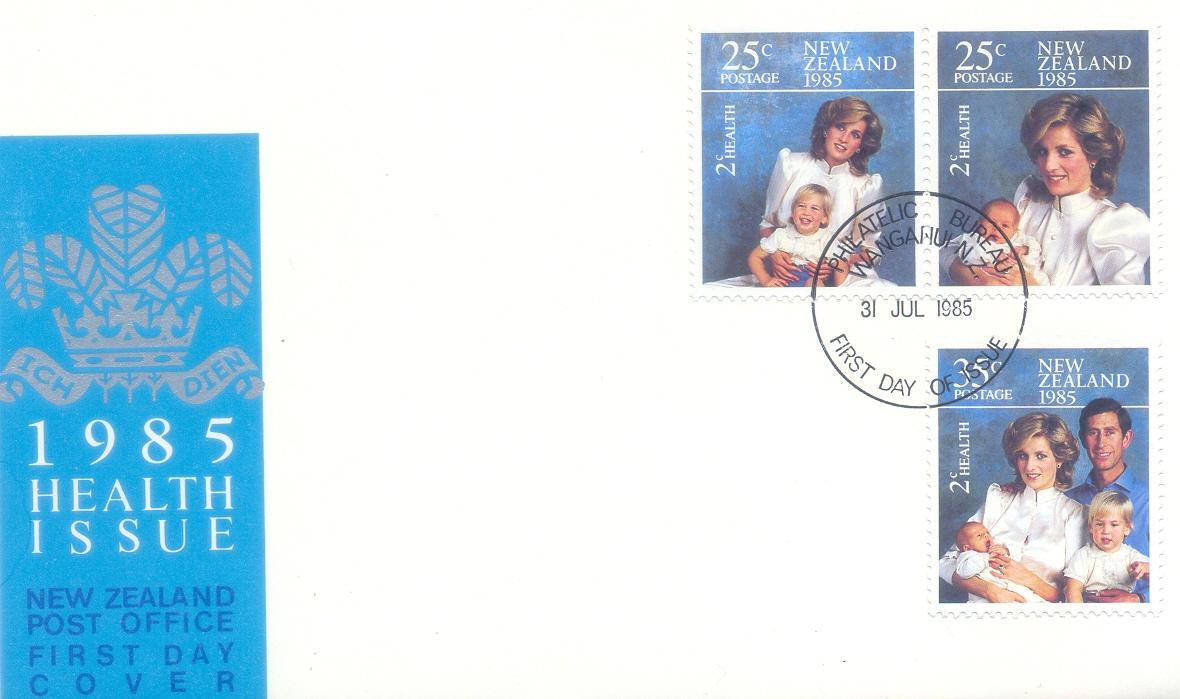
New Zealand – Health Stamps 31.7.1985


1985 Health Stamps featured photographs by Lord Snowdon of Prince Charles, The Princess of Wales, Prince William and Prince Henry.
Royal children appeared on the annual Health issue for the first time in 1943.  
The proceeds of the 'Health' value of health stamps were donated to the Children's Health Camps movement.
Thank you Maria for this lovely FDC.
25c + 2c x 2
Two se tenant stamps, one depicting The Princess of Wales and Prince William, the other The Princess of Wales and Prince Henry.
35c + 2c_a
This stamp depicted Prince Charles, The Princess of Wales, Prince William and Prince Henry.

Thursday, July 21, 2011

Royal Wedding 29.7.1981


Lady Diana Spencer married Charles Philip Arthur George (or to cut a long story short, Prince Charles, the Prince of Wales) at St Paul's Cathedral on July 29, 1981. New Zealand Post commemorated the occasion with these two stamps and the First Day Cover. And the rest as they say is history now. Maria sent me this cover.

Wednesday, November 3, 2010

New Zealand – A Slice of Heaven


From the Titahi Bay Boatsheds to Tane Mahuta, from Auckland's Sky Tower to the Christchurch Cathedral, New Zealand Post has captured the country's' 'Slices of Heaven' in its latest stamp issue 'New Zealand - a Slice of Heaven'.
The stamp concept has been developed with the premise that 'If you tried to capture a day in the life of New Zealand on something the size of a postage stamp, you might end up with this' Originally a painting on canvas, this artistic stamp issue captures a variety of uniquely kiwi experiences including: rural rugby, a 'typical country town' (with main street, garage, church, statue and tow truck), a camp ground during the school holidays, two hour traffic delays to pass a single-lane bridge on the way to a summer-holiday destination, and a world-famous New Zealand vineyard. New Zealand Post Stamps Marketing and Commercial Director, James Te Puni, said the 25 x 60 cent stamps in this release reflect New Zealand's culture, heritage and various iconic locations. "Each stamp shows a snapshot of the country and together the stamps form a unique image that captures 'a day in the life of New Zealand'. "The stamps creatively convey the distinctive kiwi culture and diverse landscapes that have led New Zealanders to refer to this beautiful nation as 'A Slice of Heaven' " said Mr Te Puni. One can go on a journey through the sights and sounds of Aotearoa, New Zealand. Along the way you’ll discover the unique kiwi culture and diverse landscapes which have lead New Zealanders to refer to this beautiful nation as ‘A Slice of Heaven’.
"Slice of Heaven" is also a single by New Zealand singer/songwriter Dave Dobbyn with the band Herbs, released in 1986 on the soundtrack of the animated motion picture, Footrot Flats: The Dog's Tail Tale. The single charted at No. 1 in New Zealand. It also appeared on Dobbyn's 1988 album, Loyal. Slice of Heaven featured in Nature's Best—New Zealand's Top 30 Songs of All Time, coming in at number 7. It was voted number 1 in 2009 by C4 viewers as the New Zealand's favourite song, and is often mistaken for the country's national anthem. This really remarkable sheetlet of stamps was given to me by Madhavi.