Showing posts with label Forests and Trees. Show all posts

Saturday, May 14, 2016

Indegenous Trees and Forests 2.2.1983

(8c) Cussonia spicata. Cussonia spicata (known as spiked cabbage treelowveld cabbage tree or common cabbage tree) is a tree in the Araliaceae family, which is native to the moister regions of Sub-Saharan Africa. It is cultivated as a garden plant in areas without extreme degrees of frost. It is one of the favorite foods of wild elephants.
(20c) Curtisia Dentata. Curtisia dentata (commonly known as the Assegai tree orCape Lancewood, is a flowering tree from Southern Africa. It is the sole species in genus Curtisia, which was originally classed as a type of "Dogwood" (Cornaceae), but is now placed in its own unique family Curtisiaceae.
It is increasingly popular as an ornamental tree for gardens, with dark glossy foliage and sprays of pure white berries. The bark of this tree is a very popular component of traditional African medicine, leading to overexploitation and a decline in the species in some areas of South Africa. The tree is protected in South Africa.
(25c) Calodendrum Capense. Calodendrum capense (Cape Chestnut) is an African tree which was first studied at The Cape in South Africa and cultivated widely for its prolific flower display. It is native to a swath of the east side of the continent from the equatorial highlands of Kenya at its northern limit southwards through isolated mountains in Tanzania to both sides of Lake Malawi, the Mashonaland Plateau and Eastern Highlands of Zimbabwe, and then along the lower slopes of the Drakensberg Mountains of South Africa and in coastal forests from Port Elizabeth to Cape Town.
(40c) Podocarpus Falcatus.  Afrocarpus falcatus ( Podocarpus falcatus) is a species of tree in the family Podocarpaceae. It is native to the montane forests of southern Africa, where it is distributed in Malawi, Mozambique, South Africa, and Swaziland. Common names include common yellowwoodbastard yellowwoodouteniqua yellowwoodAfrican fern pineweeping yew, It is widespread, in some areas abundant, and not considered threatened, but it is a protected tree in South Africa. It is grown as an ornamental tree, especially in South Africa, and occasionally abroad.

Tuesday, May 10, 2016

Trees of Venda 3.8.1983


Gardenia Spatulifolia. The bushveld gardenia is a small, relatively slow-growing tree, ideal as a focus plant in summer rainfall gardens or on patios.

Hyphaene Natalensis. Almost all parts of this very common palm are used for something, and feasability studies have been done on the economics of some aspects of this palm plant.

Albozia Adianthifolia. Are you looking for a fabulous shade tree, rich in a unique cultural history and adored by elephants and butterflies alike? Then look no further than the spectacular flat-crown albizia to add a year-round talking point to your garden!

Sesamothamnus LigardiiSesamothamnus lugardii (Transvaal sesame-bush, sesambos) is a species of plant in family Pedaliaceae, endemic to southern Namibia, eastern Botswana, southern Zimbabwe, and Kruger National Park in the Transvaal. It is a soft-stemmed shrub that grows alone or in scattered, small groups in hot, dry areas. The plant can grow to 4 meters in height with a very thick lower trunk, up to 1 meter in diameter, from which arise several thick branches. Flowers are white.

Thank you Merja.

Saturday, April 19, 2014

The Olive tree and its products 30.1.2014

A new commemorative stamp issue “The Olive tree and its products” was released by Cyprus Post on 30 January 2014. The issue comprises two stamps of the value of € 0, 34 and € 0, 51(se-tenant).
Cyprus has a long history of producing oil products. Olive trees have grown on the island since at least the Neolithic period (sixth millennium B.C.) and have been cultivated since the second millennium B.C.
Ancient oil presses for the production of olive oil dating back to the end of the 13th     century B.C. have been discovered on Cyprus.
The Olive Tree and Its Products issue includes three stamps: a €0.34 denomination picturing an olive tree in the foreground and rolling hills covered with more trees in the background; and a pair of se-tenant €0.51 stamps showing ripe olives and a bottle of olive oil. Marianna Iacovou designed the stamps. 

Thank you Merja.

Friday, March 28, 2014

Beautification of America 16.1.1969

Originally issued attached, as a se-tenant, these stamps issued on January 16, 1969 publicized First Lady Ladybird Johnson’s personal program for the Beautification of America.  Its goal was to encourage Americans to take pride in their country and plant flowers and trees.  

Each stamp represents a different area improved under this program.

Thank you Merja.

Tuesday, February 25, 2014

Cycads of Transkei


These four lovely stamps on the FDC depict the very attractive Cycads of Transkei, now in South Africa.
Cycads are seed plants typically characterized by a stout and woody (ligneous) trunk with a crown of large, hard and stiff, evergreen leaves. They usually have pinnate leaves. The individual plants are either all male or all female (dioecious). Cycads vary in size from having trunks from only a few centimeters to several meters tall. They typically grow very slowly and live very long, with some specimens known to be as much as 1,000 years old. Because of their superficial resemblance, they are sometimes confused with and mistaken for palms or ferns, but are only distantly related to either.
Cycads are found across much of the subtropical and tropical parts of the world. They are found in South and Central America (where the greatest diversity occurs), Mexico, the Antilles, southeastern United States, Australia, Melanesia, Micronesia, Japan, China, Southeast Asia, India, Sri Lanka, Madagascar, and southern and tropical Africa, where at least 65 species occur. Some can survive in harsh semidesert climates (xerophytic), others in wet rain forest conditions, and some in both. Some can grow in sand or even on rock, some in oxygen-poor, swampy, bog-like soils rich in organic material, and some in both. Some are able to grow in full sun, some in full shade, and some in both. Some are salt tolerant (halophytes).
Cycads belong to the biological division Cycadophyta. The three extant families of cycads are Cycadaceae, Stangeriaceae, and Zamiaceae. Though they are a minor component of the plant kingdom today, during the Jurassic period, they were extremely common. They have changed little since the Jurassic, compared to some major evolutionary changes in other plant divisions.
Cycads are gymnosperms (naked seeded), meaning their unfertilized seeds are open to the air to be directly fertilized by pollination, as contrasted with angiosperms, which have enclosed seeds with more complex fertilization arrangements. Cycads have very specialized pollinators, usually a specific species of beetle. They have been reported to fix nitrogen in association with a cyanobacterium living in the roots. These blue-green algae produce a neurotoxin called BMAA that is found in the seeds of cycads. This neurotoxin may enter a human food chain as the cycad seeds may be eaten by bats, and humans may eat the bats. It is hypothesized that this is a source of some neurological diseases in humans.
Thank you Maria.

Monday, December 2, 2013

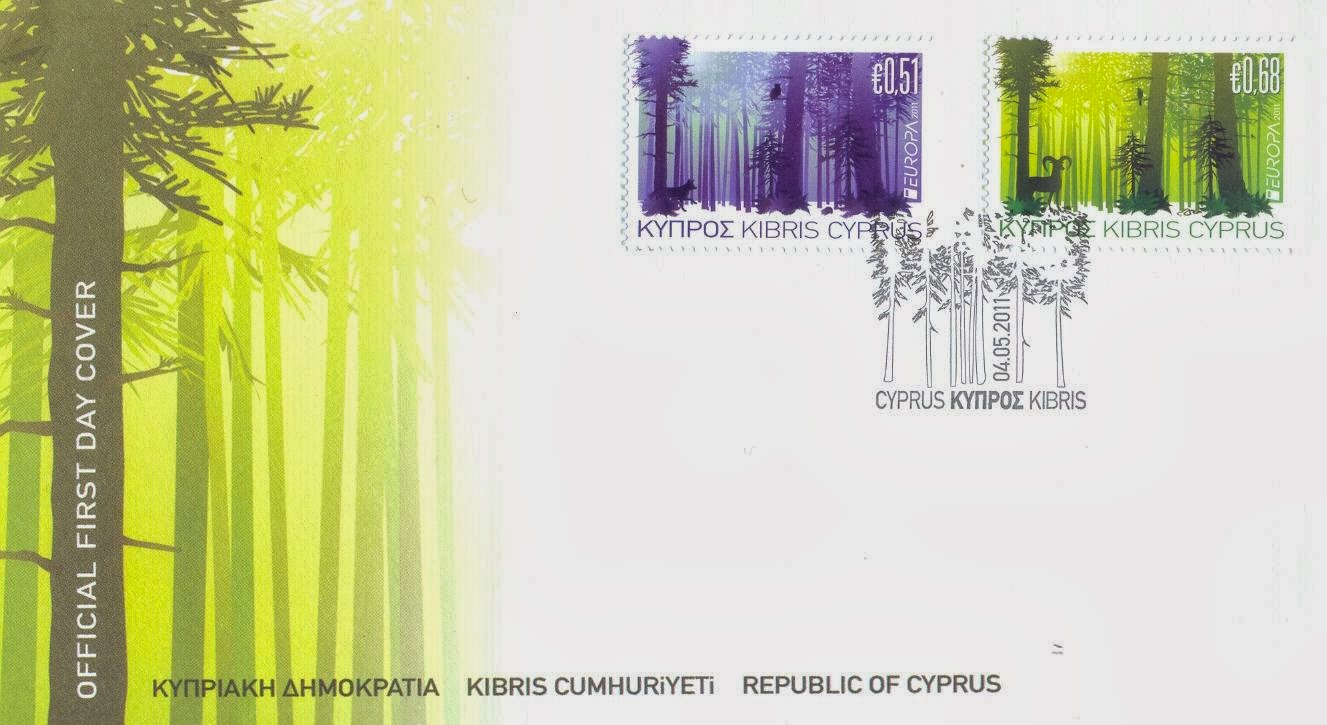
2011 The International Year of Forests 4.5.2011

The stamps on this Cyprus FDC were based on the EUROPA theme for 2011, namely, Forests. This Cyprus Post EUROPA Stamp entry was named the winner of PostEurop’s first ever EUROPA Jury Prize Competition which was held Saturday at the prestigious Brussels Town Hall, where an expert jury met and voted through closed ballot.
The International Year of Forests 2011 was established to raise awareness of how forests play an integral part in the livelihoods of 1.6 billion people worldwide, supply the habitat for millions of species, and play a critical role in mitigating the effects of climate change. 

Deforestation is the biggest threat to the world’s forests, destroying nearly 50,000 square miles per year. Replanting tropical forests will prove to be a critical tool in combating global warming, according to a report released December 9, 2010 by the U.S.-based Union of Concerned Scientists during the U.N. Climate Change Conference in Cancun, Mexico. Tree planting events in Ethiopia, Georgia, Jamaica, Lebanon, Poland and Korea are among events a number of member states and organizations have indicated their intention to promote to celebrate the International Year of Forests 2011.

Thank you Merja for this lovely FDC.

Wednesday, August 14, 2013

"twinning" of the Rambouillet Forest in France and the Black Forest in Germany 18.5.1968

The stamp on this French first day cover depicts a gnarled tree trunk and a fir tree, designed and engraved by Michel Monvoisin after drawings by French artist Marie-Elizabeth Wrede (1898-1981), and issued by France on May 18, 1968 to publicize the "twinning" of the Rambouillet Forest in France and the Black Forest in Germany.
“Twinning” between cities of different countries has been quite common, to promote friendly relations and understanding between peoples. The pairing of the Black Forest and the forest of Rambouillet should enable all those who love and care for them to meet beyond the confines of national borders.
Black forest and the forest of Rambouillet, with a surface area of 13, 000 ha, is much smaller than the Black Forest, but these two wooded areas represent each country similar to their glory, both historically and in terms of tourism.
Coming from France, the Black Forest begins in Fribourg and located between the cities of Offenburg, Triberg, Tuttingen and Schaffhausen. In the centre of the Black Forest, Lake Titisee occupies a prominent place, surrounds thermal spas of Hinterzarten, Friedenweller, Badenweiler and Faidberg, The scenery offers visitors spectacular panorames of slopes of majestic conifers, valley’s and glacial lakes, and a few remnants of strong castles. Rambouillet forest is divided into three major massifs (St. Leger, Tambouille Yvelines). It presents a wide variety of landscapes, with many ponds, rocks the most diverse species of trees. Charles X often stayed there for some time. Actually, Rambouillet is the summer residence of the Presidents of the Republic . Walkers can circulate freely throughout the forest, with the exception of a portion of the enclosure reserved for the large park. Both forests are home to abundant wildlife and variety of flowers; nature is preserved and protected for the greatest jamboree of nature lovers of all nations.
Thank you very much Maria for this lovely FDC.

Monday, June 17, 2013

Trees of Cyprus 10.10.1994

Now we come to good ole nature, and its generous natural gifts to Cyprus, as amply illustrated on the stamps on this FDC postmarked on 10.10.1994, so thoughtfully given to me by Merja. A brief description of these Trees of Cyrus is given below.

Black Pine (Pinus nigra ssp. Pallasiana). Black Pine (Pinus nigra ssp. Pallasiana) is an evergreen coniferous tree, reaching up to 17-30 in height with a straight trunk. The foliage is thick and conical in shape, and in older trees becomes flattened. The leaves are needle-like and long and are usually in pairs (occasionally found in threes). Male trees produce flowers and the females have large oval cones, found singly or in clusters. Found on pyrigenic slopes at 1200mm above sea level and as high as the Chionistra peak (1952m). A tree of great ecological and aesthetic value. Apart from the Juniper (Juniper foetidissima) it is the only tree which can survive the low temperatures and heavy snow-fall of the Troodos Mountains. It is used in building, furniture making, the construction of cases, and as firewood. It is highly flammable as it contains resin.

Cyprus Cedar (Cedrus libani ssp. Brevifolia). Cyprus Cedar (Cedrus libani ssp. Brevifolia) is an endemic, evergreen, coniferous tree, 20-30 m high with straight trunk. On mature tees the branches spread out in clear horizontal layers. The leaves are small and needle-like on thick spines; there are male flowers and the female cones are large and oval and stand upright on the branches. Natural clusters of the Cedar are now found only in the Tripylos area in the Paphos forest at 1000-1400m above sea level. This area has been declared a natural reserve for flora and fauna in accordance with the forestry law. The cedar is a strictly protected species, of great ecological and aesthetic value. In the past its wood was used for ship-building and furniture making, and is highly flammable because it contains resin.

Golden Oak (Quercus alnifolia). Golden Oak (Quercus alnifolia) is an endemic evergreen shrub or small tree, growing to up to 10m in height with a multitude of branches and broad irregular foliage. The leaves are thick, hard and leathery, oval in shape, dentate and are golden or brown underneath and dark green on top. The flowers are male and the tree bears acorns. The Golden Oak is found in pyrogenic slopes at 700-1900m, and is the main species, together with the rough pine, of forest vegetation of our country. The Golden Oak is an attractive endemic tree of great ecological and aesthetic value and covers large expanses of our forest land either together with other bushy vegetation or as undergrowth beneath conifers. Its stump is able to regenerate itself should it be cut down or burned. It stabilizes sharp slopes and improves the soil. It is used as firewood and makes excellent coal.

Strawberry tree (arbutus andrachne). Strawberry tree (arbutus andrachne) is an evergreen small tree or large shrub, 3-10m high with broad, irregular foliage and typically smooth, chestnut brown bark. The leaves are thick and leathery, broad, oval in shape. The flowers are white and in clusters. Found at heights of 100-1550 m in forests and is of great ecological and aesthetic value. Its fruit is food for many bird species. It is used for firewood and coal. It is relatively resistant to fire and regenerates from its stump.

Sunday, April 21, 2013

American Trees 9.10.1978


These two covers were given to me by Pia of Finland. They show four stamps with the famous American trees on them. A brief description of each is given below.

Giant Sequoia tree. Giant Sequoia is the world's largest tree in terms of total volume. They grow to an average height of 50-85 m (150-280 ft) and 5-7 m (16-23 ft) in diameter. Record trees have been reported to be 93.6 m (307 ft) in height and 8.85 m (29 ft) in diameter. The oldest known Giant Sequoia based on ring count is 3,200 years old. Giant Sequoia is a very popular ornamental tree in many areas. Areas where it is successfully grown include most of western and southern Europe, the Pacific Northwest of North America north to southwest British Columbia, southeast Australia, New Zealand and central-southern Chile. It is also grown, though less successfully, in parts of eastern North America.

Pinus strobus, commonly known as the eastern White Pine, is a large pine native to eastern North America. It occurs from Newfoundland west through the Great Lakes region to south eastern Manitoba and Minnesota, and south along the Mississippi Basin and Appalachian Mountains to northernmost Georgia and Mississippi. It is also known as the white pinenorthern white pine, orsoft pine. This tree is known to the Native American Haudenosaunee (Iroquois nation) as the Tree of Peace. It is also known as the Weymouth pine in the United Kingdom, named after George Weymouth who brought it to England in 1620.

American white oak - large slow-growing deciduous tree of the eastern United States having stout spreading branches and leaves with usually 7 rounded lobes; yields strong and durable hard wood.

American gray birch - medium-sized birch of eastern North America having white or pale grey bark and valueless wood; occurs often as a second-growth forest tree. Gray birch is an attractive tree that is often used as a winter landscape plant or when space limitations require the use of trees with a smaller stature. It can also be planted as a nurse tree to protect more valuable pines in the landscape that require protection to become established.

Wednesday, June 8, 2011

Canada - Forests


Thank you Guy Dorval for this lovely First Day Cover on Forests in this the International Year of Forests in 2011.


Monday, May 30, 2011

EUROPA - Cyprus – Forests 4.5.2011


This year's series "Europe 2011" consists of two stamps of 51 and 68 cent and has "Forests" as its theme. This theme has been chosen by the European Public Postal Operators (PostEurop) and is common to all country-members of this Association.
The forest, as we all know, is an area of large or small trees and bushes that densely cover a relatively large area of land. In contrast with an artificial forest, that is made up of trees planted by man, the natural forest consists of naturally grown trees that have developed on their own and has various names such as thicket, wood, or, if it is a small area, it is known as a spinney.
All natural forests constitute a particular community with their own life. An entire world with trees, all sorts of greenery, various wild animals, large and small birds, reptiles and bugs live in the forest, depending on the characteristics of every region. The trees in the forests differ according to the geographical zone or area. In the cold forests of North Europe, Canada and North America, evergreen coniferous trees are found, whereas n the forests of the temperate zone, where the summers are hot and the winters are cold, broad-leaf deciduous trees dominate the area. In the warmer climates we find the tropical forests, where the tips of the tall trees form a canopy cover, allowing hardly any light to pass through, making it an ideal area where exotic birds of paradise are found.
There are many benefits to a country in having a forest; in addition to their contribution to the economy of a country and the improvement to the residents' standards of living from their direct benefits, forests provide us with oxygen, have an effect on the climate of the area, mitigate extreme heat from the atmosphere, are wind breaks, prevent soil erosion, regulate the movement of surface and underground waters and spread happiness and joy, offering places of pleasure, where the public go to hunt, picnic, camp, walk and enjoy nature. Without the forests, there would be no life on our planet. My Dear friend Merja sent this FDC.

Monday, May 23, 2011

Forests


Around 60 % of Ã…land is covered by forest. This year’s Europa stamp theme therefore suits Ã…land Post perfectly! Artist Anette Gustafsson painted the picturesque edge of a forest. More than 40 varieties of trees and shrubs can be found in the Ã…land forests, roughly speaking. Pine-forests dominate the northern parts of Ã…land, whereas the southern parts consist of deciduous forests. On main Ã…land, we mostly find mixed forests. Spruce, pine and yew are three types of conifers native to Ã…land. Pine is the most common type of tree, both in dense forests and on bare cliffs. Spruce, on the other hand, needs nutritious soil to thrive. Common juniper, a shrub more than a tree, is also common in Ã…land. In the outer archipelago, junipers grow low, trailing along the cliffs, whereas the ones found in fertile soil are often tall and lofty. Noble trees such as ash, oak, elm, maple and lime tree are relatively common, ash being the most common species native to Ã…land. Other common types of deciduous trees are birch, alder, aspen, rowan, Swedish whitebeam, bird cherry and Finnish whitebeam. Thank you Ella for this lovely card.

Tuesday, May 17, 2011

EUROPA 2011 - Forests.


Stan sent me this lovely First Day Cover. The theme of the 20Kc Europa sponsored stamps is 'Forests'. I understand that many other European countries have also issued stamps with the same theme.