Showing posts with label Finland1981-1990. Show all posts

Tuesday, April 5, 2016

10th Anniversary of Helsinki Accords 19.6.1985

The swallow stamp issued in 1985 looks similar to the stamp issued in 30.7.1975. Values of the stamps differ. In 1975 the stamp celebrated the Conference on Security and co-operation in Europe and the Helsinki Accords were ennunciated. The Finnish stamp of 1985 celebrates the 10th Anniversary of Helsinki Accords.  On both stamps you can see Finlandia House and a swallow.

Wednesday, July 22, 2015

Christmas Stamps 2.11.1990


The stamp on the left depicts Santa Claus’ Main Post Office in the Santa Claus Village at the Arctic Circle, 8 km north of Rovaniemi. This is the only official post office of Santa Claus. It belongs to Finland's official postal service network. Here you can feel the Christmas spirit every day of the year and be served by the merry post office elves in several languages!


The stamp on the Right depicts Santa Claus's reindeer's who form an imaginary team of flying reindeers traditionally held to pull the sleigh of Santa Claus and help him deliver Christmas gifts to little children around the world. The commonly cited names of the reindeer are DasherDancerPrancerVixenCometCupidDonner, and Blitzen. They are based on those used in the 1823 poem "A Visit from St. Nicholas" (commonly called "The Night Before Christmas"), which is arguably the basis of reindeer's popularity as Christmas symbols, and in which Donner and Blitzen were originally called Dunderand Blixem respectively.
The enduring popularity of the Christmas song "Rudolph the Red-Nosed Reindeer" has led to Rudolph often joining the list.

Wednesday, August 21, 2013

200th Anniversary of Turku Musical Society 26.1.1990

The stamp on this cover was issued to commemorate the 200th Anniversary of Turku Musical Society. The Turku Philharmonic Orchestra (Finnish: Turun Filharmoninen Orkesteri) is a Finnish orchestra based in Turku, Finland. The oldest orchestra in Finland, the Turku Philharmonic is resident at the Turku Concert Hall, the first purpose-built concert hall in Finland, completed in 1952.
The orchestra was founded in 1790 under the name Turun Soitannollinen Seur (Musical Society of Turku). In 1927, the municipality of Turku took ownership of the ensemble, with Tauno Hannikainen as the orchestra's first chief conductor under municipal management.
Since January 2012, the orchestra's principal conductor is Leif Segerstam. Juha Kangas is the orchestra's principal guest conductor, since 2001. The orchestra's current composers in residence are Mikko Heiniö and Anders Hillborg.
The orchestra has recorded commercially for such labels as Ondine, Finlandia, and Naxos.
Merja gave me this nice cover.

Friday, November 9, 2012

Centenary of the Electric Power Plant at Tampere 15.3.19821

Finnish power plant operation is considered as having started on March, 15 in 1882. A prestigious crowd of distinguished guests witnessed lights being switched on in Finlayson weaving factory in Tampere marking this great event. A  total of 160 light bulbs. From this historic moment began the regular consumption of electricity in Finland. 

The Cover has depictions of Edision's bulb and a dynamo. Thank you Pia for this nice FDC.

Thursday, November 8, 2012

Kuopio 4.3.1982


Kuopio is a city and a municipality located in the region of Northern Savonia, . A popfinlandulation of 98,309 makes it the ninth biggest city in the country. The city has a total area of 2,317.24 square kilometres (894.69 sq mi), of which 719.85 km2 (277.94 sq mi) is water and half forest. The population density is only 62 /km2(160 /sq mi), but the city's urban areas are populated very densely (urban area: 1 617.6 /km²), nationally second only to capital Helsinki (urban area: 1,690.0/km²). The population of the entire Kuopio region is 119,472.
The town of Nilsiä is joining Kuopio at the beginning of the year 2013. After that, Kuopio’s population will be well over 100,000.
Kuopio celebrated its 200 years 04/03/1982. And hence, the issue of this interesting stamp and the FDC showing the Coat of Arms of this historic city. Thank you Pia.

Thursday, November 1, 2012

Seitseminen National Park 8.2.1982

Seitseminen National Park is located in the municipalities of Ikaalinen and Ylöjärvi in Finland. The national park was established in 1982 and later expanded in 1989. It now covers 45.5 square kilometres (17.6 sq mi). The park is a typical mix of upland and lowland coniferous boreal forests of the Suomenselkä watershed region. Upland areas are dominated by closed productive stands of Norway Spruce and Scots Pine while lowland areas are covered by sphagnum swamp and bog areas that also contain stunted (Scots Pine) and shrub like (Norway Spruce). These swamp and bog areas appear to be barren due to the sparse tree densities. Parts of the park contain some of the most ancient and oldest forests that are accessible to public in Finland.
The Kovero Farm, a tenant farm established in 1859, is part of the cultural heritage area of the park. Seitseminen National Park received the European Diploma of Protected Areas on June 19, 1996.  Thank you Pia for this interesting cover which was issued on 8.2.1982 on the inauguration of this Park.

Wednesday, October 24, 2012

75th Anniv. of Finland's Unicameral Parliament 25.5.1982

The Parliament Act that came into force on 1 October 1906 was a monumental reform. It replaced the old Diet dating back to the 17th century with a 200-seat unicameral Parliament.
The new Parliament Act introduced universal suffrage. No longer was the right to vote dependent on social status or gender. The reform increased the electorate tenfold. The minimum age for voting and standing for election was set at 24.
When parliamentary elections were held in the spring of 1907, Finnish women became the first in the world to exercise full political rights, including the right to stand for election. Nineteen women were returned as MPs. The unicameral Parliament held its first session on 23 May.
The new Parliament Act called for Members of Parliament to be elected directly and by secret ballot according to a proportional system based on districts. Parliament began meeting annually, placing legislative work on a regular and permanent basis.
Thank you Pia for sending me this very informative FDC which was issued to commemorate the 75th Anniversary of the Finnish Parliament on 25.5.1982. The stamp shows the hall of Parliament and one of the sculptures there.

Tuesday, October 23, 2012

Garden Plants and Greenhouses 16.4.1982

The stamp was issued to celebrate the 100th anniversary of Aura Trädgårdsvänner i Åbo (the society of "gardening friends" in Turku) on 16th April 1982. Thank you Pia for this lovely cover.
Many vegetables, berries, and fruits would grow better in Finland if the climate was warmer. Climate change may improve the conditions for horticulture in Finland. Nevertheless there is need to prepare for the changes by adapting the current and more southern plant species to suit the future climate, by developing new varieties, and by adopting new means of controlling pests that may be introduced as a result of climate change.
Many root and non-root vegetables, berries, and fruits are also grown outdoors and in greenhouses, albeit that annual crops are limited to tens of millions of kilograms. Of these horticultural products, the most common outdoor-grown vegetable is carrot, followed by onions, white cabbage, swede, and beetroot. Strawberries make up the largest outdoor berry crop, and strawberries are also the only berries produced on the same scale as the most common vegetables. Other berries that are grown in relatively large quantities are currants and raspberries. The only fruit trees to produce substantial harvests in Finland are apple trees. The most commonly cultivated greenhouse plants are tomato and cucumber. In addition to edible plants, greenhouses are also used to grow flowers, such as tulips, roses, and poinsettias.

Friday, October 19, 2012

Environment & Anti tuberculosis 16.8.1982

These three stamps on the First Day Cover were issued on 16.8.1982, not only to raise funds for the Finnish Red Cross, but also to highlight the plight of certain endangered animals. The surcharge shown on the stamps went to the Red Cross for fighting the scourge of tuberculosis. The details of the animals in question are given below. Thank you Pia for this pretty FDC.
The Garden dormouse (0.90+0.10). In spite of its name, the garden dormouse's main habitat is the forest, though it can also be found in fruit-growing regions. It is particularly common in southern Europe, but its range extends into the north. Garden dormice are often found in the Alps, in the Bavarian Forest, and in the Ore Mountains.
Flying squirrel (1.10+0.15).  Flying squirrels are not really capable of powered flight like birds or bats; instead, they glide between trees, and manoeuvre in the air using the body and the tail.
European mink. The European mink is mostly restricted to Europe. Its range was widespread in the 19th century, with a distribution extending from northern Spain in the west to the river Ob (just east of the Urals) in the east, and from the Archangelsk region in the north to the northern Caucasus in the south. However, over the last 150 years it has severely declined and been extirpated or greatly reduced over most of its former range.

Monday, October 15, 2012

Birth Centenary of Toivo Timoteus Kuula 7.7.1983

Toivo Timoteus Kuula (7 July 1883 – 18 May 1918)  was a Finnish conductor and composer. He was born in the city of Vaasa, when Finland still was a Grand Duchy under Russian rule. He is known as a colourful and passionate portrayer of Finnish nature and people.In 1909, Kuula became Jean Sibelius's first composition student. He is best remembered for his large output of melodic choir and vocal works. His instrumental works include two Ostrobothnian Suites for orchestra, a violin sonata, a piano trio, and an unfinished Symphony. Kuula's major choral work is the Stabat Mater, which remained unfinished at the time of his death. He also wrote a few dozen highly artistic piano works.
A Swedish critic once said that Kuula's music reaches parts of the human spirit where one is forced to deep examination of one's self.
Kuula was known to be a fierce Fennoman. He died in the provincial hospital in Voopuri in 1918 after being mortally wounded 18 days earlier on Walpurgis Night by a bullet fired by a Jager. The bullet was fired as a result of a quarrel that happened at the Hotel Seurahuone in conjunction with the first victory celebration of the White victory in the Civil War of Finland. Kuula is buried in Hietaniemi cemetery, Helsinki. 

Pia gave me this FDC issued to commemorate the 100th Birth Anniversary of this well known musician on 7.7.1983.

Thursday, October 4, 2012

EUROPA - inventions - Finland -Temppeliaukio Church


This Finnish FDC (EUROPA CEPT) postmarked 2.5.1983 is about Pieces of work of human genius and “inventions” which was the theme for EUROPA stamps in 1983.
The stamp which is one of a set of two depicts the Temppeliaukio Church. Temppeliaukio Church is a Lutheran church in the Töölö neighborhood of Helsinki. The church was designed by architects and brothersTimo and Tuomo Suomalainen and opened in 1969.
The Temppeliaukio/Tempelplatsen (Temple square) was selected as a location for a church in the 1930s, but the plan by J. S. Siren, the winner of the second competition to design the architecture of the church, was interrupted in its early stages when World War II began in 1939. After the war, there was another architectural competition, which was won by Timo Suomalainen and Tuomo Suomalainen in 1961. For economic reasons, the suggested plan was scaled back and the interior space of the church reduced by about one-quarter from the original plan. Construction finally began in February 1968, and the rock-temple was completed for consecration in September 1969.
The interior was excavated and built into the rock but is bathed in natural light entering through the glazed dome. The church is used frequently as a concert venue due to its excellent acoustics. The acoustic quality is ensured by the rough, virtually unworked rock surfaces. Leaving the interior surfaces of the church exposed was not something that was in the original plans for the church. Conductor Paavo Berglund told the brothers of his experiences in the best music halls, and the acoustical engineer Mauri Parjo set out requirements for the wall surfaces. The architect brothers discovered that they could fulfill all the requirements by realising their own idea of leaving the rock walls exposed in the Church Hall. This idea the brothers already had when planning the competition entry, but they had been afraid to present it thinking it too radical for the competition jury.
The Temppeliaukio church is one of the most popular tourist attractions in the city; half a million people visit it annually. The stone-hewn church is located in the heart of Helsinki. Maintaining the original character of the square is the fundamental concept behind the building. The idiosyncratic choice of form has made it a favorite with professionals and aficionados of architecture.
The church furnishings were designed by the architects. Organ builder Veikko Virtanen manufactured the church organ, which has 43 stops. There are no bells at the church; a recording of bells composed by Taneli Kuusistois played via loudspeakers on the exterior wall. Thank you Merja for this nice FDC.

Wednesday, October 3, 2012

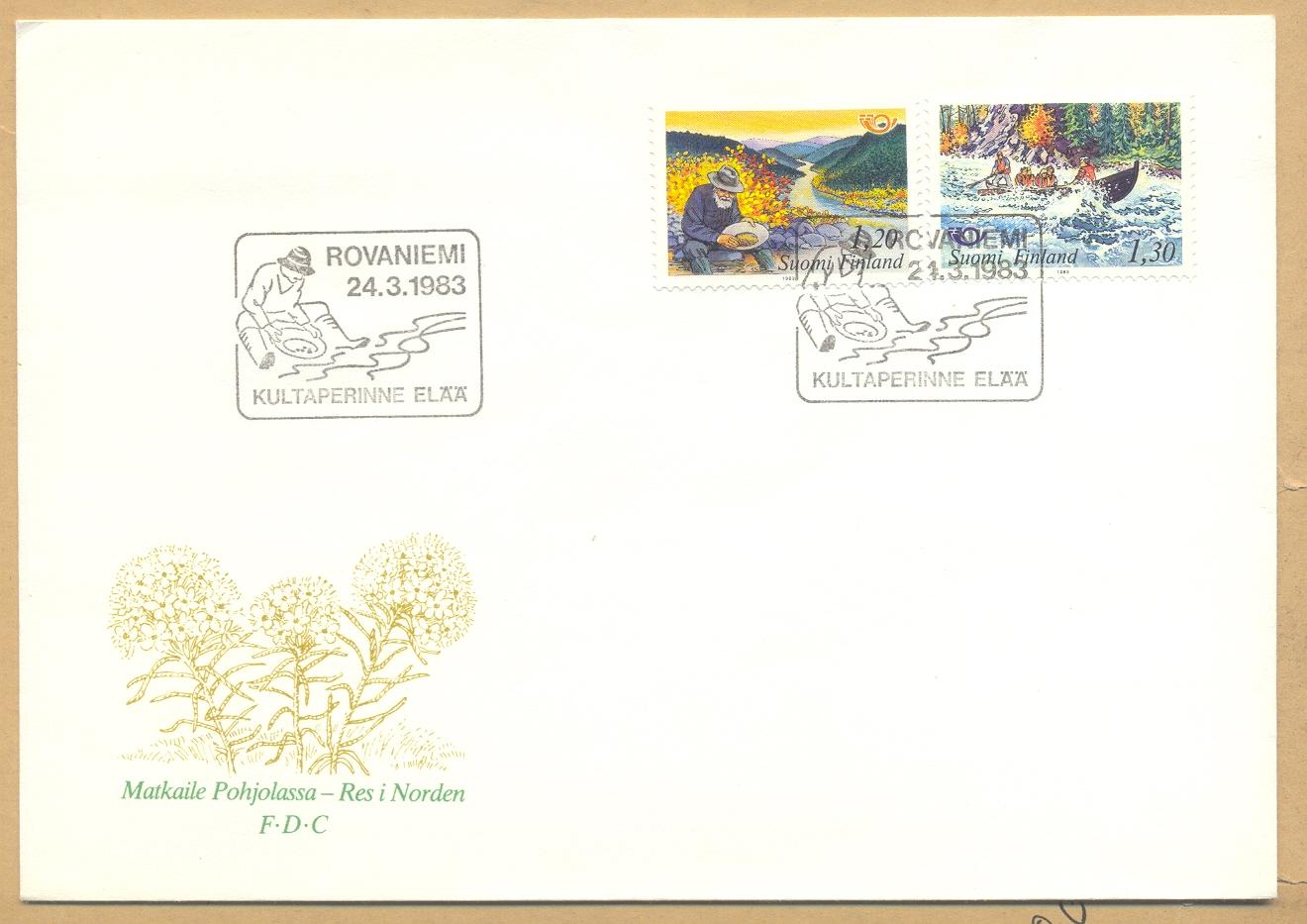
Travel in the North - Gold panning & White Water Rafting 24.3.1983

Norden stamps are a common issue amongst Nordic countries. It is as old as the Europa stamps. The idea of a Norden issue with a common motif was bred by Foreningen Norden [the Norden Association] in 1951. At the conference of the Nordic Postal Association in March the same year the consensus was to accede to the idea, but for  practical reasons it could only be accomplished later. In 1980 it was decided to issue Norden stamps every three years and (as the Europa stamps since 1974) to follow a common theme instead having a common design.

The inscriptions on the cover namely, Matkaile Pohjolassa and the same in Swedish "Res i Norden" meansTravel in the North (the theme for the year 1983).  
Gold panning (the stamp on the left) is very popular in Lapland's rivers. And gold is found there. European Goldpanning Championships 2012 were held in Finland. The postmark on the stamps read "Kultaperinne elää" in English it would mean "Gold tradition lives".
Rafting or white water rafting is a challenging recreational outdoor activity using an inflatable raft to navigate a river or other bodies of water. This is usually done on white water or different degrees of rough water, in order to thrill and excite the raft passengers. The development of this activity as a leisure sport has become popular since the mid-1970s. It is considered an extreme sport, as it can be dangerous. The stamp on the right depicts this sport being enjoyed by enthusiasts on the Kitkanjoki River.
Kitkanjoki is a river of Finland. It begins from the lake Ala-Kitka that is connected to the lake Yli-Kitka in the municipalities of Posio and Kuusamo in the province of Northern Ostrobothnia and flows then towards Russia joining the river Oulankajoki near the Russian border. It is a part of the Kovda River system in Russia and Finland from which the waters flow to the White Sea.

Thank you Merja for this interesting and pretty FDC.

Friday, September 21, 2012

Stamps designed by children in 4.11.1983


Issued on 4th November 1983 as Christmas stamps, the first Finnish stamps designed by children were the fruit of a drawing competition held for children under eight years of age, with the theme of 'What does the Finnish Christmas bring to mind?'
From among the 6,000 drawings that took part, the jury selected six-year old Eija Myllyviita's work 'Santa in the blue of the winter night' and three-year old Camilla Lindberg's 'Christmas Candles'. Hanne Kokkila's work, ranked third, became the pictorial motif for a first-day cover. Thank you Pia for this lovely cover.

Tuesday, August 28, 2012

100th anniversary of the Finnish National Board of Antiquities 30.4.1984

This stamp was issued to commemorate the 100th anniversary of the Finnish National Board of Antiquities. The stamp depicts Pottery, 3200 B.C.; a silver chalice, 1416; and a crossbow used in the 16th century. The FDC and the stamp were issued on 30.04.1984. The drawing on the cover is that of the National Museum of Finland located in Central Helsinki. This FDC was given to me by Pia.
The oldest directives concerning antiquities were given in Sweden-Finland in 1666, when prehistoric sites and other antiquarian monuments were declared to be under the protection of the State. The clergy were ordered to compile descriptions of the sites of antiquarian and topographical interest that were to be found in their parishes, and around 20 such descriptions from Finland were eventually sent to the newly founded Antiquities College in Stockholm. In the 1680’s, the law was extended to include precious metal objects found in the ground; these were to be offered to the Crown, which could claim them against a reward.
 In the 1700’s, the antiquities laws were augmented several times, most notably in the legislation of 1734. This period saw the rise of the view that antiquities formed part of the national cultural heritage since they represented the works of the ancestors.
 After the Russo-Swedish War of 1808-1809, Finland became a part of Russia as an autonomous Grand Duchy. Though the Swedish law of 1734 was still in force, no public authority was charged with overseeing the antiquities legislation. As romanticism and nationalism began to awaken, so did general concerns over the gradual deterioration of the medieval castles and stone churches.
 In 1870, the Finnish Antiquarian Society was formed to care for and document national historical monuments. The Antiquarian Society, by its activity, greatly influenced the development of Finnish antiquities legislation and administration. The Decree on the Protection of Ancient Monuments was given in 1883, and the next year saw the founding of the Archaeological Bureau, later renamed the State Archaeological Commission, charged with “the general care of country’s ancient monuments”.
 The Archaeological Commission was reorganized in 1972 and became the National Board of Antiquities.

Saturday, August 25, 2012

1984 FDI Annual World Dental Congress 27.8.1984


Thank you Pia for this FDC issued on 27.8.1984 to coincide with the 1984 FDI Annual World Dental Congress held in Helsinki on 26-31 August 1984.
The FDI World Dental Federation is a federation of approximately 200 national dental associations and specialist groups. The organization’s vision of "leading the world to optimal oral health" acknowledges that oral health is an integral part of general health and well being. So, don't eat chocolates, don't eat sweets don't eat don't eat don't eat :-))

Wednesday, August 22, 2012

150th anniversary of Helsinki University Observatory 12.9.1984


Helsinki University Observatory housed the Department of Astronomy at the University of Helsinki, south Finland until the end of 2009.
The Helsinki astronomical observatory was designed in cooperation by professor Friedrich Wilhelm Argelander and architect Carl Ludvig Engel. The building was finished in 1834. The instruments and astronomical books that had escaped the great fire in Turku were transferred to Helsinki. The observatory was among the most modern astronomical observatories of its time, and served as an example for several European observatories that were built afterwards.
A separate tower was built in the observatory garden for the telescope designed for astrophotography. This building was finished in 1890. Pia gave me this lovely FDC issued on 12.9.1984. The stamp was issued to commemorate the 150th anniversary of Helsinki University Observatory.

Thursday, July 26, 2012

UN International Year of Peace 13.10.1986

The year 1986 was designated as the International Year of Peace by the United Nations. To commemorate this day Finland issued the stamp shown on the FDC. Rainbow was selected as the emblem of the international peace year. Date of issue  was 13.10.1986.

Preparations for the International Year of Peace (1986) were activated by a report of the Secretary-General (document A/38/413) on the basis of which the General Assembly adopted resolution 38/56 on 7 December. The Assembly requested the Secretary-General to establish a voluntary fund for the programme of the Year and to carry out during 1984-1985 preparations for the Year, including the organization of regional seminars. The Year's objectives include the promotion of the ideals of peace by the united Nations and its Member States as evidence of their dedication to peace by all possible means. Thank you Pia for this FDC.

Monday, July 23, 2012

Tenpin World Championships 1987 at Helsinki, Finland


Thank you Merja, for this FDC which commemorates the XI F.I.Q World Tenpin Bowling Championships 1987 for Ladies and Men which were held from June 3rd to 13th at Helsinki, Finland. 230 Men competed in the disciplines: Singles, Doubles, Trio, 5-Player-Team, All-Event and Masters.

Now, what exactly is Tenpin Bowling? The uninitiated would ask. To put it simply it is just "bowling". In the United States and the United Kingdom) it is a competitive sport in which a player (the "bowler") rolls a bowling ball down a wooden or synthetic (polyurethane) lane with the objective of scoring points by knocking down as many pins as possible. The bowler is allowed 10 frames in which to knock down pins, with frames one (1) through nine (9) being composed of up to two rolls. The tenth frame may be composed of up to three rolls: the bonus roll(s) following a strike or spare in the tenth (sometimes referred to as the eleventh and twelfth frames) are fill ball(s) used only to calculate the score of the mark rolled in the tenth.

Bowling has a unique scoring system which keeps track not only of the current score but also strikes and spares, which give multiple marks. Effectively, there are three kinds of marks given in a score; a strike (all ten down in the first ball), a spare (all ten down by the second ball), and an open (missed pins still standing when the turn ends). A strike earns ten points plus the points for the next two balls thrown (for example, if a player got a strike then followed with a 7 then 2, their value for the strike would be 10+7+2, or 19). A spare earns ten points plus the points for the next ball thrown (again, if a player gets a spare then follow it with 7 pins down, their value for the spare would be 10+7, or 17). Open frames are added normally (example: if a player knocks down 5 on their first ball and 3 on their second the first open frame would be worth 8 points). The maximum score in tenpin bowling is 300. This consists of getting 12 strikes in a row in one game (one strike each in frames 1–9, and all three possible strikes in the tenth frame), and is also known as a perfect game.

Saturday, June 2, 2012

Centenary of the Helsinki Zoo 12.6.1989


I don’t think I am the only one who’s adrenelin starts pumping at the mention of the words “zoo” and “circus”.  What great fun it is to visit these two wonderful places, and talk about them endlessly thereafter. I admit I still do. And what is common to a zoo and a circus? That’s not difficult. It s the animals, what else. Yes animals. Exotic animals. The resident’s of Helsinki, Finland are lucky to have a wonderful zoo nearby. At Korkeasaari. Pia sent me this great FDC. The two lovely stamps on it as the Cover too were issued on 12.06.1989. The animals depicted are the Snow leopard (Panthera uncia or Uncia uncia) and the Markhor (Capra falconeri).
Korkeasaari is an island in Helsinki, Finland where the country's biggest zoo is situated. The English name of the zoo is Helsinki Zoo. The zoo is located on a 22-hectare (54-acre) rocky island. It's connected to mainland via a bridge to Mustikkamaa, where there is access to the zoo all year round. A ferry and water buses take visitors to the island summertime from Kauppatori and Hakaniemi. Korkeasaari is one of the most popular places among visitors in Helsinki. The animals on display are divided geographically to Amazonia, Africasia and Borealia. Animal species number about two hundred, and plant species about a thousand. Korkeasaari has been a recreational park for Helsinki people long before the zoo was founded, since 1569. It was first used as pasture and for fishing. In 19th century, it was used for storing timber. During the Crimean war, the island was a military area. Helsinki city gained access to it again in 1864 and then the recreational use really started: steamboat traffic was established, and a restaurant together with facilities for dancing, bowling, and picnics were provided. The zoo was started 1889.
The main collection comprises mammals and birds, but even reptiles, fish and invertebrates are on display. (The Amazonia building has an aquarium department.) No big mammals (elephants, giraffes, hippopotamus) are on display, as all warm climate animals must be indoors for wintertime. There is a large collection of big cats, and the snow leopards born in Korkeasaari are famous. Two or three times a year the zoo organizes night walks, when visitors can see the big cats and other nocturnal animals in their natural waking hours. And I am sure this must be a wonderful experience. Singapore zoo organizes a similar trip calling it a “night safari”. And it is great. I can really vouch for that.

Monday, May 28, 2012

University of Helsinki - 350th Anniversary 26.1.1990

Queen Christina (1626-1689) was the reigning queen of Sweden between 1644 and 1654. Her reign ended when she abdicated, after which she converted to Catholicism – an action which has greatly tasked historians in their attempts to offer an explanation. Christina spent the greater part of her remaining years in Rome. Her interest in cultural and scientific topics started at an early age, and she associated and corresponded with a number of the most eminent scholars of the era. Nordic Women's Literary history was the result of over a decade of work by the first-generation women's literary researchers in Sweden, Denmark, Norway, Finland, Iceland and the Faroe Islands. The works span more than a thousand-year of womens literature history. It contains 250 articles, gives information about 850 writers and is written by hundreds of female academics. 

It is in keeping with this theme that the two stamps on the cover depict firstly, University crest and Queen Christina on horseback, and on the second stamp the University crest and the degree ceremony procession in front of the main university building.


The University of Helsinki, the oldest and largest university in Finland, celebrated its 350th anniversary in 1990. Its students make up a quarter of all university students in the country. Several subjects are taught exclusively at the University of Helsinki and it also offers the largest variety of instruction. As the oldest university in Finland, the University of Helsinki is a unique and historic institution, and has been the focal point of the country’s history for the last 370 years. Today the University of Helsinki is the most comprehensive in Finland. Since 1640 the university’s part in learning has been significant. Many future leaders of the nation have been educated there. The architecture of the University in the city centre of Helsinki has become one of the beauties of the city and the National library and museum house a number of important collections. But most importantly, a university is judged by its contribution to research, both in the sciences and in the liberal arts – a theme which runs throughout the book. International comparisons have consistently placed the university among Europe’s most accomplished institutions of research and teaching. Merja gave me this historic FDC.