This issue was released in recognition of America's love for the written word. It features Abraham Lincoln, who acquired much of his education from reading, reading a book to his son, Tad.
Welcome to this stamps, first-day covers and postcards gallery of mine euphemistically called Lets Talk Stamps. My desire here, is to show as often as I can, some of my presumed beauties and talk about them. And hopefully make Your Day in the bargain. In case you want a better view, JUST CLICK on the picture and it will be ENLARGED. Please also see my picture postcards blog www.mypicturepostcards.blogspot.in
Showing posts with label USA1981-1990. Show all posts
Monday, March 6, 2017
Monday, January 16, 2017
Transportation Series Coil Stamp 16.9.1988
Although elevators are restricted in their range of travel, during the past century and a half they have greatly improved the way we live and work. As Lawrence J. Gavrich of Otis Elevator Company pointed out, "...Without the elevator...cities would not have been able to grow up as well as out...and structures like the Eiffel Tower and Empire State Building would be the stuff of science fiction.
The Transportation Series. A ground-breaking stamp was quietly issued on May 18, 1981. For the first time in U.S. history, a coil stamp featured its own unique design rather than simply copying that of the current definitive stamp. Fifty more coil stamps would be issued over the course of the next 15 years, each picturing a different mode of transportation.
The various denominations provided face values to exactly match the rates for several categories of Third Class mail (bulk rate and quanity-discounted mail). As the rates changed, new stamps with new values were added. Never before had a stamp series included so many fractional cent values.
Thursday, January 12, 2017
Montana Statehood January 15, 1989
Montana is known as the "Treasure State" because of its rich mineral resources. The stamp is based on a painting by famous Montana cowboy artist C.M. Russell. The painting was commissioned by millionaire Malcolm MacKay for his New Jersey mansion. Russell painted his favorite Montana landscape to remind MacKay of Big Sky Country.
Thank you Merja.
Thank you Merja.
Sunday, January 8, 2017
French Revolution Bicentennial July 14, 1989
The Stamp on the FDC was Issued to honour the bicentennial of the French Revolution, this stamp features the figures of Liberty, Equality, and Justice – symbols of the creation of a democratic free state.
Thank you Merja.
Wednesday, January 4, 2017
The Grand Canyon October 12, 1990
The second issue of the America Series celebrates natural world wonders. The U.S. issue pictures the Grand Canyon, not as it is today, but as it might have looked almost 500 years ago. Erosion and time have left their mark on the Canyon, but it's still "grand!"
Thank you Merja.Sunday, November 20, 2016
Thursday, May 26, 2016
Tuesday, May 24, 2016
Monday, May 23, 2016
Sunday, May 22, 2016
Space Achievements 21.5.1981
The 1981 Space Achievement block of 8 stamps was released on 21.5.1981 (Please see my post on this blog dated 27.1.2011). Merja sent me some FDC's with some of the stamps and a brief description of the stamp. I will present these before you in the next few days.
Sunday, May 15, 2016
The Transportation Series - Tugboat 12.7.1988
By helping larger ships with docking and sailing, the tiny but powerful tugboat helps keep traffic flowing smoothly and safely in the world's seaports. Before the Revolutionary War, rowboats manned by eight to ten men were used as tugs.
The Transportation Series
A ground-breaking stamp was quietly issued on May 18, 1981. For the first time in U.S. history, a coil stamp featured its own unique design rather than simply copying that of the current definitive stamp. Fifty more coil stamps would be issued over the course of the next 15 years, each picturing a different mode of transportation.
The various denominations provided face values to exactly match the rates for several categories of Third Class mail (bulk rate and quantity-discounted mail). As the rates changed, new stamps with new values were added. Never before had a stamp series included so many fractional cent values.
Most of the stamps in the Transportation Series were printed by the Bureau of Engraving and Printing, although a few were printed by private contractors. All but a few of the later stamps were produced by engraved intaglio.
Sunday, February 24, 2013
American Dogs 7.9.1984

These four stamps (one each on the four FDCs), were issued by the United States on September 7, 1984, features eight pedigreed dogsthat represent the types most often bred in the U.S. This stamp issue coincided with the centennial of the American Kennel Club. The following breeds are depicted: Beagle, Boston Terrier, Chesapeake Bay Retriever, Cocker Spaniel, Alaskan Malamute, Collie, Black and Tan Coonhound, and American Foxhound.
Thank you Hemant for this lovely set of FDCs.
Thursday, January 27, 2011
1981 Space Achievement 21.5.1981
Thanks a lot Hemant for this nice fdc commemorating US Space achievement.The 1981 Space Achievement block of 8 stamps in its normal configuration, with the 4 center space shuttle stamps, flanked by two smaller vertical pairs on each side. The design of each stamp is as follows:
- Top left stamp, Exploring the Moon, shows an astronaut on the moon.
- Top stamp second from the left side, the Space Shuttle releasing its external tanks, before it goes into orbit. This shuttle stamp position is referred to as the UL position (upper left) in the block of 4 stamps.
- Top stamp second from the right side, the Space Shuttle in orbit about to release a satellite from its cargo bay. This shuttle stamp position is referred to as the UR position (upper right) in the block of 4 stamps.
- Top right stamp, understanding the sun, shows the Skylab manned space station.
- Bottom left stamp, probing the planets, shows the Pioneer spacecraft near the planet Saturn.
- Bottom stamp second from the left side, the launch of the Space Shuttle. This shuttle stamp position is referred to as the LL position (Lower left) in the block of 4 stamps.
- Bottom stamp second from the right side, the Space Shuttle coming in for an Earth landing. This shuttle stamp position is referred to as the LR position (lower right) in the block of 4 stamps.
- Bottom right stamp, comprehending the universe, shows the hubble telescope space satellite againt backdrop of the universe.
Friday, June 11, 2010
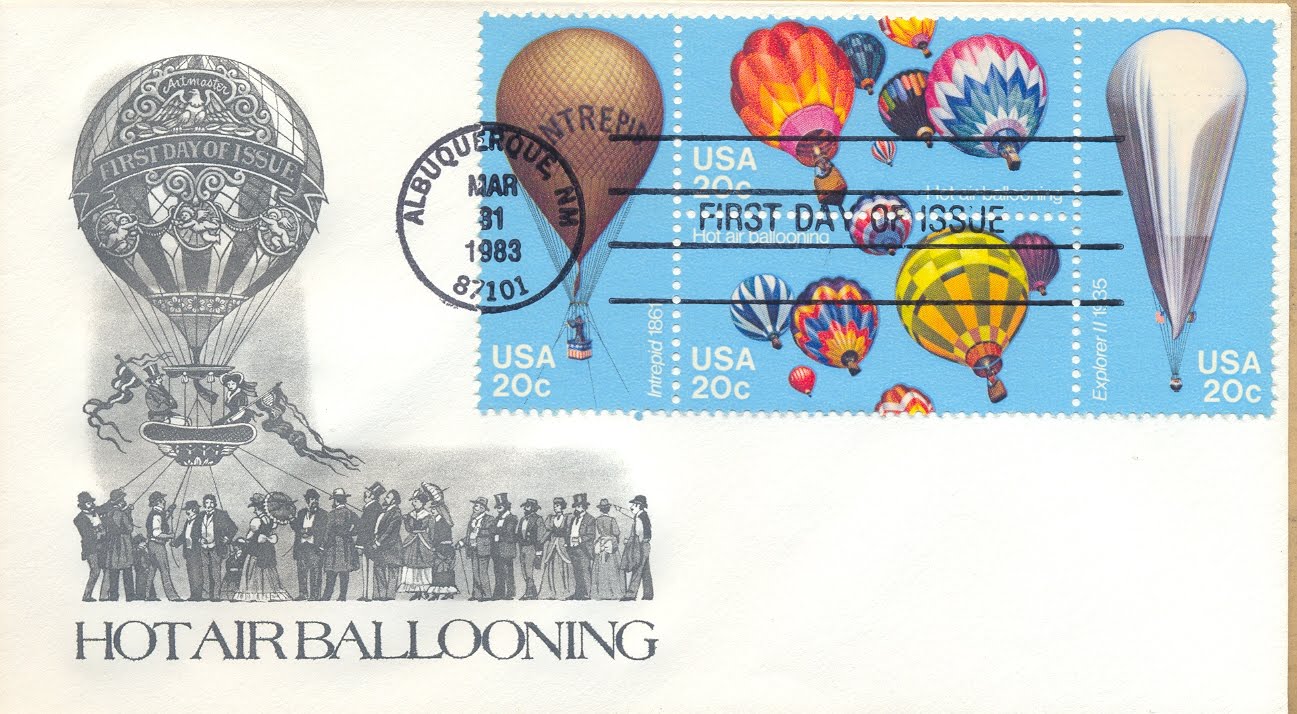
Hot air ballooning 31.3.1983

This FDC sent by Hemant is on Hot air ballooning, which is the activity of flying hot air balloons. Attractive aspects of ballooning include the exceptional quiet (except when the propane burners are firing), the lack of a feeling of movement, and the bird's-eye view. Since the balloon moves with the wind, the passengers feel absolutely no wind, except for brief periods during the flight when the balloon climbs or descends into air currents of different direction or speed.
For those interested in stamps issued by various countries on this popular sport please visit http://www.wydera.de/balloon/history3.htm
History of Gas Ballooning Several of the 20th century’s most famous gas balloonists were based in Albuquerque, which is proud to be called the hot-air ballooning capital of the world. Among the adventurers who chalked up record long-distance gas flights were Ben Abruzzo, Maxie Anderson, and Larry Newman, who became the first to cross the Atlantic in their Double Eagle II. But the history of their sport has its roots in Europe in the 1700s, where several people experimented for years with the idea of putting people in flight. Gas ballooning finally took off in 1783, within months of the first-ever unmanned hot-air flight. This new science of aviation was born in France, about the same time the United States was wrapping up its War of Independence against England. Those first balloon builders, French papermakers Joseph and Etienne Montgolfier, used heated air to make their craft rise. Not fully understanding the principles of lighter-than-air flight, they thought smoke from a straw fire did the trick. From the date of an early public flight in 1783 -- with a balloon carrying a duck, a rooster, and a sheep -- hot-air balloons have been called the Montgolfier type. It took a real scientist, Parisian physicist Jacques A.C. Charles to figure out that other gases that are lighter than air should cause balloons to rise. He believed that hydrogen would work as a lifting gas, and he found engineers who could make fabric air-tight by rubberizing it. For Professor Charles’ first flight, which also was unmanned, it took three days to fill the balloon with hydrogen, but it finally flew to the cheers of a crowd in Paris. Gas balloons are still called the Charliere-type in honor of their developer. Human flight began with a daring young man who had helped recover the animals from the Montgolfier flight – unharmed except for the rooster, whose wing may have been hurt during the rough landing in a tree. Jean Francois Pilatre de Rozier, working with a friend, the marquis D’Arlandes, convinced the skeptical French king to let them be the first human aeronauts. They took off on Nov. 21, 1783, and landed safely 25 minutes later. The dream of human flight had finally become a reality. Ten days later, Professor Charles flew in his gas balloon. He had already solved the most important problems of balloon flight. From his time until today, the tube under the balloon, called the appendix, would remain open in flight, and he added a valve that let pilots fly lower by letting gas out of the balloon. His Dec. 1, 1783, flight went 27 miles. Today’s gas balloonists use many of the professor’s methods, which included using sand for ballast.
Tuesday, June 1, 2010
The Marshall Islands - Halley's Comet 21.11.1985

Halley's Comet or Comet Halley is the best-known of the short-period comets, and is visible from Earth every 75 to 76 years. Halley is the only short-period comet that is clearly visible to the naked eye from Earth, and thus the only naked-eye comet that might appear twice in a human lifetime. Other naked-eye comets may be brighter and more spectacular, but will appear only once in thousands of years. Halley's returns to the inner Solar System have been observed by astronomers since at least 240 BC, and recorded by Chinese, Babylonian, and medieval European chroniclers, but were not recognized as reappearances of the same object. The comet's periodicity was first determined in 1705 by English astronomer Edmond Halley, after whom it is now named. Halley's Comet last appeared in the inner Solar System in 1986 and will next appear in mid-2061.
During its 1986 apparition, Halley's Comet became the first to be observed in detail by spacecraft, providing the first observational data on the structure of a comet nucleus and the mechanism of coma and tail formation. These observations supported a number of longstanding hypotheses about comet construction, particularly Fred Whipple's "dirty snowball" model, which correctly surmised that Halley would be composed of a mixture of volatile ices—such as water, carbon dioxide and ammonia—and dust. However, the missions also provided data which substantially reformed and reconfigured these ideas; for instance it is now understood that Halley's surface is largely composed of dusty, non-volatile materials, and that only a small portion of it is icy.
To commemorate the famous Comet The Marshall Islands issued these nice FDCs and the special stamp. The Marshall Islands, officially the Republic of the Marshall Islands (RMI), is a Micronesian nation of atolls and islands in the middle of the Pacific Ocean, just west of the International Date Line and just north of the Equator. This nation of roughly 62,000 people is located north of Nauru and Kiribati, east of the Federated States of Micronesia, and south of the U.S. territory of Wake Island, to which it lays claim. In 1986 independence was attained under a Compact of Free Association with the United States. My friend Hemant send these to me for our viewing pleasure.
Labels:
Marshall Islands,
Space Exploration,
USA1981-1990
Friday, January 1, 2010
Subscribe to:
Comments (Atom)