Showing posts with label Flowers. Show all posts

Saturday, April 8, 2017

Catkins bring a promise of spring 24.2.2017

Sending Easter greetings has long traditions, and a postcard with a spring theme is a delight for all recipients. This year, the Easter stamp features a bunch of catkins painted by artist Maarit Ailio. The playfully named Virvon varvon publication was designed by Paula Salviander. 
– I especially like painting with watercolors so I chose them as the illustration technique. I also feel that a traditional painting technique suits well a delicate spring stamp, Ailio says.
– Catkins are nature’s own treasures. In fact, what could better suit a stamp for the spring’s most beautiful celebration than a bunch of catkins.
The Virvon varvon sheet contains fifteen domestic no-value indicator stamps.
Thank you Ella.

Thursday, April 6, 2017

Summer flowers with an aphorism! 24.2.2017

Popular postcard artist Anna-Mari West has illustrated the adorable stamp with traditional summer flowers. Her previous work includes the bunny-themed 2016 Easter stamp.
– The bunch has at least daisies, red clovers, bluebells and blueberry twigs. In my opinion, the old, worn wood surface in the picture goes well with nature’s colorful flowers. The highlight of this work was the design of the sheet—I even had the chance to add a flower-themed aphorism to it, West says.
The aphorism is: ”Flowers do not solve all of the world’s problems, but they are a good start.” 

Saturday, March 11, 2017

International Flower Arrangement Festival 8.2.2010

International Flower Arrangement Festival.

Thank you Merja. 

Thursday, December 22, 2016

Amsterdam – Gaasperplaspark Floriade ’82 7.4.1982

Once in every 10 years an international garden festival, called “Floriade”, is organized in the Netherlands. In 1982 the Regional Park Gaasperplas in Amsterdam hosted this event. Approximately four years prior to the festival the work on the Floriade started. During these years the site of 55ha was transformed from polder to an exhibition park. Pieter van Loon functioned as the substitute of the principal landscape architect. Furthermore, he was the coordinator of the landscape design team. Over 3.5 million people visited the Floriade in 1982.

Wednesday, December 7, 2016

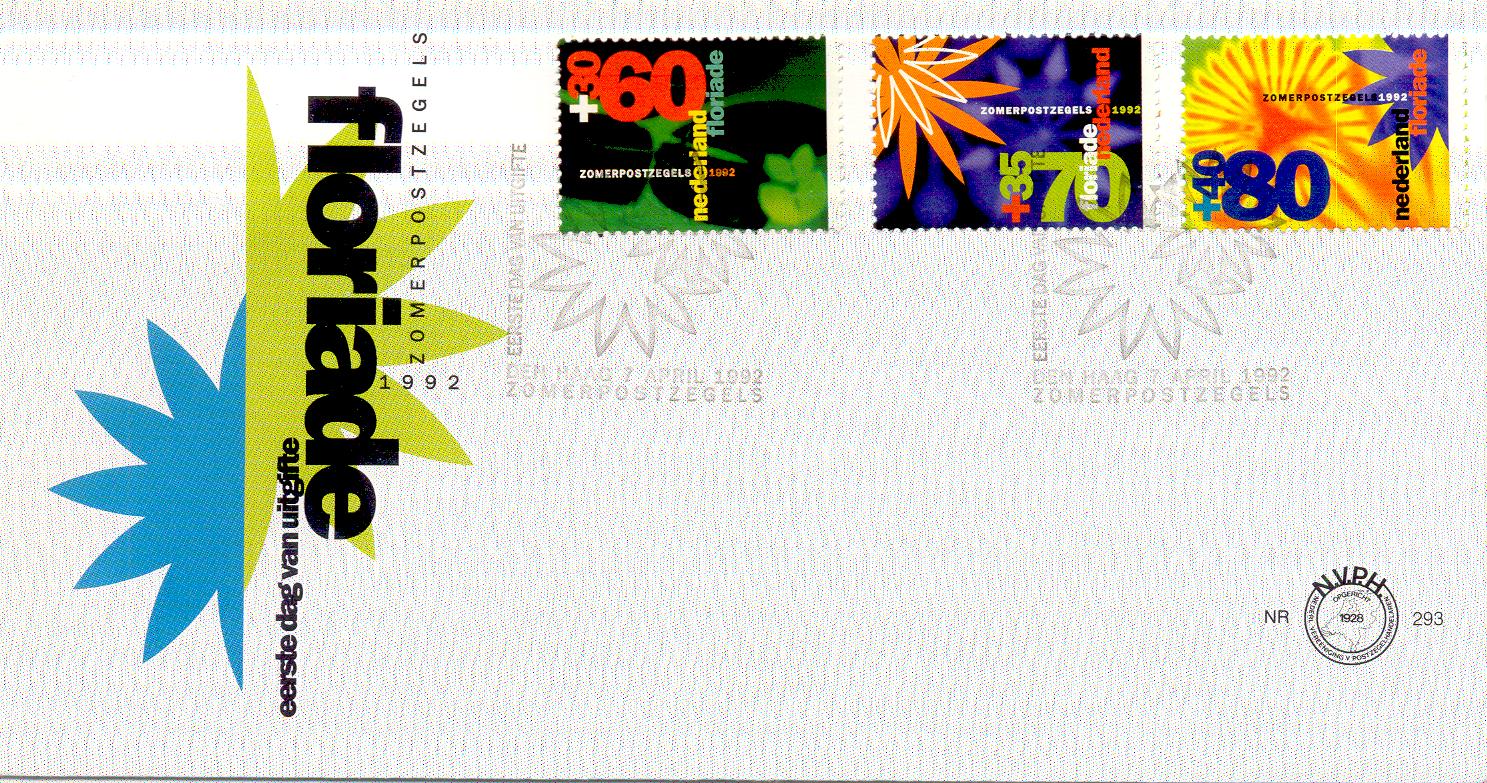
Floriade 17.4.1992

Floriade is an international exhibition and garden festival, held every 10 years in the Netherlands. All have been World Horticultural Expositions and listed as an A1 category exhibition by the International Association of Horticultural Producers and hence recognized by the Bureau of International Expositions. The stamps on the FDC were issued during the Floriade held in 19922 at the Hague. 
Thank you Merja.


Friday, November 4, 2016

Monday, June 6, 2016

Wednesday, May 11, 2016

Endangered Flowers and Plants 17.3.1988

(16c) Clivia NobilisClivia nobilis (green-tip forest lily), is a species of flowering plant in the genus Clivia, of the family Amaryllidaceae, native to South Africa. It grows to about 38 cm (15 in). It has evergreen strap-shaped leaves, and bears pendent umbels of multiple narrow, trumpet-shaped, red and yellow flowers, tipped with green.
(30c) Dierama Pulcherrimum. Dierama, is a genus of flowering plants in the iris family, Iridaceae. Common names include hairbellsAngel's Fishing Rodfairybells, andwandflowers in English and grasklokkies in Afrikaans. They are native to Africa, with most occurring in the southern regions of the continent. The center of diversity is the Province of KwaZulu-Natal in eastern South Africa.
(40c) Moraea Reticulata. Moraea, the Cape tulips, is a genus of plants in the family Iridaceae, first described as a genus in 1758. The group is widespread across Africa, the Mediterranean, and central and southwestern Asia. The genus name is a tribute to the English botanist Robert More. Moraeas have iris-like flowers. The corms of some species have been used as food, though they usually are small, and some species are unpleasant and some are poisonous.
(50c) Crinum CampanulatumCrinum campanulatum is a large to small, evergreen or deciduous perennial that often forms clumps when well established. They are mainly summer growing plants with a dormant period in the winter. The rootstocks are typical bulbs, which are able to survive permanent water or waterlogged soils as well as seasonal dry spells. The leaves are perennial; four to many, green, with or without a prominent midrib, narrowly channelled to strap-shaped. The flowering stem is up to 1 m long.

Thank you Merja.

Thursday, April 7, 2016

Endangered Plants and Flowers 8.8.1962

The three stamps on this Polish FDC are part of a set of 12 stamps issued in 1962 to highlight protected plants and flowers.
(90) Gentiana clusii (sometimes called "Clusius' gentian") is a large-flowered, short-stemmed gentian, native to Europe. Gentiana clusii is named after Charles de l'Écluse (Carolus Clusius), one of the earliest botanists to study the alpine flora.
(90) Dictamnus is a genus of flowering plant in the family Rutaceae, with a single species, Dictamnus albus, which has several geographical variants. It is also known as burning bush, dittany, gas plant, and fraxinella. It is an herbaceous perennial, native to warm, open woodland habitats in southern Europe, north Africa and much of Asia.
(90) Nymphaea alba, also known as the European white water-lily, white water rose or white nenuphar, is an aquatic flowering plant of the family Nymphaeaceae. It grows in water and likes large ponds and lakes. The leaves can be up to 30 cm (12 in) in diameter and they take up a spread of 150 cm (59 in) per plant. The flowers are white and they have many small stamens inside. It is found all over Europe and in parts of North Africa and the Middle East in freshwater.
Thank you Merja.

Wednesday, April 6, 2016

Lush and lavish Siberian Iris! 26.2.2016

This spring’s 1st class stamp bears an oil painting of a lavender Siberian iris by Tiina Suikkanen. The artist was surprised to discover how beautiful the traditional perennial plant actually is. “I had been watching the Siberian iris for such a long time I could no longer see its beauty. But as I started examining it in more detail, I noticed the fine colors and shapes it has,” Ms Suikkanen says. 
This is the first stamp designed by Suikkanen, but she has painted the Siberian iris before, and it is one of her favorite themes. In summer 2014, the Imatra-based artist was awarded the title of the Young Artist of the Year by Art Centre Salmela.
Thank you Ella.

Friday, January 8, 2016

Roses in Australia 19.5.1982


Stamps 27c :- Marjorie Atherton, 40c :- Imp65c :-Minnie Watson and 75c :- Satellite.
These stamps were also withdrawn in 1982.Stamps were designed by Betty Conabere. 
Mrs. Elizabeth Conabere was a botanical illustrator who lived and worked in an elderly house surrounded by a garden, in the Victorian country town of Mansfield. In 1969, on completing drawings of alpine plants for the National Herbarium in Melbourne, she commenced work on the two-volume limited edition book Wildflowers of south eastern Australiapublished in 1974. The original paintings for this work were purchased by the Victorian Ministry for the Arts, and presented to the La Trobe Library. Mrs. Conabere had also worked on Illustrations for the Victorian Lands Department depleting plants which have been declared noxious weeds. Her 1982 stamp commissions for Australia Post included both ‘Roses in Australia’ and ‘Eucalypts’.

Thank you Merja for this lovely FDC.

Wednesday, January 6, 2016

Aotearoa 16.3.1966


Aotearoa, originally used in reference to the North Island of New Zealand, is now the most widely known and accepted Māori name for the entire country. It is often pronounced Utera by English speakers, and is becoming widespread in the bilingual names of national organisations, such as the National Library of New Zealand / Te Puna Mātauranga o Aotearoa. Since the 1990s it has been the custom to sing New Zealand's national anthem, "God Defend New Zealand", in both Māori and English, exposing the term Aotearoa to a wider audience.

Sunday, December 13, 2015

1977 International Flower Show silk First Day Cover, Nantes 18.5.1977

The stamp on the FDC depicts a Symbolic Flower. The theme of the 1977 Show was  "Flowers in the City".
The Floralies Committee is a non-profit organization created in 1943 by a group of volunteers all active in various types of horticultural associations. Organizer of the International Floralies-Nantes, the main mission of the Committee is to promote horticulture,maintain the high level of expertise and reputation of the association and advise people on various horticultural issues.

Thank you Merja. People must have really enjoyed this Flower Show.

Tuesday, May 5, 2015

Hard to catch Peach-leaved bellflower 10.4.2015

On 10th April 2015, Peach-leaved bellflower appears on an Åland stamp. Wild life photographer Andy Horner shot the photo of this adorable meadow flower which is much easier to spot than to photograph. 
He spotted the flower alongside the cycle path some 100 metres from his home in Mariehamn, but shooting a photo of it proved difficult. “The human eye obviously perceives the special hue of the bellflower differently from the hue perceived by both digital sensor and traditional film, turning the colour slightly purple in the photo. Presumably, this particular shade of blue lies very close to the invisible ultraviolet colour of the spectrum”, Andy explains.
Peach-leaved bellflower (Campanula persicifolia) is the most common species of the eight different species of bellflower growing in Åland. It appears on road shoulders and meadows and in gardens in the beginning of July. It usually becomes approx. 50 cm tall, and its bell-shaped, mostly blue flowers of five fused petals become 3.5 cm long and sit in clusters on the erect, unbranched stems.

Thank you Ella for the four lovely fdc's from Åland.

Sunday, April 12, 2015

Festive bouquet 2.3.2015


March's floral stamp is called Festive bouquet. Riikka Juvonen has designed a colorful and abundant orchid and peony bouquet for the stamp. Riikka Juvonen is a multitalented artist, writer and illustrator from Helsinki. She has written dozens of books and also illustrated most of them. Years spent abroad among different cultures can be seen in Juvonen's works as bold use of colors, for instance.

Thank You Dear Ella for this lovely FDC.

Tuesday, November 11, 2014

Bellflower 8.5.2014

It took him several weeks to find the perfect nettle-leaved bellflower to photograph for this year’s SEPAC stamps. 
Photographer Andy Horner spent quite some time in a ditch before he could catch it in ultimate lighting.

Finding the perfect nettle-leaved bellflower was not so easy. This type of bellflower is not very common in Åland and it grows in shady deciduous forests, not exactly the ideal environment to shoot this towering flower without any shadows and against a clean background. Nature photographer Andy Horner was on the lookout for weeks. 

Nettle-leaved bellflower belongs to the family Campanulaceae. In Åland, we find some 15 species. Its square stem and serrated leaves resemble those of the nettle, hence the name. The Latin name Campanula trachelium derives from campa meaning bell and trachelium meaning throat. The herb was formerly used to treat sore throat. 

Thank you Dear Ella for this lovely FDC with the bellflower stamp.

Sunday, July 13, 2014

Transkei 1.5.1986 i - Aloe Pratensis


The four lovely stamps on this cover issued at Mount Ayliff in the erstwhile state of Transkei represent the various kinds of Aloe pratensis prevalent in the area. Aloe pratensis is a small to medium sized Aloe. The plants are found growing in rocky outcroppings and grassland. Aloe pratensis flowers in habitat from June to October.

Distribution of Aloe pratensis is in the Eastern Cape,Transkei,Lesotho and Kwazulu-Natal.
Aloe pratensis (Rocky Meadow Aloe) - A small clustering aloe with 8 inch wide rosettes of upright gray leaves that have sharp pale reddish-brown spines along the leaf margins and white tubercles on the lower leaf surface. Each rosette can produce up to 4 unbranched flower spikes with white papery bracts and pale peach to yellow flowers, usually between early winter and mid spring. This aloe comes from the Eastern Cape Province and KwaZulu Natal in South Africa where it grows from sea level up to high elevations in the Drakensberg Mountians. The specific epithet 'pratensis' meaning "growing in a meadow" is unfortunate as this plant is more often found growing among and wedged between rocks.  

Thank you Maria for this lovely cover with the four pretty stamps.

Friday, June 20, 2014

Finland 5.5.2014 - Spring Flowers 5.5.2014

t would not be spring without a flower stamp. This year's stamp depicts a viola. Illustrated by Leena Airikkala, the 1st class Bunch of Violas stamp will be published in a sheet of ten stamps. The plant theme is familiar to Airikkala. Her Apple Blossom stamp was selected as the most beautiful Finnish stamp in 2005. 

Thank you Dear Ella.