Showing posts with label Papal Visit. Show all posts

Tuesday, June 14, 2016

Pope Paul VI Visits Geneva to address ILO Conference on Fiftieth Anniversary 10.6.1969

Paul VI Visits Geneva to address ILO Conference on Fiftieth Anniversary

Pope Paul VI paid a one-day visit to Geneva Pope today to address the delegates at the International Labour Conference on the occasion of the fiftieth anniversary of the International Labour Organization (ILO).
Thank you Merja.

Tuesday, February 9, 2016

Friday, September 25, 2015

Pope John Paul’s Second Visit to Poland 21.4.1983

This was Pope John Paul’s second visit to his native Poland after becoming the Pope. Besides addressing various religious gatherings Pope John Paul II also held a private meeting with Lech Walesa, the founder and leader of Solidarity, Poland's independent trade union movement. Solidarity was been banned since December 1981 when martial law was declared following social tensions in Poland.
It is the second time Pope John Paul II - who was formerly Archbishop of Krakow - returned to his native Poland since he became head of the Roman Catholic Church in 1978.

Pope John Paul II born Karol Józef Wojtyła (18 May 1920 – 2 April 2005), served as Pope from 1978 to 2005. He was elected by the second Papal conclave of 1978, which was called after Pope John Paul I, who was elected in August after the death of Pope Paul VI, died after thirty-three days. Then-Cardinal Wojtyła was elected on the third day of the conclave and adopted his predecessor's name in tribute to him. In the years since his death, John Paul II has been declared a saint by the Roman Catholic Church. He is referred to by Roman Catholics as Pope Saint John Paul II or Saint John Paul the Great, for example as a name for institutions.
John Paul II is recognised as helping to end Communist rule in his native Poland and eventually all of Europe. John Paul II significantly improved the Catholic Church's relations with Judaism, Islam, the Eastern Orthodox Church, and the Anglican Communion. He upheld the Church's teachings on such matters as artificial contraception and the ordination of women, but also supported the Church's Second Vatican Council and its reforms.
He was one of the most travelled world leaders in history, visiting 129 countries during his pontificate. As part of his special emphasis on the universal call to holiness, he beatified 1,340 people and canonised 483 saints, more than the combined tally of his predecessors during the preceding five centuries. By the time of his death, he had named most of the College of Cardinals, consecrated or co-consecrated a large number of the world's bishops, and ordained many priests. A key goal of his papacy was to transform and reposition the Catholic Church. His wish was "to place his Church at the heart of a new religious alliance that would bring together Jews, Muslims and Christians in a great religious armada".
He was the second longest-serving pope in modern history after Pope Pius IX, who served for nearly 32 years from 1846 to 1878. Born in Poland, John Paul II was the first non-Italian pope since the Dutch Pope Adrian VI, who served from 1522 to 1523. John Paul II's cause for canonisation commenced in 2005 one month after his death with the traditional five-year waiting period waived. On 19 December 2009, John Paul II was proclaimed Venerable by his successor Pope Benedict XVI and was beatified on 1 May 2011 (Divine Mercy Sunday) after the Congregation for the Causes of Saints attributed one miracle to his intercession, the healing of a French nun from Parkinson's disease. A second miracle attributed to John Paul II's intercession was approved on 2 July 2013, and confirmed by Pope Francis two days later (two miracles must be attributed to a person's intercession to be declared a saint). John Paul II was canonised on 27 April 2014 (again Divine Mercy Sunday), together with Pope John XXIII. On 11 September 2014, Pope Francis added John Paul II's optional memorial feast day to the worldwide General Roman Calendar of saints, in response to worldwide requests. It is traditional to celebrate saints' feast days on the anniversary of their deaths, but that of John Paul II (22 October) is celebrated on the anniversary of his papal inauguration.

This was Pope John Paul’s second visit to his native Poland after becoming the Pope. Besides addressing various religious gatherings Pope John Paul II also held a private meeting with Lech Walesa, the founder and leader of Solidarity, Poland's independent trade union movement. Solidarity was been banned since December 1981 when martial law was declared following social tensions in Poland.

It is the second time Pope John Paul II - who was formerly Archbishop of Krakow - returned to his native Poland since he became head of the Roman Catholic Church in 1978.

Thank you Merja.

Thursday, September 24, 2015

Apostolic Journey to Brazil 4.7.1980

Visit of Pope Paul II On the occasion of the ecumenical meeting (Porto Alegre, Brazil on 4th July 1980).

Monday, September 21, 2015

Pope Visits Milan 20.5.1983


This Italian cover and the special postmark on it is to commemorate the Inauguration of the XXth Eucharistic Congress in Milan, Italy by Pope Paul II.

Sunday, September 13, 2015

Visit of Pope Pius XII to Equatorial Guinea in 1980


This cover marked the visit of Pope Pius XII to Equatorial Guinea  in 1980.

Thank you Merja.

Saturday, September 12, 2015

Visit of Pope Pius XII to Germany 18.11.1980

This cover marked the visit of Pope Pius XII to Germany in 1980.


Thank you Merja.

Friday, July 10, 2015

IVth World Youth Day - Visit of Pope John Paul II 19.8.1989

The stamp on this fdc  shows Pope John Paul II at the International Catholic Youth Forum, World Youth Day 15th to 20thAugust 1989 at Santiago de Compostela in Spain.

World Youth Day (WYD) is an event for young people organized by the Roman Catholic Church. World Youth Day was initiated by Pope John Paul II in 1985. For the first celebration of WYD in 1986, bishops all over the world were invited to schedule an annual youth event to be held every Palm Sunday in their dioceses. It is celebrated at the diocesan level annually, and at the international level every two to three years at different locations.  

Monday, June 15, 2015

Pope Paul II visit to France 2.6.1980


This stamp and FDC were issued by The Vatican when Pope Paul II returned after his visit to France.
During his reign, Pope John Paul II ("The Pilgrim Pope") made 104 foreign trips, more than all previous popes combined. In total he logged more than 1,167,000 km (725,000 mi). He consistently attracted large crowds on his travels, some among the largest ever assembled. While some of his trips (such as to the United States and the Holy Land) were to places previously visited by Pope Paul VI (the first pope to travel widely), many others were to countries that no pope had ever previously visited.


On 2 June 1980, he made a pilgrimage to Lisieux in northern France, the home town of St. Therese of the Child Jesus of the Holy Face.
 
Thank you Merja.

Saturday, May 30, 2015

The Pope Visits Papua New Guinea 7.5.1984

Pope John Paul II received a joyous and informal welcome in Port Moresby on 7.5.1984 as he arrived from South Korea on the second leg of his Far Eastern tour.

After the military formality and precision of his four-day South Korean stay, the Pope responded with delighted warmth to the relaxed and spontaneous airport reception and the cheers that accompanied him as his open vehicle made its way through town to Hubert Murray Stadium, a rugby field where he celebrated a floodlighted evening mass.

At the airport, where he was welcomed with a 21-gun salute, each round was greeted by the welcoming crowd with squeals of delight. A strong wind blew the smoke from each round back on the papal party and the welcomers led by the Governor General, Sir Kingsford Dibela, and Prime Minister Michael Somare, causing much laughter.

The onlookers were surprised, then responded with laughter and applause when the Pope in his arrival remarks switched from English to Motu and then to pidgin, the two principal vernaculars. Blessing for the Island

Calling for God's blessings on Papua New Guinea, the Pope said:
''May His peace descend on your beautiful islands, your great rivers, high mountains and deep valleys. May it descend on your volcanoes and fill your blue seas.''
The Pope also used all three languages in sections of the mass, which was marked by indigenous music and fervent singing.

After the mass, the Pope delighted the lingering crowd of 20,000 by praising the three million people of Papua New Guinea as ''a very, very lovely people.'' His remarks touched off cheers and thumping of traditional kundu drums.

Indigenous dance groups performed for the Pope as he arrived and at the mass. Slowly, John Paul walked along the rows of male drummers in feathered headgear, their faces painted in glowing colored patterns, and grass- skirted female dancers. Whenever the Pope or another speaker drew applause, the drummers drummed and the dancers clapped, swaying their hips.

In sharp contrast to South Korea, where admittance to most of the events on the papal schedule required surrender of identity cards, all who came were welcome both at the airport and at mass. Many carried drums and other instruments; in South Korea people had to come empty-handed for most occasions. Formal and Informal Purposes.

The formal purpose of the visit was to mark the centennial of the arrival of the first missionaries. The Constitution describes Papua New Guinea, a land where tribal warfare has never quite ceased, as a Christian country.
But the formal occasion for the visit did not appear to be what mattered to the people who came to greet the Pontiff. They saw it happily as a form of international recognition of their independence.

''It is very historic,'' Simon Frigia, an aide to the Prime Minister, said. ''A Pope has never landed in this land.''

Thank you Merja for this memorable FDC.

Sunday, May 17, 2015

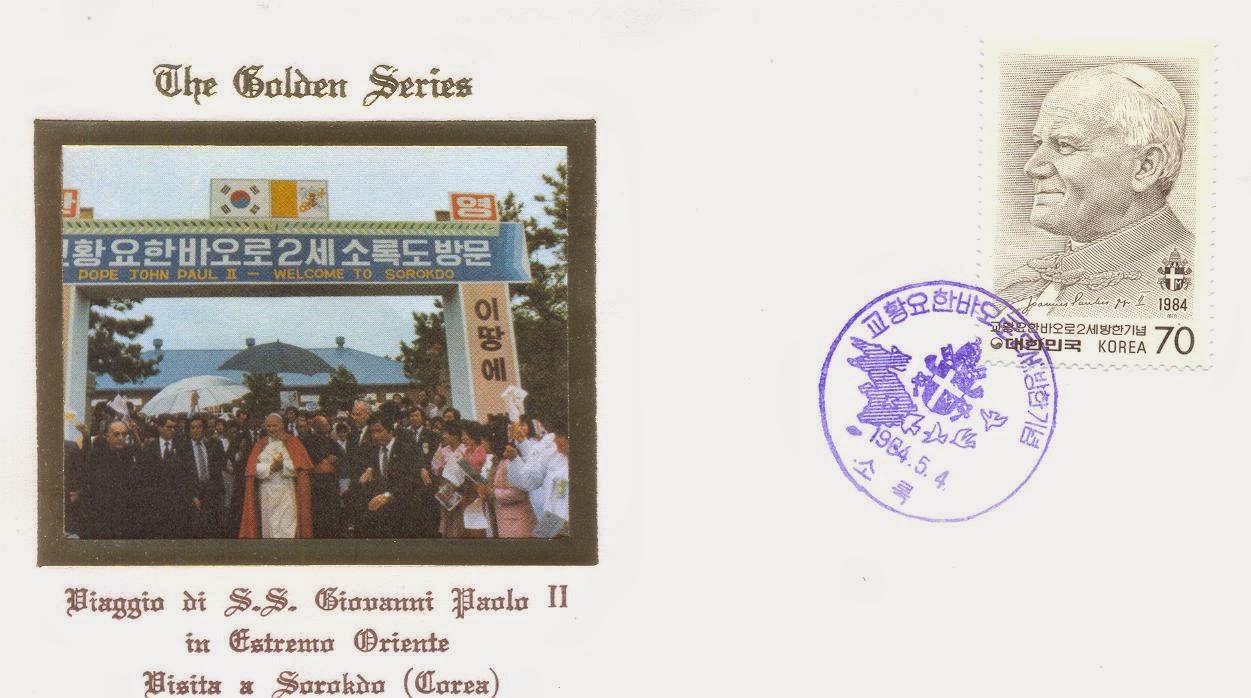
Pope Paul II visist's Korea in 1984 4.5.1984

This stamp and the FDC were issued by South Korea on 4.5.1984 during Pope Paul II's first visit to that country. The cover shows the Pope during his visit to Sorokdo City.

Thank you Dear Merja.

Friday, September 9, 2011

Pope Benedict’s First Papal Visit to Cyprus 4.6.2010


Pope Benedict XVI’s overseas travels typically involve vast crowds of adoring Catholics, often squeezed into sports stadiums or public venues for large-scale Masses.
But when Benedict made the first official papal visit to Cyprus in June 4-6 2010, his total flock numbered just 25,000, and his main speech was held in the sports field of an elementary school. Even so, Benedict’s words and gestures during his brief visit resonated far beyond the divided island nation. The momentous issues on his agenda include the Catholic Church’s relations with Orthodox Christianity, Islam and Judaism, and the plight of Christians throughout the Middle East.
As indicated in a document released earlier that year, major topics of the Vatican synod included religious freedom in Muslim countries, Islamic extremism, Israel’s “occupation” of the Palestinian territories, and the recent exodus of Christians from the region.
Benedict also met with Archbishop Chrysostomos II, leader of Cyprus’s 800,000 Orthodox Christians, in the latest sign of warming relations between the Catholic and Eastern Orthodox churches, which split nearly 1,000 years ago. In December of the previous year, the Vatican and Russia finally established full diplomatic relations — a move previously opposed by the large and influential Russian Orthodox Church, which long resented Catholics for allegedly attempting to convert Orthodox believers.
Benedict’s visit could also highlight a source of conflict between Orthodox Christians and Muslims. For three and half decades, the island has been divided between the internationally recognized Republic of Cyprus in the south, and a northern sector seized by the Turkish military in 1974, which is now almost exclusively Muslim.
Although travel between the zones has been permitted since 2003, reunification is not in sight. Orthodox leaders are especially vehement about the desecration and destruction of the churches they were forced to abandon in the north, a subject they raised during Benedict’s stay.
Islam has been a delicate subject for Benedict since September 2006, when he quoted a medieval description of the religion as “evil and inhuman” and “spread by the sword,” which led to violent outbursts throughout the Muslim world. Merja my dear friend gave me this memorable FDC.

Wednesday, April 21, 2010

POPE JOHN PAUL II VISITS THE UNITED STATES 2.10.1979


On 1 October 1979 Pope John Paul II arrived in Boston on the first leg of his first trip to the United States. Pope John Paul II had been elevated to the chair of Saint Peter the previous October after the sudden death of Pope John Paul I, whose thirty-four-day reign was the shortest in modern history. The new pope, formerly Cardinal Karol Woytyla, archbishop of Krakow, Poland, was the first non-Italian pope since 1522 elevated to the papacy.

The Pope's Message

American Catholics received John Paul II with great excitement at his stops in Boston, New York City, Philadelphia, Des Moines, Chicago, and Washington, D.C. In New York the pope spoke to the United Nations, endorsing support from industrial countries for the less-developed nations of the world, which struggled to provide for their people. He also spoke out vigorously for human rights: "All human beings in every nation and country should be able to enjoy effectively their full rights under any political regime or system." On the Middle East he insisted that the Palestinian question would have to be addressed before peace could be achieved.
To commemorate this historic visit of the Pope special postmarks at each of the Papal Visit Stations were issued, namely at Boston, New York, Philadelphia, Des Moines, Chicago, Washington, D.C amongst others. My friend James C. Speshock sent this very special set of covers to me.