Showing posts with label 2nd World War. Show all posts

Thursday, February 2, 2017

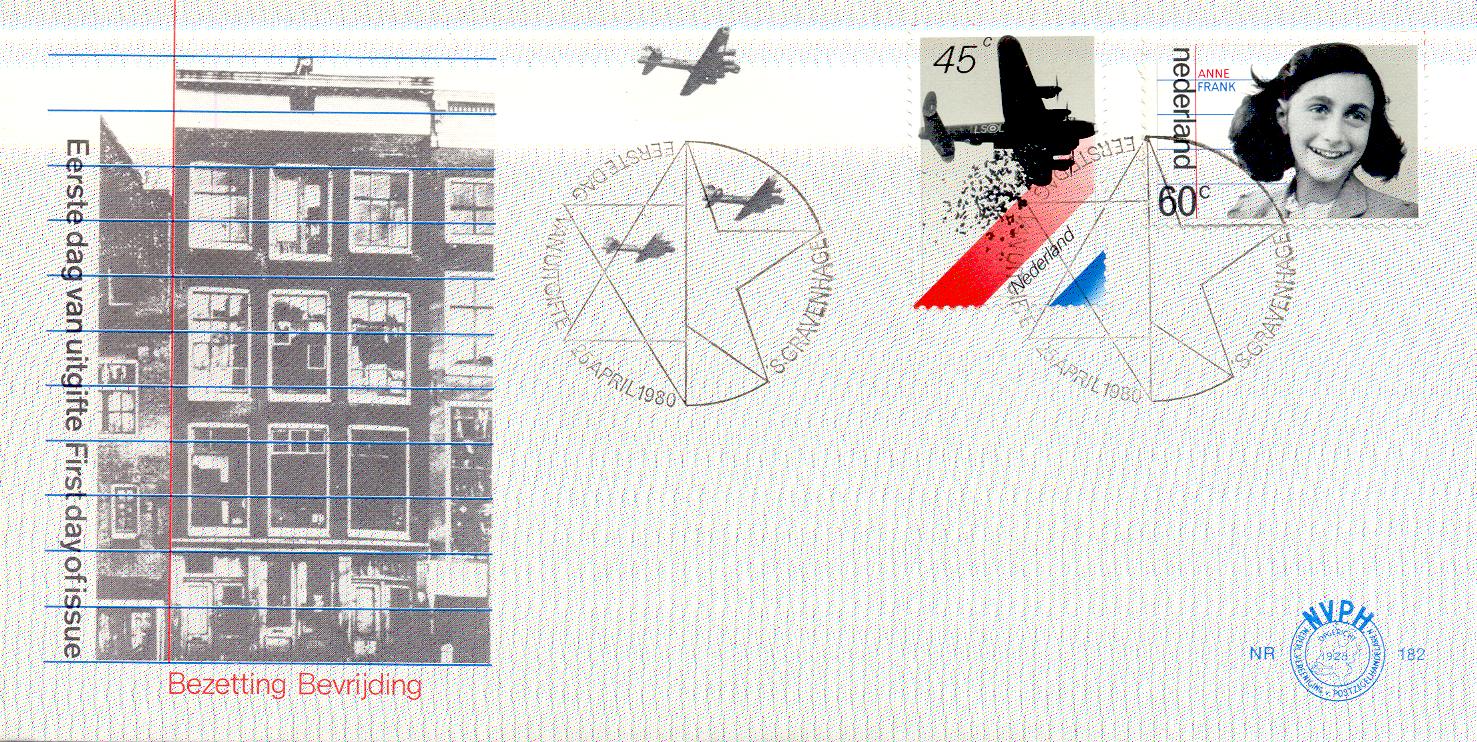
Holland During Occupation and then Liberation 25.4.1980


(45c) British Liberator bomber throws food parcels during the Liberation Phase of the Second World War.
(60c) Family portrait of Anne Frank.
Annelies Marie Frank (12 June 1929 – February or March 1945) was a German-born diarist and writer. One of the most discussed Jewish victims of the Holocaust, she gained fame posthumously following the publication of her diary, The Diary of a Young Girl (originally The Secret Annex),which documents her life in hiding from 1942 to 1944, during the German occupation of the Netherlands in World War II. It is one of the world's most widely known books and has been the basis for several plays and films.
Born in Frankfurt, Germany, she lived most of her life in or near Amsterdam, Netherlands, having moved there with her family at the age of four-and-a-half when the Nazis gained control over Germany. Born a German national, Frank lost her citizenship in 1941 and thus became stateless. By May 1940, the Franks were trapped in Amsterdam by the German occupation of the Netherlands. As persecutions of the Jewish population increased in July 1942, the family went into hiding in some concealed rooms behind a bookcase in the building where Anne's father worked. From then until the family's arrest by the Gestapo in August 1944, Anne kept a diary she had received as a birthday present, and wrote in it regularly. Following their arrest, the Franks were transported to concentration camps. In October or November 1944, Anne and her sister, Margot, were transferred to Bergen-Belsen concentration camp from Auschwitz, where they died (probably of typhus) a few months later. They were originally estimated by the Red Cross to have died in March, with Dutch authorities setting 31 March as their official date of death, but research by the Anne Frank House in 2015 suggests they more likely died in February.
Frank's father, Otto, the only survivor of the family, returned to Amsterdam after the war to find that her diary had been saved by one of the helpers, Miep Gies, and his efforts led to its publication in 1947. It was translated from its original Dutch version and first published in English in 1952 as The Diary of a Young Girl, and has since been translated into over 60 languages.

Thursday, November 24, 2016

Greek National Resistance (1941-1944) 8.11.1982

The FDCs and the stamps on them depict the National Resistance offered by the Greek citizens and Partisans against the German invaders during World War II.
(12) Resistance FightersNatl. Resistance Movement, 1941-44: Partisan Men and Women, by P. Gravalos.
(21) Destruction of Gorgopotamos Rail Bridge, 25 Nov. 1942Greek resistance fighters in collaboration with the British Allies destroyed the Gorgopotamos Rail Bridge which was heavily used by the German occupation forces as a supply line.
(2) The Massacre of Kalavryta, 13 Dec. 1943
 The massacre of Kalavryta refers to the extermination of the male population of Kalavryta village and the total destruction of the village by the German occupation forces.
(30) Resistance fighters in Kaisariani (Athens).

Thank you Merja.

Wednesday, December 23, 2015

Refugees after Second World War 16.5.1960


Many refugees remained in camps almost fifteen years after the end of the Second World War. This was seen as disgraceful by those who had suffered greatly during the war and those who were concerned about their situation. It was at this point that the United Nations launched a program to resolve the refugee problem once and for all. 1959-1960 was announced as World Refugee Year. The aim of this project was to 'clear the camps'. It achieved some significant results, especially in Europe. By the end of 1960, for the first time since before the war, all the refugee camps in Europe were closed.
The United Nations approved World Refugee Year in June 1959 with the intention to encourage the return of refugees and Displaced Persons to their original places of residence  

Saturday, September 19, 2015

Marshal of France Jean Joseph Marie Gabriel de Lattre de Tassigny, GCB, MC - 25th Anniversary of the Capitulation of Hitler 8.5.1970


Jean Joseph Marie Gabriel de Lattre de Tassigny, GCB, MC (2 February 1889 – 11 January 1952) was a notable French military commander during World War II and the First Indochina War. De Lattre was posthumously promoted to Marshal of France. De Lattre fought in World War I and was wounded twice. He was made a knight of Legion of Honour in December 1914.

De Lattre specialized in cavalry and was made head of the French War College in 1935. After World War I, he served as an officer in the French headquarters during the Rif War. He joined General Weygand's headquarters in 1932. Weygand had the choice between de Lattre and de Gaulle and chose de Lattre because of his superior rank and honors. De Lattre then served in the headquarters of an infantry regiment at Metz.

Once France had been liberated, as part of the Alliance, his army crossed the Rhine and invaded Germany. There the First Army, now numbering more than 320,000 soldiers, took Karlsruhe, Ulm and Stuttgart before crossing the Danube and arriving in Austria. De Lattre represented France at the German unconditional surrender in Berlin on 8 May 1945.

In 1951, illness forced de Lattre de Tassigny to return to Paris where he later died of cancer; he was posthumously made MarĂ©chal de France. Jean de Lattre de Tassigny was buried in a state funeral lasting five days, in what LIFE magazine described asthe "biggest military funeral France had seen since the death of Marshal Foch in 1929". 

Thank you Merja.

Wednesday, September 11, 2013

Honouring All those Who Served in World War II - 9.5.1946

On 9.5.1946 the U.S.P.S issued a 3c Dark Violet coloured stamp which honours all those who served in World War II and pictures the Honourable Discharge EmblemThe five stars surrounding the emblem honour those who died in each of the five services – Army, Navy, Coast Guard, Marines, and Merchant Marines.
Honourable discharge is awarded to those members of the armed forces who receive a rating between good and excellent for their service. While honourable discharge is usually given to those who complete their term of service, those who don’t complete their time can receive the honour as long as they’re not discharged due to misconduct. 
Some of the earliest plans for a multi-service honourable discharge patch originated in 1919 following World War I. The purpose was to allow honourably discharged individuals to wear their uniforms for a period of time after leaving the service if they couldn’t afford civilian clothes. 
The original design was similar to the eagle on the Presidential Seal, but was changed in 1943 by Franklin Roosevelt and Winston Churchill. Their new design pictured an eagle preparing for flight, called “The Eagle Has Flown.” This was meant to coincide with the first major Allied offensives against the Axis Powers in the Pacific and Atlantic. 
The emblem is also known by another name – “ruptured duck.” This name is credited to actress Hedy Lamarr, wife of Friedrich Mandl, the owner of several German arms factories. According to legend, Lamarr created countless revolutionary ideas that improved weapon design and production, which made her husband jealous. Fearing for her life, Lamarr fled to America where she described her escape as a hazardous flight on a “segeltuch gebrochen” or broken bird. The more literal translation of the phrase is “ruptured duck.” When women working in the manufacturing plant that produced the honourable discharge pins heard her story, they began labelling the boxes “ruptured ducks” partially in honour of her story and also because policy at the time required that boxes be labelled something other than what they contained, to confuse enemy agents.
The Army and Navy adopted the honourable discharge emblem on November 9, 1944. The emblem is worn above the right front pocket on all outer uniforms.