Monday, October 8, 2012

FINLANDIA 95 - 27.1.1994


Pia sent this lovely FDC which celebrated Finlandia-95 (an international stamp exhibition) with the  miniature sheet shown on the cover. This was also the occasion to commemorate the 100th anniversary of the International Olympic Committee, and XVII Winter Olympic Games in Lillehammer in 1994. The stamps and the cover were issued on 27.01.1994. The Designer was Pirkko Juvonen-Valtonen.
The sports men and women on the stamps are:- Marja-Liisa Kirvesniemi and Marjo Matikainen.  Marja-Liisa Kirvesniemi (née Hämäläinen; born 10 September 1955 in Simpele) was a former Finnish cross country skier.  
Marjo Tuulevi Matikainen-Kallström (born February 3, 1965 in Lohja) was a politician and former Finnish cross-country skier.  
Arnold Clas Robert Thunberg (5 April 1893 – 28 April 1973) was a Finnish speed skater who won five Olympic gold medals  He was born and died in Helsinki.
Veikko Kankkonen  (born 5 January 1940 in Sotkamo) is a Finnish ski jumper who was active in the 1960's. Kankkonen earned two ski jumping medals at the 1964 Winter Olympics with a gold in the individual normal hill and a silver in the individual large hill.  
Veikko Hakulinen (4 January 1925 – 24 October 2003) was a Finnish forestry technician and cross country skier, triple champion in both the olympics and world championship competition in cross country skiing.  Hakulinen was born in Kurkijoki (now part of the Republic of Karelia), Viipuri Province and died in Valkeakoski after a traffic accident.

Sunday, October 7, 2012

Safety at Sea - Lighthouses


This UN First Day Cover regarding Safety at Sea was issued on 18.3.1983 with an official Geneva cachet, was given to me by my friend Merja.


The importance of lighthouses is that they help ships out at sea to find the harbour safely, especially when there are rocks or icebergs which the ships may bump into.

Some may question the need for lighthouses in the present days of GPS and other forms of electronic navigation at sea. I think they are Still pretty important. Not as much as they used to be perhaps, when they were the only option but still important as navigational beacons and as warning for hazardous conditions for boats (and aircraft) that don't have (or have inoperative) the latest electronics. If your ship has the so called high tech equipment, and if it works, you may not need a lighthouse. In all other cases you'll need one. And that is why the UN decided to issue this stamp to highlight the importance of Lighthouses for Safety at Sea.

Saturday, October 6, 2012

Jon Sigurdsson


Jón Sigurðsson (June 17, 1811 – December 7, 1879) was the leader of the 19th century  Icelandic Independence movement. Þjóðernishyggja is the Icelandic term for  nationalism; nationmindedness is a rough translation of the term. Its use was instrumental in the Icelandic movement for independence from Denmark, led by independence hero Jón Sigurðsson. He became an expert on the sagas and on Icelandic history. He never graduated from university, as Icelandic politics grew to consume all his time.
The home of Jón and Ingibjörg in Copenhagen became a centre for all Icelanders in the city. They had no children except for one foster-son who was Jón's nephew. However, a contemporary remarked that "all Icelanders are their children". He died in Copenhagen in 1879.
His birthday, June 17, was chosen as  Iceland's National holiday to recognize his efforts toward Icelandic independence, and a picture of Jón graces the 500 Icelandic Krónur banknote.
He is often referred to as President ("Jón forseti") by Icelanders. The main reason for this is that since 1851 he served as President of the Copenhagen Department of the Icelandic Literature Society. He was also the president of Althing several times, for the first time in 1849. He is currently pictured on Iceland's 500  kronur bill, and has been honoured on Icelandic postage stamps on the centenaries of his birth and death, the 150th anniversary of his birth, and on the creation of the Republic of Iceland (on his 133rd birthday). Maria sent me this FDC which marks the 150th Birth Anniversary of Jon Sigurdsson on 17th June 1961.

Friday, October 5, 2012

Slovenia 29.1.2010 - Valentine's Day - Squirrel's in Love


These squirrels are so cute. They're so in love and want to celebrate Valentine's Day together.

What a wonderful thought. But, that is exactly what is depicted on this cover and on the Love Greeting on the stamp itself. Slovenia issued this delightful cover and stamp on 29.1.2010. Thank you Maria for this lovely First Day Cover.

Thursday, October 4, 2012

EUROPA - inventions - Finland -Temppeliaukio Church


This Finnish FDC (EUROPA CEPT) postmarked 2.5.1983 is about Pieces of work of human genius and “inventions” which was the theme for EUROPA stamps in 1983.
The stamp which is one of a set of two depicts the Temppeliaukio Church. Temppeliaukio Church is a Lutheran church in the Töölö neighborhood of Helsinki. The church was designed by architects and brothersTimo and Tuomo Suomalainen and opened in 1969.
The Temppeliaukio/Tempelplatsen (Temple square) was selected as a location for a church in the 1930s, but the plan by J. S. Siren, the winner of the second competition to design the architecture of the church, was interrupted in its early stages when World War II began in 1939. After the war, there was another architectural competition, which was won by Timo Suomalainen and Tuomo Suomalainen in 1961. For economic reasons, the suggested plan was scaled back and the interior space of the church reduced by about one-quarter from the original plan. Construction finally began in February 1968, and the rock-temple was completed for consecration in September 1969.
The interior was excavated and built into the rock but is bathed in natural light entering through the glazed dome. The church is used frequently as a concert venue due to its excellent acoustics. The acoustic quality is ensured by the rough, virtually unworked rock surfaces. Leaving the interior surfaces of the church exposed was not something that was in the original plans for the church. Conductor Paavo Berglund told the brothers of his experiences in the best music halls, and the acoustical engineer Mauri Parjo set out requirements for the wall surfaces. The architect brothers discovered that they could fulfill all the requirements by realising their own idea of leaving the rock walls exposed in the Church Hall. This idea the brothers already had when planning the competition entry, but they had been afraid to present it thinking it too radical for the competition jury.
The Temppeliaukio church is one of the most popular tourist attractions in the city; half a million people visit it annually. The stone-hewn church is located in the heart of Helsinki. Maintaining the original character of the square is the fundamental concept behind the building. The idiosyncratic choice of form has made it a favorite with professionals and aficionados of architecture.
The church furnishings were designed by the architects. Organ builder Veikko Virtanen manufactured the church organ, which has 43 stops. There are no bells at the church; a recording of bells composed by Taneli Kuusistois played via loudspeakers on the exterior wall. Thank you Merja for this nice FDC.

Wednesday, October 3, 2012

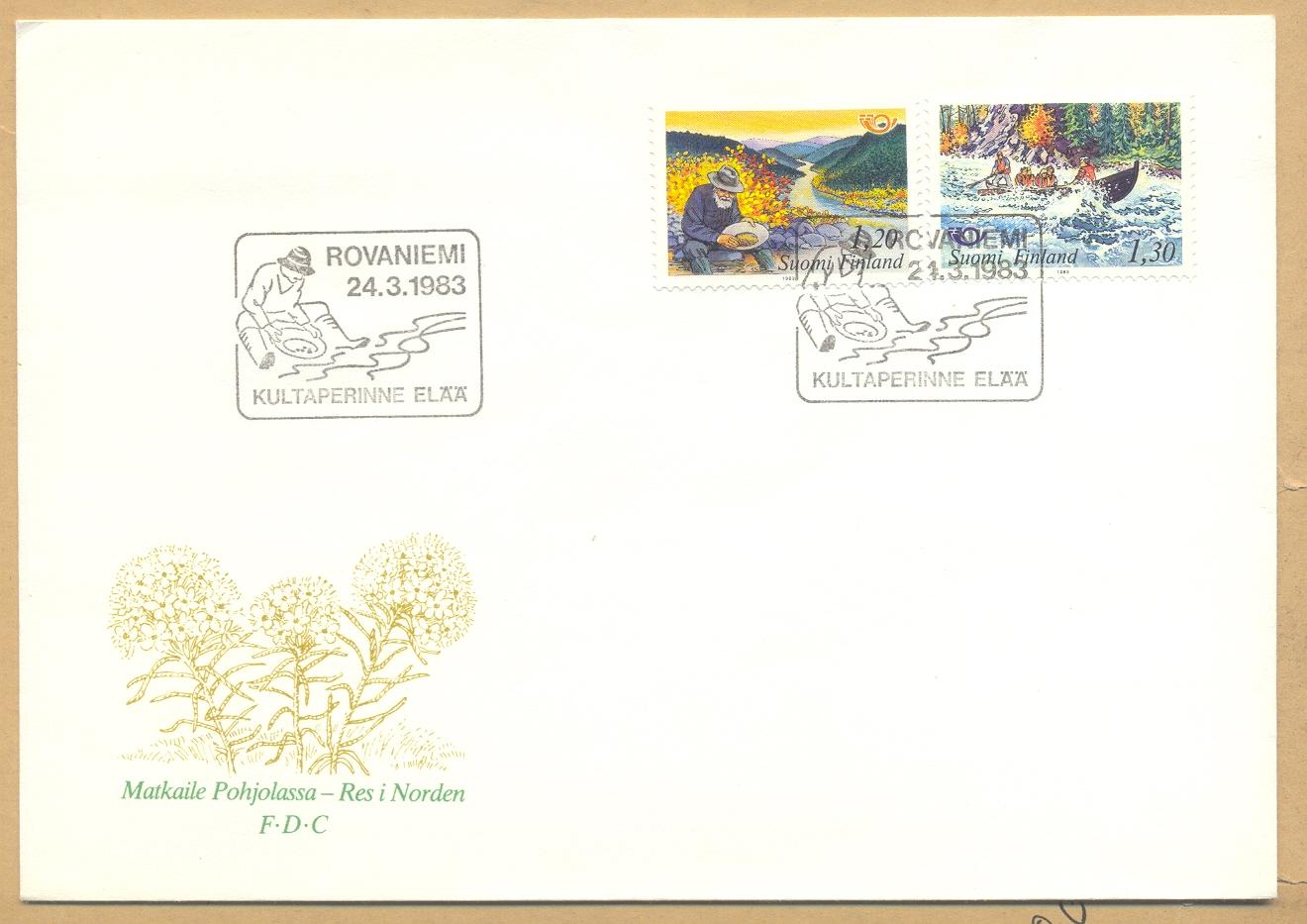
Travel in the North - Gold panning & White Water Rafting 24.3.1983

Norden stamps are a common issue amongst Nordic countries. It is as old as the Europa stamps. The idea of a Norden issue with a common motif was bred by Foreningen Norden [the Norden Association] in 1951. At the conference of the Nordic Postal Association in March the same year the consensus was to accede to the idea, but for  practical reasons it could only be accomplished later. In 1980 it was decided to issue Norden stamps every three years and (as the Europa stamps since 1974) to follow a common theme instead having a common design.

The inscriptions on the cover namely, Matkaile Pohjolassa and the same in Swedish "Res i Norden" meansTravel in the North (the theme for the year 1983).  
Gold panning (the stamp on the left) is very popular in Lapland's rivers. And gold is found there. European Goldpanning Championships 2012 were held in Finland. The postmark on the stamps read "Kultaperinne elää" in English it would mean "Gold tradition lives".
Rafting or white water rafting is a challenging recreational outdoor activity using an inflatable raft to navigate a river or other bodies of water. This is usually done on white water or different degrees of rough water, in order to thrill and excite the raft passengers. The development of this activity as a leisure sport has become popular since the mid-1970s. It is considered an extreme sport, as it can be dangerous. The stamp on the right depicts this sport being enjoyed by enthusiasts on the Kitkanjoki River.
Kitkanjoki is a river of Finland. It begins from the lake Ala-Kitka that is connected to the lake Yli-Kitka in the municipalities of Posio and Kuusamo in the province of Northern Ostrobothnia and flows then towards Russia joining the river Oulankajoki near the Russian border. It is a part of the Kovda River system in Russia and Finland from which the waters flow to the White Sea.

Thank you Merja for this interesting and pretty FDC.

Tuesday, October 2, 2012

40th Anniversary of ICELAND Air Post


This cover and the stamps on it commemorate 40 Years of Iceland Air Post. Thank you Maria for this FDC.

Icelandair traces its roots back to 1937, when Flugfélag Akureyrar was founded in Akuryei on the north coast of Iceland. Flight operations started in 1938 with a single floatplane of the type Waco YKS-7. In 1939 the airline had to be grounded when the aircraft was destroyed in a capsizing accident. The company moved to Reykjavik, were it acquired another Waco aircraft and was re-launched in 1940 as Flugfélag Íslands, which translates asFlight Company of Iceland. Previously, two unrelated airlines of the same name had existed in the country (from 1919 to 1920, and between 1928 and 1931).
 For international purposes, the name Iceland Airways was adopted. The fleet was expanded with a Beechcraft Model 18 in 1942, and with two de Havilland Dragon Rapide as well as one U.S.-made Consolidated PBY Catalina in 1944, the latter being the first ever aircraft registered in Iceland to be flown to Iceland by an Icelandic crew from North America. On 11 July 1945, this aircraft operated the first commercial flight over the Atlantic Ocean for the airline, which led from Reykjavík to Largs in Scotland with four passengers and four crew members on board. Regular flights to Prestwick Airport, Scotland and Copenhagen in Denmark, using B-24 Liberator aircraft leased from Scottish Airlines were launched in 1946.